
 Worksheets
Unit 1 – Linear, Polynomial, and Rational Functions
Total questions: 136
Worksheet time: 5hrs 25mins
y = 1/5x + 5
y = 3 -x
m = 3/4
m = 5/8
y = 2x - 7.
What is the slope of this line?
y = 3x - 6 and passes through the point (15,5).
y = x - 5 through (1, -2)
y = 2/7x - 5 through (2, -3)
y = 1/3x - 4 through (-3, 2)
y = 5/4x + 4 through (-4, -3)

is {-1, 0 , 1}?


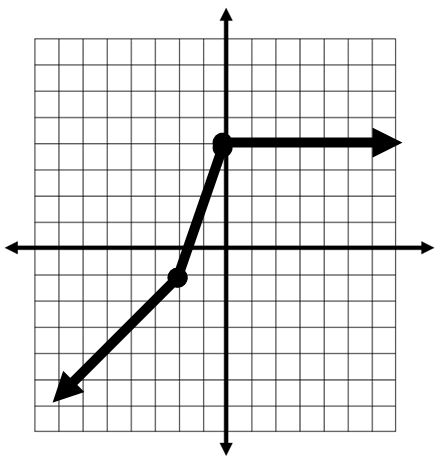
What is the RANGE of the function?
All Real Numbers
y ≤ 4
y < 4
0 < y < 4

What is the domain interval for the green piece of this function?
-2 < x ≤ 1
-1 < x ≤ 0.5
x > -2
x ≤ 1

Evaluate f(0)
0
19
9
-19

Which graph matches:
-x+4 if x < 2
2x-6 if x ≥ 2
A
B
C
D


What is the DOMAIN of the function?
All Real Numbers
x ≤ 4
x > 4
0 ≤ x ≤ 4


How many "pieces" are graphed in this function?
1
2
3
4

What is the y-intercept of this parabola?
(6, 0)
(-2, 0)
(-4, -2)
(0, 6)
What is the axis of symmetry of this parabola?
-4
x = -4
x = -2
y = -4
Let the graph of g be a translation 2 units down and 4 units left of the graph of f(x) = x2. Write a rule for g.
g(x) = (x - 4)2 - 2
g(x) = (x + 4)2 - 2
g(x) = (x - 4)2 + 2
g(x) = (x + 4)2 + 2
Let the graph of g be a translation 7 units right and a reflection of the graph of f(x) = x2. Write a rule for g.
g(x) = -(x - 7)2
g(x) = (x - 7)2
g(x) = -(x + 7)2
g(x) = (x + 7)2
Let the graph of g be a translation 7 units right and 12 units up of the graph of f(x) = (x + 3)2 - 8. Write a rule for g.
g(x) = (x - 4)2 + 4
g(x) = (x + 10)2 + 4
g(x) = (x - 4)2 - 20
g(x) = (x + 10)2 - 20
Identify the function graphed here.
f(x)=(x+4)2−2
f(x)=(x−4)2−2
f(x)=−(x+4)2−2
f(x)=−(x−4)2−2

Identify the function graphed here.
f(x)=(x−3)2
f(x)=−(x−3)2
f(x)=−x2+3
f(x)=(x+3)2
Which of the following is a quadratic function that has a vertex at (2, -7) and opens up?
f(x)=(x+2)2−7
f(x)=−(x+2)2−7
f(x)=−(x−2)2−7
f(x)=(x−2)2−7
Which of the following is a quadratic function that has a vertex at (0, 10) and opens down?
f(x)=−x2+10
f(x)=−(x−10)2
f(x)=x2+10
f(x)=(x+10)2

Which of these Thanksgiving foods is your favorite?
Turkey
Stuffing
Pumpkin Pie
Mashed potatoes
Other

The height of a rocket, at selected times, is shown in the table above.
Based on these data, which statement is not a valid conclusion?
The rocket was launched from a height of 180 feet.
The maximum height of the rocket occurred 3 seconds after launch.
The rocket was in the air approximately 6 seconds before hitting the ground.
The rocket was above 300 feet for approximately 2 seconds.
Morgan throws a ball up into the air. The height of the ball above the ground, in feet, is modeled by the function h(t) = −16t2 + 24t, where t represents the time, in seconds, since the ball was thrown. What is the appropriate domain for this situation?
0≤t≤1.5
0≤t≤9
0≤h(t)≤1.5
0≤h(t)≤9

A ball is thrown into the air from the edge of a 48-foot-high cliff so that it eventually lands on the ground. The graph below shows the height, y, of the ball from the ground after x seconds.
For which interval is the ball's height always decreasing?
0≤x≤2.5
0<x<5.5
2.5<x<5.5
x≥2
An archer shoots an arrow into the air such that its height at any time, t, is given by the function h(t) = -16t2 + kt + 3. If the maximum height of the arrow occurs at time t = 4, what is the value of k?
128
64
8
4
The expression -4.9t2 + 50t + 2 represents the height, in meters, of a toy rocket t seconds after launch. The initial height of the rocket, in meters, is
0
2
4.9
50
A model rocket is launched from ground level. Its height, h meters above the ground, is a function of time t seconds after launch and is given by the equation h = −4.9t2 + 68.6t.
What would be the maximum height, to the nearest meter, attained by the model?
243
242
241
240
The height, y, of a ball tossed into the air can be represented by the equation
y = −x2 + 10x + 3, where x is the elapsed time. What is the equation of the axis of symmetry of this parabola?
y = 5
y = -5
x = 5
x = -5
A ball is thrown straight up at an initial velocity of 54 feet per second. The height of the ball t seconds after it is thrown is given by the formula h(t) = 54t − 12t2 .
How many seconds after the ball is thrown will it return to the ground?
9.2
6
4.5
4
The height of a swimmer’s dive off a 10-foot platform into a diving pool is modeled by the equation
y = 2x2 − 12x + 10, where x represents the number of seconds since the swimmer left the diving board and y represents the number of feet above or below the water’s surface.
What is the farthest depth below the water’s surface that the swimmer will reach?
6 feet
8 feet
10 feet
12 feet
The height of a ball Doreen tossed into the air can be modeled by the function h(x) = −4.9x2 + 6x + 5, where x is the time elapsed in seconds, and h(x) is the height in meters. The number 5 in the function represents
the initial height of the ball
the time at which the ball reaches the ground
the time at which the ball was at its highest point
the maximum height the ball attained when thrown in the air

Factor by grouping and then set = 0 to find zeros.
P(x) = x3 -3x2-5x+15


y = -x2 - 5x + 12
y = 2x2 - 9x + 5
f(x) = -x2 - 4x + 12.
(3 + i)(1 - 4i)
f(x) = x3 + 2x2 - 6x + 8
f(x) = 3x3 + 2x2 - 6x + 7
f(x) = 2x3 + 5x2 - 9x + 5
2x3 - 11x2 + 12x + 9 = 0
x3 - 7x - 6 = 0
(5p2+5p-26)÷(p+3)
5p-10, R 4
5p-12, R 1
5p-13, R 8
5p-10, R 5

3x3 + 5x - 1 ÷ x + 1
3x3 - 3x2 + 8x - 9
3x2 - 3x + 8 - 9/x+1
3x2 + 3x + 8 + 7/x+1
3x3 + 3x2 + 8x + 7
Which?


The solution, root, x-intercept, and zero of a problem are all the same thing.
P(x) = 3x4+4x-8 have?
P(x) = 2x - 6x2 - 8 have?

Find all rational zeros of the following polynomial
f(x) = x3-5x2-2x+24
-2,1,0
-2,-3,-4
4,3,-2
0,0,0


Select all the information that applies to the given rational function.
V.A. at x = -3 and x = 1
Hole at (1, 0)
H.A. at y = 2
x-intercepts at (3,0) and (1, 0)

Select all the information that applies to the given rational function.
V.A. at x = 1
No Holes
H.A. at y = 0
y-intercept at (0, 1/2)

Select all the information that applies to the given rational function.
V.A. at x = -1
No Holes
H.A. at y = -1/4
x-intercepts at (0,0) and (-1,0)

Select all the information that applies to the given rational function.
V.A. at x = 2
No Holes
H.A. at y = -1/3
y-intercepts at (0, 1/2)

Select all the information that applies to the given rational function.
No V.A.
No Holes
O.A. at y = x-3
no x-intercepts or y-intercepts

Select all the information that applies to the given rational function.
V.A. at x = 3 and x = -1
No Holes
0.A. at y = x + 5
y-intercept at (0,0)

Graph the function.


Graph the function.


Select all the information that applies to the given rational function.
V.A. at x = -3 and x = 1
Hole at (1, 0)
H.A. at y = 2
x-intercepts at (3,0) and (1, 0)
Select all the information that applies to the given rational function.
V.A. at x = 1
No Holes
H.A. at y = 0
y-intercept at (0, 1/2)
Select all the information that applies to the given rational function.
V.A. at x = -1
No Holes
H.A. at y = -1/4
x-intercepts at (0,0) and (-1,0)
Select all the information that applies to the given rational function.
V.A. at x = 2
No Holes
H.A. at y = -1/3
y-intercepts at (0, 1/2)
Select all the information that applies to the given rational function.
No V.A.
No Holes
O.A. at y = x-3
no x-intercepts or y-intercepts
Select all the information that applies to the given rational function.
V.A. at x = 3 and x = -1
No Holes
0.A. at y = x + 5
y-intercept at (0,0)
Graph the function.
Graph the function.

Graph the function.


Graph the function.


Select all the information that applies to the given rational function.
V.A. at x = -3 and x = 1
Hole at (1, 0)
H.A. at y = 2
x-intercepts at (3,0) and (1, 0)
Select all the information that applies to the given rational function.
V.A. at x = 1
No Holes
H.A. at y = 0
y-intercept at (0, 1/2)
Select all the information that applies to the given rational function.
V.A. at x = -1
No Holes
H.A. at y = -1/4
x-intercepts at (0,0) and (-1,0)
Select all the information that applies to the given rational function.
V.A. at x = 2
No Holes
H.A. at y = -1/3
y-intercepts at (0, 1/2)
Select all the information that applies to the given rational function.
No V.A.
No Holes
O.A. at y = x-3
no x-intercepts or y-intercepts
Select all the information that applies to the given rational function.
V.A. at x = 3 and x = -1
No Holes
0.A. at y = x + 5
y-intercept at (0,0)
Graph the function.
Graph the function.
Graph the function.
Select all the information that applies to the given rational function.
V.A. at x = -3 and x = 1
Hole at (1, 0)
H.A. at y = 2
x-intercepts at (3,0) and (1, 0)
Select all the information that applies to the given rational function.
V.A. at x = 1
No Holes
H.A. at y = 0
y-intercept at (0, 1/2)
Select all the information that applies to the given rational function.
V.A. at x = -1
No Holes
H.A. at y = -1/4
x-intercepts at (0,0) and (-1,0)
Select all the information that applies to the given rational function.
V.A. at x = 2
No Holes
H.A. at y = -1/3
y-intercepts at (0, 1/2)
Select all the information that applies to the given rational function.
No V.A.
No Holes
O.A. at y = x-3
no x-intercepts or y-intercepts
Select all the information that applies to the given rational function.
V.A. at x = 3 and x = -1
No Holes
0.A. at y = x + 5
y-intercept at (0,0)
Graph the function.
Graph the function.
Graph the function.
Graph the function.
Select all the information that applies to the given rational function.
V.A. at x = -3 and x = 1
Hole at (1, 0)
H.A. at y = 2
x-intercepts at (3,0) and (1, 0)
Select all the information that applies to the given rational function.
V.A. at x = 1
No Holes
H.A. at y = 0
y-intercept at (0, 1/2)
Select all the information that applies to the given rational function.
V.A. at x = -1
No Holes
H.A. at y = -1/4
x-intercepts at (0,0) and (-1,0)
Select all the information that applies to the given rational function.
V.A. at x = 2
No Holes
H.A. at y = -1/3
y-intercepts at (0, 1/2)
Select all the information that applies to the given rational function.
No V.A.
No Holes
O.A. at y = x-3
no x-intercepts or y-intercepts
Select all the information that applies to the given rational function.
V.A. at x = 3 and x = -1
No Holes
0.A. at y = x + 5
y-intercept at (0,0)
Graph the function.
Graph the function.
Graph the function.
Graph the function.

