
Font size
 Worksheets
Year 9 Physics Autumn Assessment 2024
Total questions: 50
Worksheet time: 35mins
Quantities that have size and direction are called (a) .
Quantities with a size but no direction are called (a) .
A person walks 5 m north and then 5 m south. Calculate the distance they travel.
(a)
A person walks 5 m north and then 5 m south. Calculate their displacement.
(a)
Two cars are travelling at 10 m/s, in different directions. Select the sentences that are true.
Their speeds are the same.
Their speeds are different.
Their velocities are the same.
Their velocities are different.
Jasmine runs exactly 3 laps around a 400 meter track. What is the DISPLACEMENT?
800 m
400 m
0 m
1200 m
A contact force is from
objects physically touching
far apart objects
not touching object
always a pull
A non-contact force is between
two objects that aren't touching
two objects that are touching
the ground and wheels
you and me

The three examples pictured are of
Non-contact Forces
Contact Forces

The force between the two people through the rope is
Tension
Thrust
Gravity
Friction

Gravitational Force is a
Contact Force
Myth
Non-contact Force
Magnetic Force is an example of ____________ force.
contact
non-contact
balanced
unbalanced
Moon has more mass, and therefore stronger gravity
Moon has less mass, and therefore stronger gravity
Moon has more mass, and therefore weaker gravity
Moon has less mass and therefore weaker gravity
As distance between two objects increase the gravitational force

What is Newtons 1st law
An object at rest will remain at rest
F=m*a
Mass and acceleration
Equal and opposite forces
John pushes against the wall. The wall in turn exerts a force in the opposite direction. Which one of Newton's laws is this?
2nd law
3rd law
1st law
4th law
Which one of these is the 2nd law?
The harder I push this, the faster it accelerates.
If I am in a car crash, and the car stops, why do I keep going forward?
When I push on my desk, it pushes back at me
When i drop a feather and a brick and there is no air resistance, they will land the same time
two forces acting in opposite directions on an object, and equal in size
Friction
F=ma
Balanced Force
Friction

What is the resultant force?
40 N left
0 N Balalnced
400 N right
40 N right


What is the resultant/ net force?
400 N Up
400 N Down
- 400 N Down
800 N Down
If forces on an object are unbalanced, it will _______
make the object to move or change direction.
make it move at same speed.
it will remain still.
The head of an arrow represent the __________ of force.
strength
length
direction
The sum of all forces acting on an object is called
unbalanced force.
balanced force.
resultant force.

What is the resultant force?
40N, Left
40N, Right
0N, Balanced
75N, Right
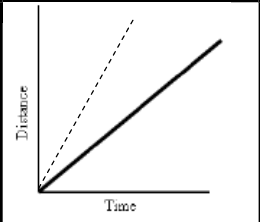
Match the description to the graph:
"The car is coming back."


Segment A-B The bus is _________________.
at rest
returning (to original position)
moving forward
In which of the following graphs below did one runner overtake (run past) the other?


Describe the motion in the graph:
Constant Speed (positive slope)
Stopped (at rest)
Acceleration (increasing speed)
Return Home (negative slope)


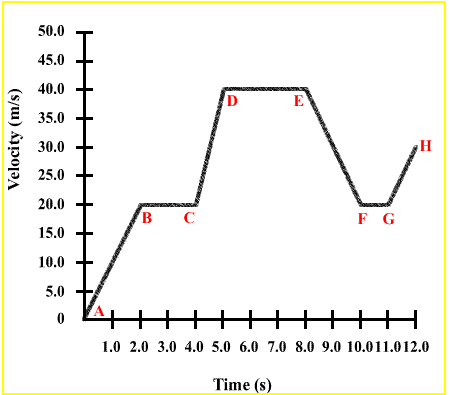

Calculate the distance travelled in section B.
(a)

Where is the acceleration the highest?
0-1s
1-3s
3-5s
The area under a velocity-time graph represents (a) .

It took 500 Newtons of force to push a car four meters. How much work was done?
2000 J
125 J
0.008 J
500 J
What is needed calculate power?
work
time
mass
distance
Two workers use 100 N of force to move a sofa 2 meters in 2 seconds. How much power is required?
100 watts
400 watts
104 watts
50 watts

