wayground logo

Free Printable Worksheets

Font size

S
M
L
XL
Worksheets

Periodic table and trends

Total questions: 48

Worksheet time: 51mins

Name
Class
Date
1.

Which of the following will have a larger radius than Zinc?

a)

Gallium

b)

Aluminum

c)

Magnesium

d)

Strontium

2.

Which of the following will have a higher electronegativity than arsenic (As)?

a)

Carbon (C)

b)

Neon (Ne)

c)

Antimony (Sb)

d)

Germanium (Ge)

3.
As atoms of elements in group 16 are considered in order from top to bottom, the electronegativity of each successive element....
a)
decreases
b)
increases
c)
remains the same
d)
none of the above
4.
Which atom has the largest atomic radius?
a)
potassium
b)
rubidium 
c)
francium
d)
cesium
5.
As you move down the periodic table atoms get bigger.  This is because ____________.
a)
The atoms have more mass.
b)
The atoms have more protons.
c)
The atoms have more energy levels
d)
The atoms have more nuetrons
6.
As you move across the periodic table atoms tend to get smaller because, ______________.
a)
the atoms have more mass.
b)
the atoms have less mass
c)
the atoms have more protons.
d)
the atoms have less electrons.
7.
Atoms that have a high electronegativity, _______________.
a)
give up their electrons more easily.
b)
hold on to their electrons more tightly.
c)
have more electron shells.
8.
Ionization energy is...
a)
the energy required to add an electron to a specific atom
b)
how much energy it takes to remove an electron from an atom
c)
the energy required to shield the outer electrons from the nucleus
d)
a measure of the ability of an atom to attract electrons
9.
The element with the largest electronegativity in the halogens is - 
a)
At
b)
F
c)
Cl
d)
Br
10.
Which periodic group has the smallest atomic radius?
a)
Alkali metals
b)
Halogens
c)
Noble Gases
d)
Transition metals
11.

A measure of the size of an atom, and is generally defined as the distance from the nucleus to the outermost electron orbit

a)

chemical reactivity

b)

atomic radius

c)

energy levels

d)

orbit

12.
What group does this element belong to?
a)
Group 1: Alkali metals
b)
Group 18: Noble Gases
c)
Group 2: Alkaline-Earth Metals
d)
Group 17: Halogens
13.

What's a valence electron?

a)

electrons in the second orbital

b)

electrons in the outermost shell of an atom

c)

the atomic number

d)

electrons in the first energy level

14.

Which element would be in group 16?

a)

V

b)

W

c)

X

d)

Y

e)

Z

15.

Which element would be in group 2?

a)

V

b)

W

c)

X

d)

Y

e)

Z

16.

This could be the dot diagram of

a)

Mg

b)

Cl

c)

C

d)

O

17.
Each column in the periodic table is called a 
a)
period
b)
group
c)
cluster
d)
unit
18.

one or two letters that represent the name of an element

a)

element name

b)

element symbol

c)

atomic number

d)

atomic mass

19.
The horizontal row on the periodic table is called a
a)
group
b)
family
c)
period
d)
atomic number
20.

Rows in the periodic table are called (a)  

Columns in the periodic table are called ​ (b)  

Choose from the below words
period
group
21.

Elements in the periodic table are sorted by:

a)

Increasing atomic number

b)

Increasing atomic mass

c)

Alphabetical order

d)

Increasing number of valence electrons

22.

How many periods are there in the periodic table?

a)

18

b)

9

c)

7

d)

6

23.
Which of these grouping of elements could have the characteristic of brittle?
a)
Metal
b)
Nonmetal
24.
Which of the following is a good conductor of heat?
a)
Metal
b)
Nonmetal
c)
Metalloid
25.
If a material can easily be drawn into the shape of a wire, it is
a)
Ductile
b)
Magnetic
c)
Malleable
d)
Reactive
26.
Iron is a good conductor, malleable and magnetic. What type of element is Iron? 
a)
Metal
b)
Nonmetal
c)
Metalloid
d)
Pretty
27.
Silicon is a semiconductor and has properties of both metals and nonmetals. What type of element is Silicon? 
a)
Metal
b)
Nonmetal
c)
Metalloid
d)
Pretty
28.

The figure above shows a periodic table with the position of one element indicated by an X. How would the element in position X be classified?

a)

halogen

b)

metalloid

c)

noble gas

d)

non-metal

29.

What are the shaded elements?

a)

Metals

b)

Nonmetals

c)

Metalloids

30.

Which elements are to the right of the zig zag?

a)

metals

b)

nonmetals

c)

metalloids

31.

Which chemical symbol is written correctly for the element bromine?

a)

bR

b)

BR

c)

Br

d)

br

32.

What are the three main groups of the periodic table?

a)

groups

b)

metal

c)

nonmetals

d)

metalloids

e)

periods

33.

Which fact is TRUE about the elements found on the periodic table?

a)

They all have the same atomic number

b)

They are NOT pure substances

c)

They are arranged in alphabetical order

d)

Elements in the same column have similar properties

34.
Which group of the periodic table is composed of inert (not reactive)  gases?
a)
alkali metals
b)
alkaline earth metals
c)
halogens
d)
noble gases
35.
Which is a halogen?
a)
Helium
b)
Chlorine
c)
Oxygen
d)
Neptune
36.

Ions are formed when atoms gain or lose ___.

a)

electrons

b)

protons

c)

neutrons

d)

atomic mass

37.

What property is being measured in this diagram?

a)

Density

b)

Ionization Energy

c)

Atomic Radius

d)

Atomic Mass

38.

What type of elements are malleable and ductile?

a)

noble gases

b)

nonmetals

c)

metals

d)

halogens

39.
Which of the following will have a lower ionization energy than Scandium (Sc)?
a)
Helium (He)
b)
Titanium (Ti)
c)
Calcium (Ca)
d)
Magnesium (Mg)
40.

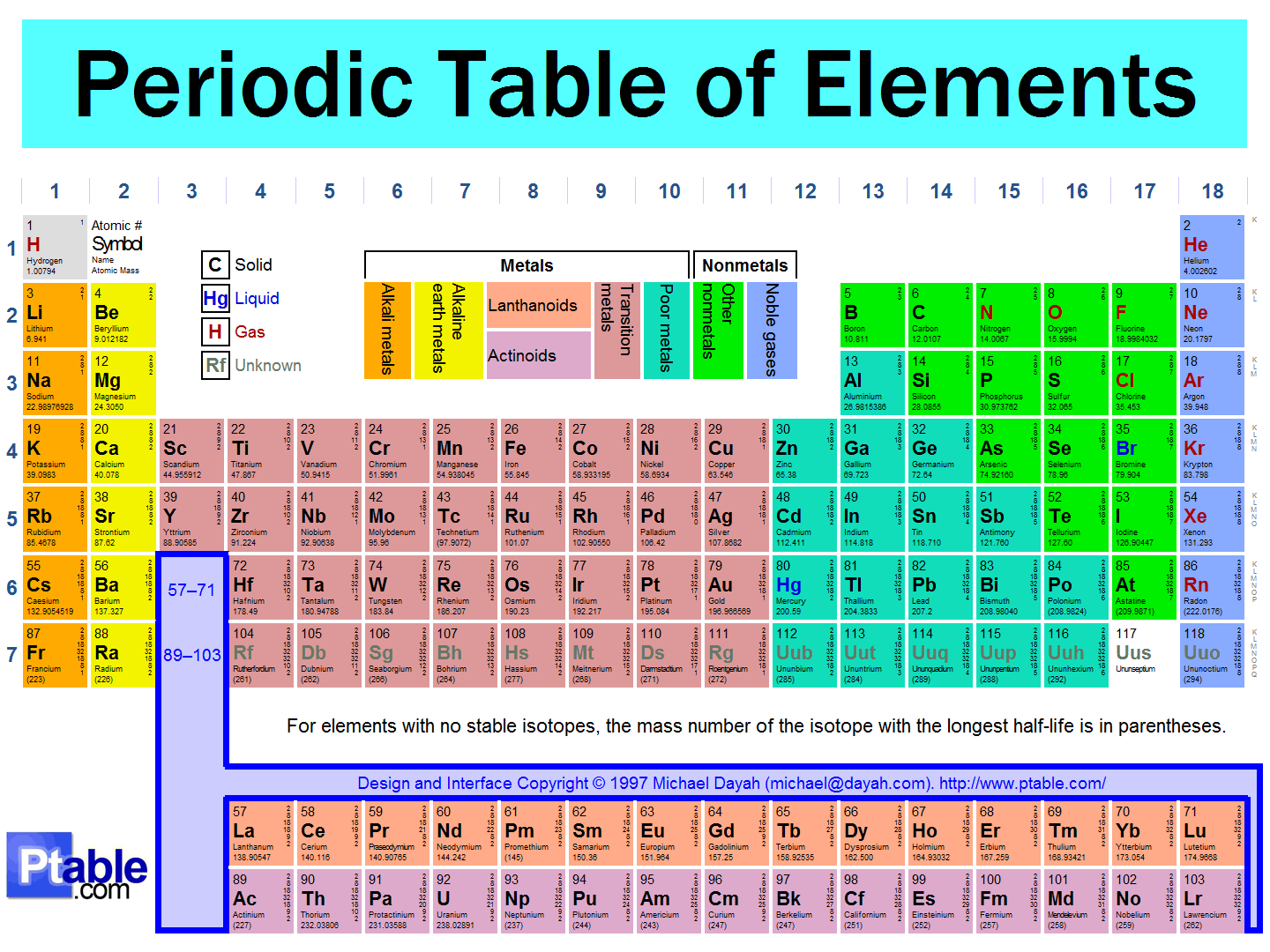
Which color on the image of the periodic table corresponds with the actinides.

a)

red

b)

black

c)

blue

d)

yellow on bottom

41.

The elements in this family are soft, silvery, and very reactive with water.

a)

Alkaline Earth Metals

b)

Alkali Metals

c)

Transition Metals

d)

Lanthanides

42.
Which is an alkali metal?
a)
Magnesium
b)
Iron
c)
Sodium
d)
Europium
43.

How many groups are in the periodic table?

a)

18

b)

8

c)

11

d)

15

44.

Which of these elements has the least amount of Electronegativity?

a)

Neon (N)

b)

Boron (B)

c)

Rubidium (Rb)

d)

Barium (Ba)

45.

Group 2 elements are called.....

a)

Alkali metals

b)

Alkaline earth metals

c)

Halogens

d)

Transition metals

e)

Inner transition metals

46.

Group 17 elements are called.....

a)

Alkali metals

b)

Alkaline earth metals

c)

Halogens

d)

Transition metals

e)

Inner transition metals

47.

Group 3-12 elements are called.....

a)

Alkali metals

b)

Alkaline earth metals

c)

Halogens

d)

Transition metals

e)

Inner transition metals

48.

The bottom two rows of elements are called.....

a)

Alkali metals

b)

Alkaline earth metals

c)

Halogens

d)

Transition metals

e)

Inner transition metals