
 Worksheets
Unit 2 HCHEM Atomic structure review
Total questions: 65
Worksheet time: 2hrs 30mins
Rutherford's gold foil experiment provided evidence for which of the following statements?
Negative and positive charges are spread evenly throughout an atom.
Alpha particles have a positive charge.
Gold is not as dense as previously thought.
There is a dense, positively charged mass in the center of an atom.
In an atomic model that includes a nucleus, positive charge is
concentrated in the center of an atom
spread evenly throughout an atom.
concentrated at multiple sites in an atom
located in the space outside the nucleus
Which statement about subatomic particles is true?
Protons, neutrons, and electrons all have about the same mass.
Unlike protons or neutrons, electrons have no mass.
Neutrons have no charge and no mass.
An electron has far less mass than either a proton or neutron.
Which of the following is unique for any given element?
the number of neutrons
the charge on the electrons
the number of protons
the mass of a neutron
The number of protons in one atom of an element is that element's
mass number.
balanced charge.
atomic number.
isotope.
How would you find the number of neutrons in a an atom?
atomic number - mass number
mass number - atomic number
electron number - atomic number
atomic number - isotope number
Which statement is true about oxygen-17 and oxygen-18?
They do not have the same number of protons.
Their atoms have an identical mass.
They are isotopes of oxygen.
They have the same mass number.
Which statement accurately represents the arrangement of electrons in the Bohr's atomic model?
Electrons vibrate in fixed locations around the nucleus.
Electrons travel around the nucleus in fixed energy levels with energies that vary from level to level.
Electrons travel randomly in the relatively large space outside the nucleus.
What is the difference between an atom in the ground state and an atom in an excited state?
The atom in the ground state has less energy and is less stable than the atom in an excited state.
The atom in an excited state has one fewer electron than the atom in the ground state.
The atom in an excited state has more energy and is less stable than the atom in the ground state.
The atom in an excited state has one more electron that the atom in the ground state.
In Rutherford's gold foil eperiment, alpha particles bounce straight back from the foil having struck __________ in the gold atoms.
nulcei
electrons
empty space
gold
Protons and ________ are found in the nucleus of an atom.
hydrogen
atoms
electrons
neutrons
If element "A" has 23 protons, its ______________________ is (are) 23.
electrons
mass number
atomic number
neutrons
The nuclei of isotopes contain different numbers of ________.
protons
neutrons
electrons
atomic numbers
The region in which an electron is most likely to be found is called a(an) ________________.
atom
electron spot
orbital
nucleus
An atom in which an electron has moved to a higher energy level is in a (an) ______ state.
excited
ground
neutral
positive

What is 8?
atomic number
mass number
atomic weight
isotope

O is the
atomic number
atomic symbol
atomic name
atomic weight

Oxygen is the atomic
number
weight
symbol
name

15.999 is the atomic
weight
number
electron
name
What is the mass number Beryllium if you have 5 neutrons?
10
8
9
11
What is the isotope symbol of nitrogen if it has 7 neutrons?
nitrogen-14
nitrogen-7
nitrogen-8
nitrogen-15
What is the element symbol if the atomic number is 15?
N
O
S
P
How many neutrons does boron-11 have?
5
6
7
11
If the:
Atomic number = 15
Mass number = 31
How many electrons do you have?
15
16
30
31
In a Bohr Diagram, how many electrons will go in each shell?
2, 6, 16
2, 6, 18
2, 4, 6
2, 8, 18
In the Bohr diagram for the element Aluminum, how many electrons will go in each shell?
2, 8, 3
2, 8, 18
3, 8, 2
2, 6, 5

Which particles change the charge in atoms when ions are formed?
Protons
Electrons
Neutrons

Cations are...
Positive
Negative
Neutral

Anions are...
Positive
Negative
Neutral

An atom becomes _________ when it gains electrons.
Positive
Negative
Neutral

An atom becomes _______ when it loses electrons.
Positive
Negative
Neutral
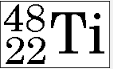
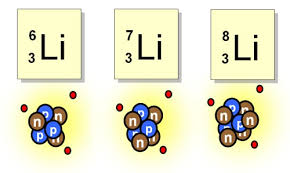
1s2 2s2 2p6 3s2

1s22s22p63s23p6
4s23d104p6


What are the four energy sublevels?
s, p, d, and f
a, b, c, and d
w, x, y, and z
1, 2, 3, and 4

What element has this orbital notation?
lithium
beryllium
boron
carbon

Which element is represented by this orbital notation?
neon
sodium
magnesium
aluminum
Which of the following is the orbital notation for oxygen?


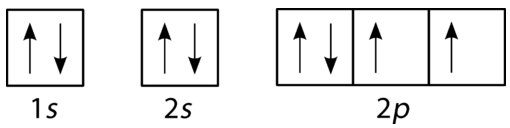
I. 7735X II. 7733X III. 8137X IV. 8135 X
An unknown element has three isotopes. Given the abundances and relative masses, determine (from the periodic table) which element it is.
Abundances | Relative masses
0.005% | 234.04 amu
0.720% | 235.04 amu
99.275% | 238.05 amu
HINT: You do NOT need to calculate anything here.
Uranium (#92, Atomic Mass: 238.03 amu)
Fluorine (#9, Atomic Mass: 19.00 amu)
Mercury (#89, Atomic Mass: 200.59 amu)
Polonium (#84 209 amu)
Element Z has 2 natural isotopes. One isotope has a mass of 15.0 amu and a relative abundance of 30%. The other isotope has a mass of 16.0 amu and a relative abundance of 70%. Estimate the average atomic mass for this one element.
15.0 amu
16.0 amu
15.7 amu
16.9 amu

