
 Worksheets
Atomic Structure Quizziz Review 2024-2025
Total questions: 40
Worksheet time: 40mins
Name
Class
Date
1.
Naturally occurring lithium is a combination of two isotopes that contains 7.6% Li-6 and 92.4% Li-7. In terms of subatomic particles, which of the following best explains why Li-6 and Li-7 are considered isotopes of the same element.
a)
Li-6 and Li-7 have the same number of neutrons and different numbers of protons
b)
Li-6 and Li-7 have different atomic numbers but the same mass number
c)
Li-6 and Li-7 have the same number of protons and different numbers of neutrons
d)
Li-6 and Li-7 have the same atomic number but different mass numbers
2.
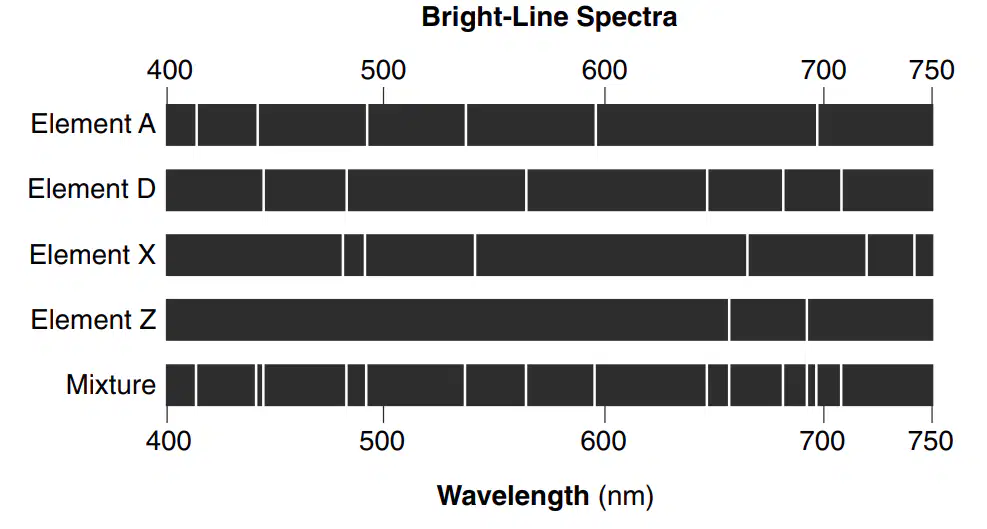
The bright-line spectra observed in a spectroscope for three elements and a mixture of two of these elements are represented in the diagram below. Identify which elements are in the mixture? Check all that apply
a)
Element A
b)
Element D
c)
Element X
d)
Element Z
e)
none of the above
3.
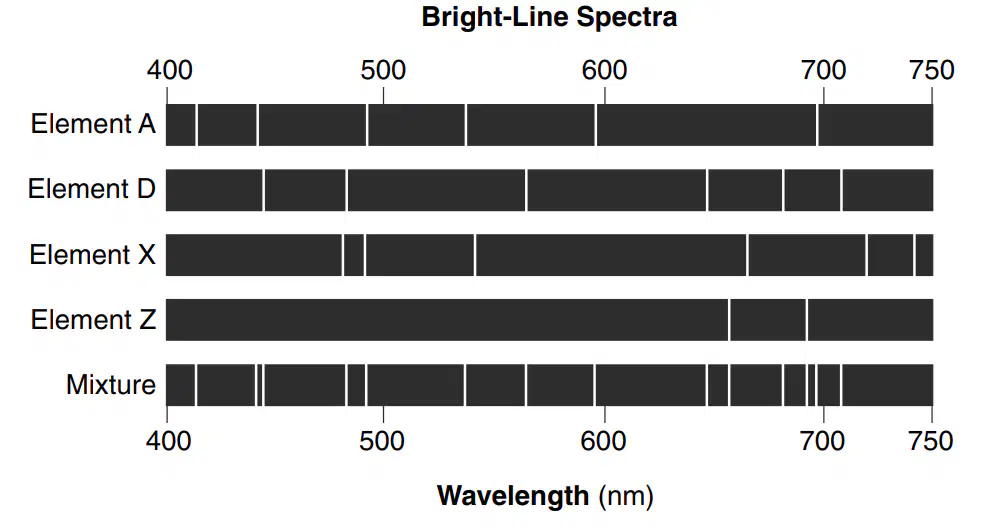
The bright-line spectra observed in a spectroscope for three elements and a mixture of two of these elements are represented in the diagram below. Which of the following best explains what each spectral line represents?
a)
electrons absorb energy as the move from ground to excited state
b)
electrons absorb energy as the move from excited to ground state
c)
electrons emit energy as the move from ground to excited state
d)
electrons emit energy as the move from excited to ground state
4.

The following table shows information for six samples of different elements. Which of the following samples are isotopes?
a)
samples A and B
b)
samples C and D
c)
samples D and E
d)
samples E and F
5.
The atomic mass of chlorine is 35.5 amu. The only naturally occurring isotopes of are Cl-35 and Cl-37. The percent abundances in a naturally occurring sample of element A are closest to...
a)
0% Cl-35 and 100% Cl-37
b)
25% Cl-35 and 75% Cl-37
c)
50% Cl-35 and 50% Cl-37
d)
75% Cl-35 and 25% Cl-37
e)
100% Cl-35 and 0% Cl-37
6.

The table below gives the atomic mass and the abundance of the two naturally occurring isotopes of copper.
a)
(62.93 u)(30.85) + (64.93 u)(69.15)
b)
(62.93 u)(0.3085) + (64.93 u)(0.6915)
c)
(62.93 u)(69.15) + (64.93 u)(30.85)
d)
(62.93 u)(0.6915) + (64.93 u)(0.3085)
7.
Which part of a calcium atom in the ground state is represented by the dots in its Lewis electron-dot diagram?
a)
the inner electrons that occupy the first 3 electron shells
b)
the outermost electron in the 4th shell
c)
the valence neutrons in the third shell
d)
the number of electrons located within the nucleus
8.
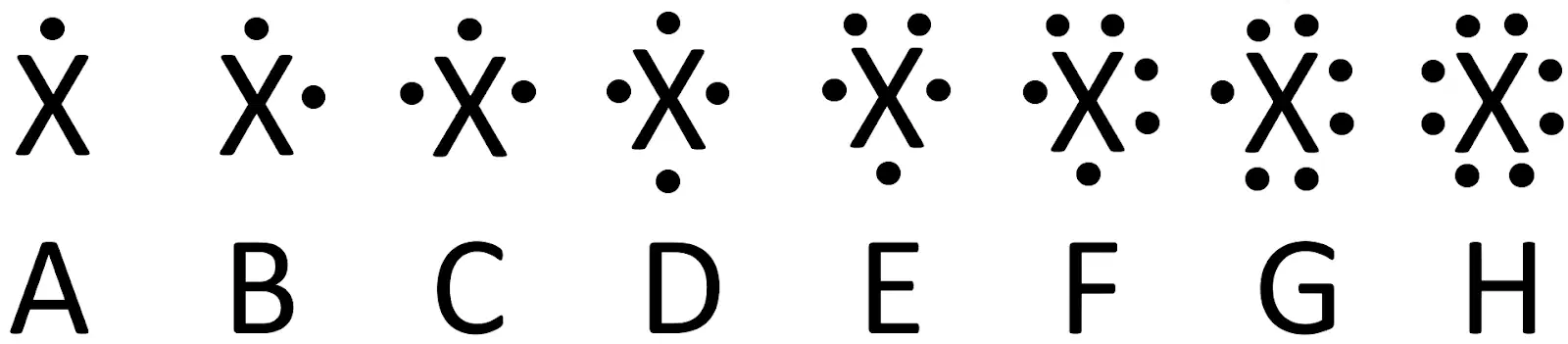
Which of the following Lewis dot diagrams would represent an phosphorus atom. Write the letter in the space provided.
a)
E
b)
A
c)
B
d)
C
e)
D
9.
In the land of make-believe, the atomic mass of the element Magoatite (Ma) is 63.6 atomic mass units. The only naturally occurring isotopes of Magoatite are Ma-63 and Ma-65. The percent of Magoatite are closest to
a)
31% Ma-63 and 69% Ma-65
b)
50% Ma -63 and 50% Ma -65
c)
69% Ma -63 and 31% Ma -65
d)
100% Ma 63 and 0% Ma -65
10.
Which statement describes the earliest model of the atom?
a)
An atom is an indivisible hard sphere.
b)
An atom has a small, dense nucleus.
c)
The atom is mostly empty space.
d)
Electrons are negative particles in an atom.
11.
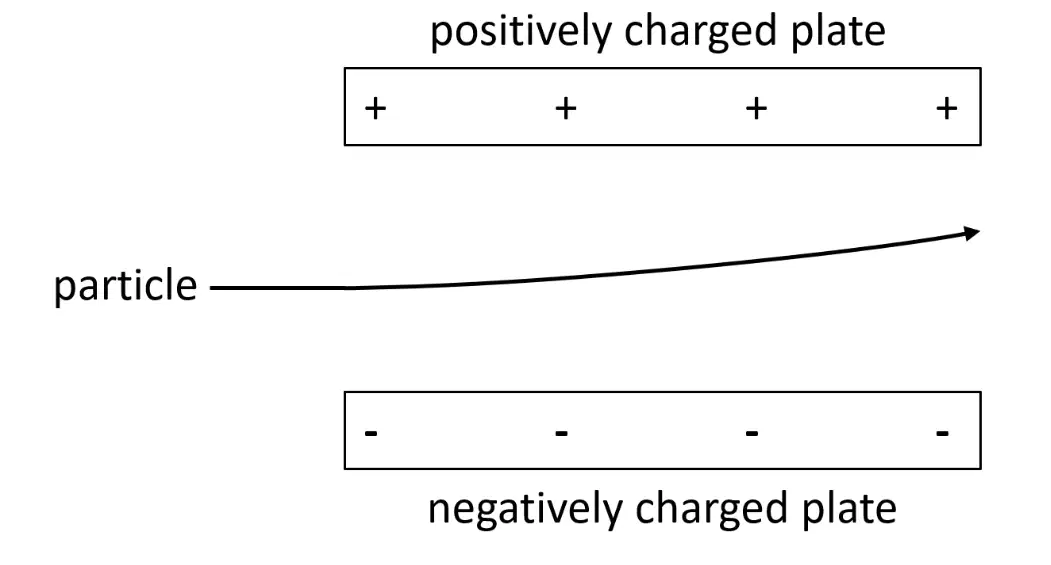
The diagram below represents a particle traveling through an electric field. Which particle is traveling through the electric field?
a)
proton
b)
electron
c)
neutron
d)
alpha particle
12.
Which statement describes the results of Rutherford’s gold foil experiment?
a)
A positively charged nucleus is surrounded by positively charged particles.
b)
A positively charged nucleus is surrounded by mostly empty space.
c)
A negatively charged nucleus is surrounded by positively charged particles.
d)
A negatively charged nucleus is surrounded by mostly empty space.
13.
In an all neutral atoms of carbon, which of the following is always true?
a)
The number of protons will equal the number of neutrons
b)
The number of electrons will equal the number of neutrons
c)
The number of protons will be greater than the number of neutrons
d)
The number of electrons will equal the atomic number
14.

Given the table below that shows student's examples of proposed models of the atom, which model correctly describes the locations of protons and electrons in the Bohr model of the atom?
a)
A
b)
B
c)
C
d)
D
15.
Which statement describes a concept included in the wave-mechanical model of the atom?
a)
Protons, neutrons, and electrons are located in the nucleus.
b)
Electrons orbit the nucleus in shells at fixed distances.
c)
Atoms are hard, indivisible spheres.
d)
Electrons are located in regions called orbitals.
16.
Which group of atomic models is listed in historical order from the earliest to the most recent?
a)
hard-sphere model, wave-mechanical model, electron-shell model
b)
hard-sphere model, electron-shell model, wave-mechanical model
c)
electron-shell model, wave-mechanical model, hard-sphere model
d)
electron-shell model, hard-sphere model, wave-mechanical model
17.

The table below gives the masses of two different subatomic particles found in an atom. Which of the subatomic particles are each paired with their corresponding names?
a)
X – electron, Y – proton, Z – neutron
b)
X – neutron, Y – electron, Z – proton
c)
X – proton, Y – neutron, Z – electron
d)
X – electron, Y – neutron, Z – proton
18.
An atom from a collected sample is determined to have 12 protons, 13 neutrons, and 12 electrons. What is the charge of the nucleus for this atom?
a)
1+
b)
0
c)
12+
d)
13+
19.
An atom from a collected sample is determined to have 6 protons, 7 neutrons, and 6 electrons. What is the mass number for this atom?
a)
6
b)
7
c)
13
d)
19
20.
Which of the following pairs of atoms have the same number of neutrons?
a)
H-2 and He-2
b)
H-3 and He-3
c)
H-2 and H-3
d)
H-3 and He-4
21.

The table below shows the number of protons, neutrons, and electrons in four ions. Which of the following ions would have a charge of 2+?
a)
A
b)
B
c)
C
d)
D
22.

The following table shows the subatomic particles for five unidentified elements as either ions or neutral atoms. Which atom(s) would have the same mass number? Choose all that apply.
a)
A
b)
B
c)
C
d)
D
23.
A sample of matter must be Nickel-57 (Ni) if…
a)
Each atom in the sample has a mass of 57 amu.
b)
Each atom in the sample has 28 protons.
c)
Each atom in the sample is capable of conducting electricity.
d)
Each atom in the sample has an electron configuration of 2-8-16
24.
Which of the following are isotopes?
a)
C-14 and N-14
b)
H-3 and He-3
c)
O-16 and S-32
d)
Cl-35 and Cl-37
25.
Which of the following is not true regarding isotopes?
a)
All isotopes have the same electron configuration
b)
All isotopes have the same mass number
c)
All isotopes have the same number of protons
d)
All isotopes emit the same spectral lines on a bright line emission spectrum.
26.
The atomic mass of an element is the weighted average of the atomic masses of
a)
the least abundant isotopes of the element
b)
the naturally occurring isotopes of the element
c)
the artificially produced isotopes of the element
d)
the natural and artificial isotopes of the element
27.
Which statement best describes the nucleus of an atom of Na-23?
a)
It has a charge of +11, there are 12 neutrons, and is surrounded by a total of 23 electrons.
b)
It has a charge of +23, there are 22 neutrons, and is surrounded by a total of 11 electrons.
c)
It has a charge of +11, there are 12 neutrons, and is surrounded by a total of 11 electrons.
d)
It has a charge of +23, there are 12 neutrons, and is surrounded by a total of 12 electrons.
28.
How many total electrons can be found in a completely filled 3rd principle energy level?
a)
2
b)
8
c)
18
d)
32
29.
How many occupied electrons shells can be found in an atom of calcium?
a)
4
b)
1
c)
2
d)
3
e)
5
30.
Which of the following best describes a sodium atom as it ionizes into a sodium ion?
a)
the sodium atom loses an electron and the oxidation number increases
b)
the sodium atom loses an electron and the oxidation number decreases
c)
the sodium atom gains an electron and the oxidation number increases
d)
the sodium atom gains an electron and the oxidation number decreases
31.
Which of the following electron configurations would represent an atom of copper in excited state?
a)
2-3-1
b)
2-8-18-1
c)
2-8-14-3
d)
2-8-17-2
32.
Which statement describes how an atom in the ground state becomes excited?
a)
The atom releases energy, and one or more electrons move to a lower electron shell.
b)
The atom releases energy, and one or more electrons move to a higher electron shell.
c)
The atom absorbs energy, and one or more electrons move to a lower electron shell.
d)
The atom absorbs energy, and one or more electrons move to a higher electron shell.
33.
When an excited electron in an atom moves to the ground state, the electron
a)
absorbs energy as it moves to a higher energy state
b)
absorbs energy as it moves to a lower energy state
c)
emits energy as it moves to a higher energy state
d)
emits energy as it moves to a lower energy state
34.
What is the highest principal energy level for an electron in an atom of sodium in the ground state?
a)
3
b)
1
c)
2
d)
4
e)
5
35.
Which electron configuration represents an atom in ground state for an element having a completely filled 2nd principal energy level?
a)
2-3
b)
2-7-2
c)
2-8-4
d)
2-8-17-1
36.
Which atom in the ground state has five valence electrons and ten electrons in its kernel (inner electrons)?
a)
Nitrogen (N)
b)
Phosphorus (P)
c)
Boron (B)
d)
Magnesium (Mg)
37.
Which electron configuration represents an atom of bromine in an excited state?
a)
2-8-17-6
b)
2-8-18-7
c)
2-8-17-8
d)
2-8-18-8
38.
Which atom in ground state would have the same electron configuration as an K⁺ ion?
a)
Sodium (Na)
b)
Calcium (Ca)
c)
Krypton (Kr)
d)
Argon (Ar)
39.
Which of the following elements would form an ion with a charge of +3?
a)
C
b)
Cl
c)
Al
d)
N
40.
Compared to the energy and charge of the electrons in the first shell of a Cs atom, the electrons in the second shell of this atom have
a)
less energy and the same charge
b)
less energy and a different charge
c)
more energy and the same charge
d)
more energy and a different charge
100 %

