
NEW
Font size
 Worksheets
AS Particle physics, units 1.0, 2.0 + 3.0
Total questions: 21
Worksheet time: 11mins
A polonium-210 nucleus is formed when a stationary nucleus of bismuth-210 decays. A beta-minus (β⁻) particle is emitted in this decay. Outline, with reference to β⁻ decay, why bismuth-210 and polonium-210 have different proton numbers.
Bismuth-210 emits a beta-minus particle, which increases the proton number by one.
Bismuth-210 emits a beta-minus particle, which decreases the proton number by one.
Bismuth-210 emits a beta-minus particle, which does not change the proton number.
Bismuth-210 emits a beta-minus particle, which doubles the proton number.
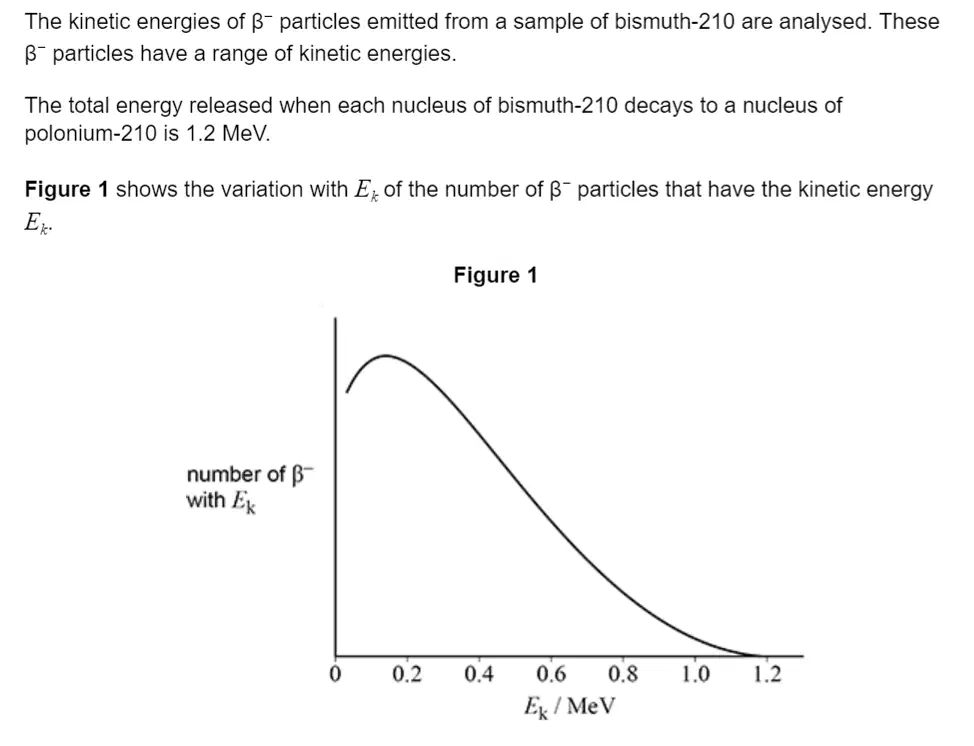
Explain how the data in Figure 1 support the hypothesis that a third particle is produced during β⁻ decay.
The data shows a continuous energy spectrum of emitted electrons.
The data indicates a discrete energy level for emitted electrons.
The data supports the conservation of charge only.
The data shows no evidence of additional particles.
The range of the electromagnetic interaction is infinite. The table below gives the range of the strong nuclear interaction and the range of the weak nuclear interaction. | Interaction | Range / m | |-----------------|-----------| | strong nuclear | 10^-15 | | weak nuclear | 10^-18 | Which particle is likely to travel the shorter distance in the tank of water before interacting?
Positron
Electron antineutrino
An atom of oxygen-15 \((^{15}_{8}O)\) gains two electrons to form an ion. What is the specific charge of the ion?
-1.3 \times 10^7 \, \text{C kg}^{-1}
-2.4 \times 10^7 \, \text{C kg}^{-1}
-5.1 \times 10^7 \, \text{C kg}^{-1}
-6.4 \times 10^7 \, \text{C kg}^{-1}
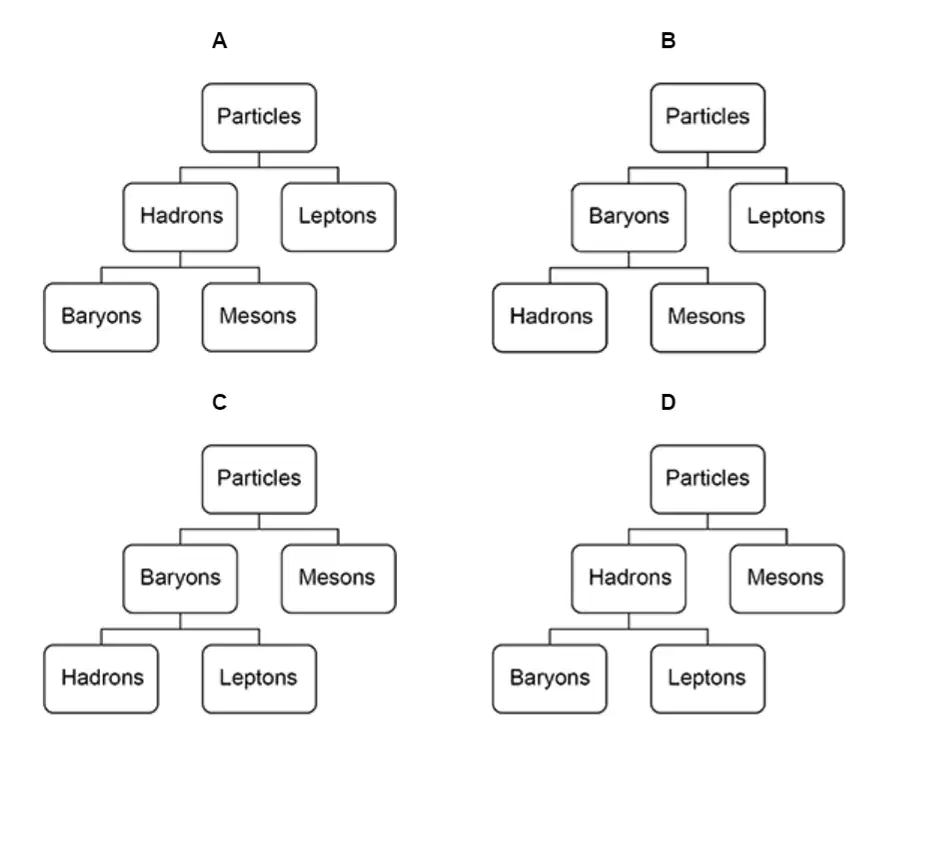
Which shows the classification of particles?
A
B
C
D

Calculate the speed of X. Ignore relativistic effects.
1.0⋅107 m/s
2.0⋅107 m/s
3.0⋅107 m/s
4.0⋅107 m/s
The K⁺ decays to produce an anti-muon and a muon neutrino. Which conservation law is associated with this decay?
Conservation of energy
Conservation of momentum
Conservation of strangeness
Conservation of charge
The proton number of uranium is 92 and the proton number of radon is 88. Which series of decays turns a uranium nucleus into a radon nucleus?
α + β⁻ + β⁻ + α + α
β⁻ + β⁻ + α + β⁻ + α
α + α + α + α + β⁻
β⁻ + β⁻ + β⁻ + β⁻ + α

Which row identifies particles E, F, and G?
A. E: up quark, F: down quark, G: neutrino
B. E: down quark, F: up quark, G: neutrino
C. E: up quark, F: down quark, G: antineutrino
D. E: down quark, F: up quark, G: antineutrino
A possible decay of a negative pion is π⁻ → e⁻ + Y. What is particle Y? Tick (✓) one box.
ν̅ₑ
νₑ
π⁰
1₀n
Some subatomic particles are classified as hadrons. There are two classes of hadrons. Which of the following is a class of hadrons?
Baryons
Leptons
Photons
Neutrinos

The table contains data about two completely ionised samples of pure boron. Each sample contains only isotopes X and Y. Deduce which sample, 1 or 2, contains a greater percentage of isotope Y.
Sample 1 contains a greater percentage of isotope Y.
Sample 2 contains a greater percentage of isotope Y.
Both samples contain an equal percentage of isotope Y.
It cannot be determined from the given data.
Determine whether the following reaction is a possible decay for the neutral pion π⁰. π⁰ → e⁺ + μ⁺ + ν̅ₑ
Yes, it is a possible decay.
No, it is not a possible decay.
The kaon K⁰ and the anti-kaon K̅⁰ are the same particle. Is this suggestion correct?
Yes, they are the same particle.
No, they are different particles.
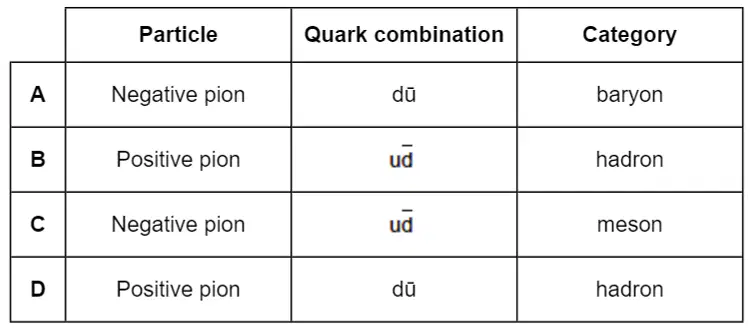
Which row gives a particle with its quark combination and category?
Negative pion, dū, baryon
Positive pion, ūḋ, hadron
Negative pion, ūḋ, meson
Positive pion, dū, hadron
Which of the following particles is a lepton?
Proton
Neutron
Electron
Pion
What is the quark composition of a proton?
uud
udd
uuu
ddd
Which interaction is responsible for the decay of a neutron into a proton, electron, and antineutrino?
Strong nuclear interaction
Electromagnetic interaction
Weak nuclear interaction
Gravitational interaction
What is the quark composition of a neutron?
uud
udd
uuu
ddd
Which of the following particles is a baryon?
Electron
Proton
Neutrino
Photon
Which interaction is responsible for the binding of protons and neutrons in the nucleus?
Electromagnetic interaction
Weak nuclear interaction
Strong nuclear interaction
Gravitational interaction

