

wayground logo

Free Printable Worksheets

Font size

S
M
L
XL
Worksheets

Colonization Test

Total questions: 30

Worksheet time: 23mins
Name
Class
Date
1.
Which of the following was NOT a reason that explorers came to the Americas?
a)
Curiosity (Glory)
b)
Create Trade Routes (Gold)
c)
Build communities with Natives (Gratitude)
d)
Spread Christianity (God)
2.
Which continents make up the New World?
a)
South America and Europe
b)
Europe and Africa
c)
North America and Europe
d)
North and South America
3.
Who benefited from the exploration of the Americas?
a)
European Explorers
b)
Natives (Indigenous people)
c)
Everyone
d)
No one
4.
Which of the following was NOT a symptom of the plague (diseases spread) in Mexico?
a)
Sores from head to foot
b)
Difficulty moving
c)
Blindness
d)
Loss of ability to speak
5.
Which statement is true regarding the population changes after 1520?
a)
The population in Mexico greatly decreased due to both diseases and violent encounters with the conquistadors.
b)
The population in Mexico increased as new marriages were formed with the conquistadors.
c)
The population in Mexico stayed the same and was not affected by the conquistadors.
d)
The population in Mexico decreased because many people decided to move away.
6.
What was the Columbian Exchange?
a)
The journey Columbus took to the New World in which he searched for gold.
b)
The transfer of plants, animals, culture, and human populations between the Old and New Worlds
c)
A trade agreement between Europe and Asia
d)
A treaty between Native American tribes and European settlers
7.
Which of the following was a major impact of the Columbian Exchange?
a)
Increased isolation between continents
b)
The decline of European exploration
c)
The spread of new crops and animals to different parts of the world
d)
The complete eradication of Native American populations (meaning the whole population is gone).
8.
Which disease had a devastating impact on Native American populations as a result of the European exploration?
a)
Smallpox
b)
Malaria
c)
Influenza
d)
Covid
9.
Which of the following statements about Columbus is TRUE?
a)
Columbus was so invested in exploration that he paid for his own journey to help develop maps.
b)
Columbus found land that is now the United States.
c)
Columbus successfully created a colony in Hispaniola with a thriving economy and happy citizens.
d)
The Spanish rulers sent Columbus to find a route to Asian in hopes of new land and riches.
10.
Which two countries led the way in early exploration of the Americas?
a)
England and France
b)
Spain and Portugal
c)
Spain and England
d)
Portugal and France
11.
Which of the following statements is FALSE about the treatment of indigenous people.
a)
Many European explorers brought diseases to the new lands.
b)
Most indigenous populations warmly welcomed the explorers into their lands and worked together.
c)
In multiple locations, the natives were slaughtered and killed.
d)
The native populations on many colonies decreased dramatically after the arrival of the explorers.
12.
What role did technological advancements play in facilitating European colonization during the Age of Exploration?
a)
They had no significant impact on colonization.
b)
It made colonization harder because the maps were unfinished.
c)
It greatly helped colonization by improving navigation and quality of ships.
d)
It only benefited indigenous populations.
13.
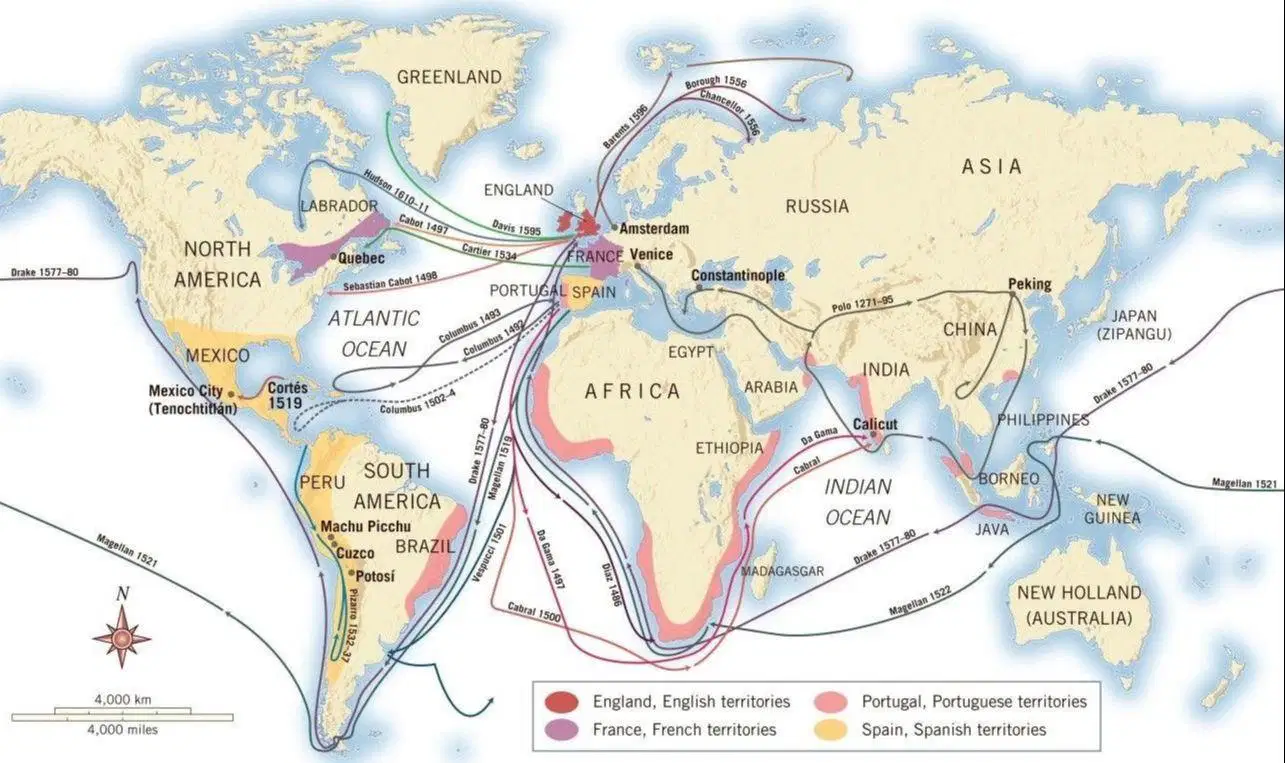
Based on the map, who did NOT travel around the southern tip of Africa?
a)
Diaz
b)
De Gama
c)
Cartier
d)
Drake
14.

What was one of the main reasons for the decline in the indigenous population after European contact?

a)

Introduction of new agricultural techniques

b)

Spread of European diseases

c)

Establishment of trade routes

d)

Cultural exchange programs

15.

Which European country was the first to establish a permanent settlement in the New World?

a)

France

b)

England

c)

Spain

d)

Portugal

16.

European understand of world _______ was incomplete.

a)

History

b)

Geography

c)

Science

d)

Arts

17.

Explorers sailed in ships from ________ to lands as far as North and South America, Africa, Southeast Asia, and Australia.

a)

America

b)

Europe

c)

France

d)

Greece

18.

___________ sailed from Spain around the bottom of South America, and all the way across the Pacific ocean to the Phillippines looking for spices land.

a)

Cristopher Columbus

b)

Ferdinand Magellan

c)

Vascoda Gama

d)

Henry Hudson

19.

What was the major religion behind the Age of Discovery?

a)

Christianity

b)

Islam

c)

Buddhism

d)

Judaism

20.

Which continent had horses BEFORE the Columbian Exchange?

a)

Americas

b)

Europe

21.

Which continent had potatoes BEFORE the Columbian Exchange?

a)

Americas

b)

Europe

22.

In the Age of Discovery, Western European sailors were looking for new trade routes. What products were they searching for?

a)

furs

b)

lumber

c)

spices

d)

gems

23.

Who was first to set up a sailing school in Portugal that led to the Age of Discovery? He sent sailors to explore the west coast of Africa.

a)

Prince Henry the Navigator

b)

Vasco da Gama

c)

Amerigo Vespucci

d)

Bartolomeu Dias

24.

Which Spanish explorer was the first to circumnavigate the globe after discovering a passage through South America. He died in the Moluccas while fighting in a war to help the Chief of Cebu?

a)

Ferdinand Magellan

b)

Francis Drake

c)

Amerigo Vespucci

d)

John Cabot

25.

Which continent is located in the yellow circle?

a)

North America

b)

South America

c)

Europe

d)

Africa

26.

Which continent is located in the yellow circle?

a)

North America

b)

South America

c)

Europe

d)

Africa

27.

Which continent is located in the yellow circle?

a)

North America

b)

South America

c)

Europe

d)

Africa

28.

Which continent is located in the yellow circle?

a)

North America

b)

South America

c)

Europe

d)

Africa

29.

The Spanish conquistadores led by Cortes conquered_________.

a)

the Aztecs of Mexico

b)

the Inca Empire in Peru

c)

French settlements in Canada

d)

Muslim towns in Africa

30.

The area that Columbus actually explored included present-day________.

a)

Florida and the Gulf Coast

b)

New York and New England

c)

India and Asia

d)

Cuba and Bahamas
