
 Worksheets
Energy and Climate Test Review
Total questions: 25
Worksheet time: 13mins
Name
Class
Date
1.
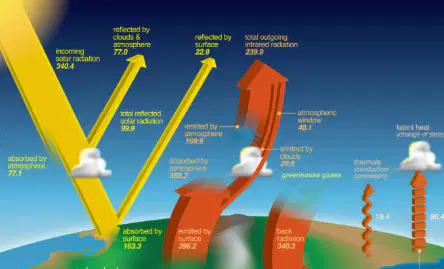
The balance between the amount of solar energy coming in and the energy radiated or reflected out. It determines the Earth's temperature and climate.
a)
Energy Budget
b)
Greenhouse gasses
c)
Feedback loop
d)
Carbon sink
2.
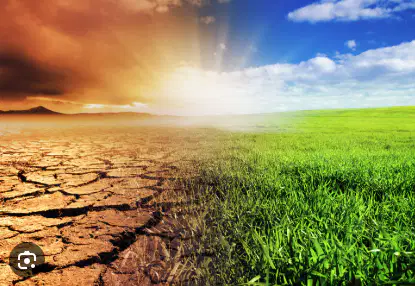
Average weather conditions for a region year after year, after looking at 30 or more years of data.
a)
Climate
b)
Weather
c)
Global Warming
d)
Geosphere
3.
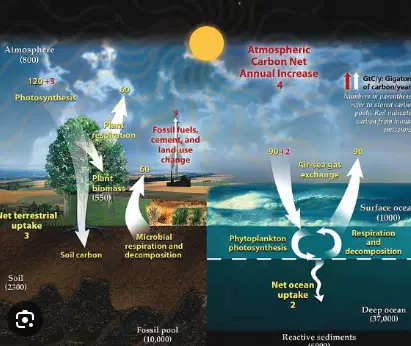
A reservoir, either natural or artificial, that absorbs more carbon from the atmosphere than it releases to the atmosphere.
a)
Carbon sink
b)
Biosphere
c)
Reflection
d)
Radiation
4.
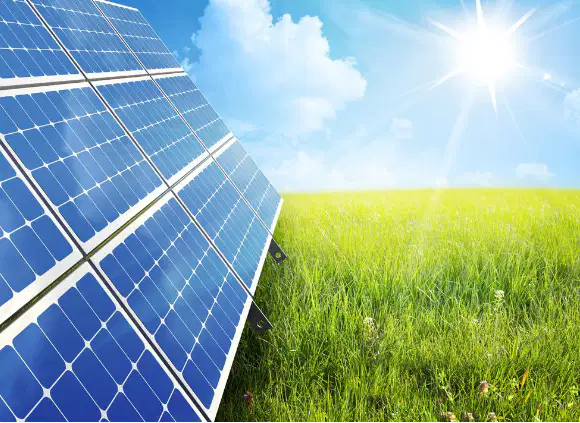
The act of taking in or soaking up energy.
a)
Absorption
b)
Reflection
c)
Radiation
d)
Ocean circulation
5.
A change in the direction of a wave at an interface between two media that sends the wave back into the medium from which it came.
a)
Reflection
b)
Radiation
c)
Absorption
d)
Greenhouse gasses
6.
The emission or transmission of energy as particles or waves
a)
Radiation
b)
Reflection
c)
Absorption
d)
Hydrosphere
7.
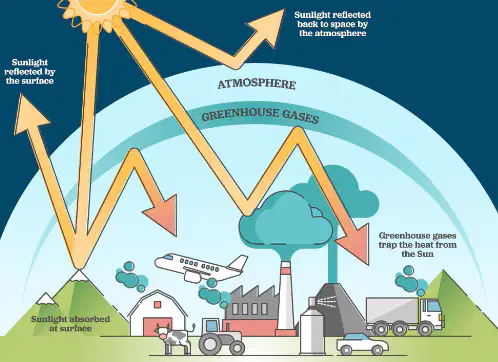
Any molecule in the atmosphere that traps heat within the atmosphere.
a)
Greenhouse gas
b)
Energy
c)
Carbon sink
d)
Earth's energy budget
8.
A long-term change in the temperature range and other atmospheric conditions of Earth.
a)
Climate change
b)
Weather
c)
Feedback loop
d)
Atmosphere
9.
An increase in the average temperature of Earth's atmosphere, especially a sustained increase great enough to cause changes in the global climate.
a)
Global warming
b)
Earth's Energy Budget
c)
Reflection
d)
Absorption
10.
The large-scale movement of water in the ocean.
a)
Ocean circulation
b)
Radiation
c)
Global warming
d)
Wave
11.
When a change in one part of the system affects second part of the system causing a reciprocal change in the first part of the system.
a)
Feedback loop
b)
Absorption
c)
Reflection
d)
Earth's Energy Budget
12.
What would be an appropriate time scale for climate change caused by a volcano?
a)
Less than 10 years
b)
Hundreds of years
c)
Thousands of years
d)
Millions of Years
13.
What would be an appropriate time scale for climate change caused by a change in ocean circulation?
a)
Less than 10 years
b)
Hundreds of years
c)
Thousands of years
d)
Millions of years
14.
What would be an appropriate time scale for climate change caused by a change in the eccentricity (shape) of Earth's orbit?
a)
Less than 10 years
b)
Hundreds of years
c)
Thousands of years
d)
Millions of years
15.
What would be an appropriate time scale for climate change caused by human activity?
a)
Less than 10 years
b)
Hundreds of years
c)
Thousands of years
d)
Millions of years
16.
What would be the result if there was more energy input than output in Earth's Energy Budget?
a)
Temperatures would increase.
b)
Temperatures would decrease.
c)
Temperatures would stay the same.
17.
What would be the result if there was more energy output than input in Earth's Energy Budget?
a)
Temperatures would increase.
b)
Temperatures would decrease.
c)
Temperatures would stay the same.
18.
What is the main cause of global changes in climate over long periods of time?
a)
Changes in the flow of energy in Earth’s systems
b)
Changes in variety and complexity of plants and animals
c)
Interaction between Earth and the most massive planets
d)
Changes in the Sun's solar activity
19.

Based on the diagram, which of the following statements is correct?
a)
Human activity is causing more carbon into the atmosphere
b)
Human activity is causing more carbon into the vegetation and soil
c)
More carbon is naturally flowing into the atmosphere
d)
Overall, there is more carbon flowing into the atmosphere than into vegetation and soil
20.
Which of the following would most likely lead to a cooler global climate?
a)
Volcanic activity sufficient to produce ash clouds that cover a significant portion of Earth’s atmosphere for an extended period of time
b)
Slower rotation of Earth, leading to a permanent lengthening of periods of both daylight exposure and darkness on Earth
c)
Melting of polar ice caps that leads to a rise in sea level over the entire planet and less available habitat for land-dwelling plants and animals
d)
Human activity, including the burning of fossil fuels that increases the amount of carbon dioxide and other gases that trap thermal energy in the atmosphere
21.
Minnesota is cold in winter and warm in summer. This would describe the
a)
weather
b)
global climate
c)
regional climate
22.
Last night we had a thunderstorm. This describes
a)
weather
b)
climate
c)
global climate
23.
El Nino and La Nina are the warm and cold cycles of..
a)
wind patterns
b)
volcanic activity
c)
ocean circulations
24.
Aphelion
a)
The position when the earth is closest to the sun
b)
The position when the earth is furthest from the sun
c)
The position when the moon is full
25.
Perihelion
a)
The earth's position when closest to the sun.
b)
The earth's position when furthest from the sun.
c)
The moon's full moon position
100 %

