
 Worksheets
Module 6 Slides 1-8
Total questions: 31
Worksheet time: 24mins
basic requirements for life (carbon, hydrogen, oxygen, phosphorus, potassium, nitrogen, sulfur, calcium, iron, sodium, chlorine, magnesium)
(a)
substance (element or compound) an organism must get from a source outside its cells
(a)
required in large quantities; play principal roles in cell structure and metabolism (proteins, carbohydrates)
(a)
required in small amounts; involved in enzyme function and maintenance of protein structure (manganese, zinc, nickel).
(a)
contain carbon and hydrogen atoms and are usually the products of living things
•Methane (CH4), carbohydrates, lipids, proteins, and nucleic acids
(a)
atom or molecule that contains a combination of atoms other than carbon and hydrogen
•Metals and their salts (magnesium sulfate, ferric nitrate, sodium phosphate), gases (oxygen, carbon dioxide) and water
(a)
Chemical analysis of cell contents: What percentage of a cell is water?
70%
90%
97%
99%
Chemical analysis of cell contents: What percentage of dry cell weight is organic compounds?
70%
90%
97%
99%
Chemical analysis of cell contents: What percentage of the cell is composed of Carbon, Hydrogen, Oxygen, Nitrogen, Phosphorus, and Sulfur?
70%
90%
96%
99%
Sources of the element carbon define two basic nutritional types
Heterotroph
Autotroph
Chemotroph
Autoheterotroph
must obtain carbon in an organic form such as proteins, carbohydrates, lipids, and nucleic acids made by other living organisms
(a)
•– an organism that uses CO2, an inorganic gas, as its carbon source
•Not nutritionally dependent on other living things
(a)
Some organic compounds cannot be synthesized by organisms because they lack the genetic and metabolic mechanisms to synthesize them. These compounds are known as
(a)
gain energy from chemical compounds
(a)
gain energy through photosynthesis
(a)
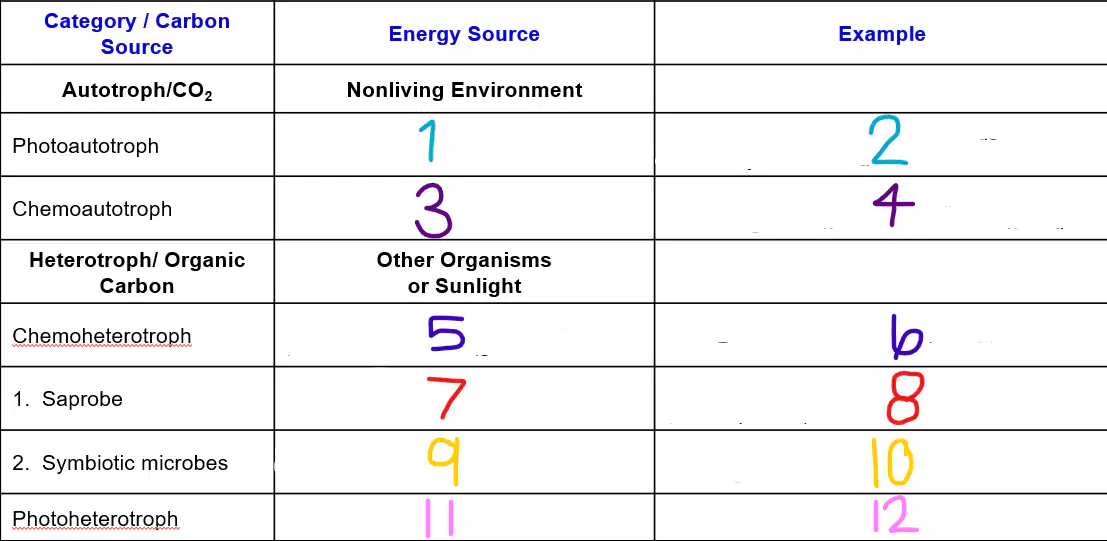
1
(a)
2
Photosynthetic organisms such as algae, plants, and cyanobacteria
Only certain bacteria and archaea, such as methanogens and deep-sea vent bacteria
4
Photosynthetic organisms such as algae, plants, and cyanobacteria
Only certain bacteria and archaea, such as methanogens and deep-sea vent bacteria
7
Obtain organic matter from living organisms
Metabolize the organic matter from dead organisms
9
Obtain organic matter from living organisms
Metabolize the organic matter from dead organisms
5
Metabolic conversion of the nutrients from other organisms
Sunlight or organic matter
6
Protozoa, Fungi, many bacteria, animals
fungi, bacteria, some protozoa (some decomposers)
Parasites, commensals, mutualistic microbes
Purple and green photosynthetic bacteria
8
Protozoa, Fungi, many bacteria, animals
fungi, bacteria, some protozoa (some decomposers)
Parasites, commensals, mutualistic microbes
Purple and green photosynthetic bacteria
10
Protozoa, Fungi, many bacteria, animals
fungi, bacteria, some protozoa (some decomposers)
Parasites, commensals, mutualistic microbes
Purple and green photosynthetic bacteria
12
Protozoa, Fungi, many bacteria, animals
fungi, bacteria, some protozoa (some decomposers)
Parasites, commensals, mutualistic microbes
Purple and green photosynthetic bacteria
11
Metabolic conversion of the nutrients from other organisms
Sunlight or organic matter
1
(a)
3
(a)
Photoautotrophs use two modes of photosynthesis:
Oxygenic photosynthesis
Anoxygenic photosynthesis
Aerobic photosynthesis
Anaerobic photosynthesis
•Produce oxygen and use chlorophyll as the primary pigment
(a)
•no oxygen but sulfur production, use bacteriochlorophyll as pigment
(a)

