
 Worksheets
Science Homework Assignment 10/15/2024
Total questions: 10
Worksheet time: 5mins
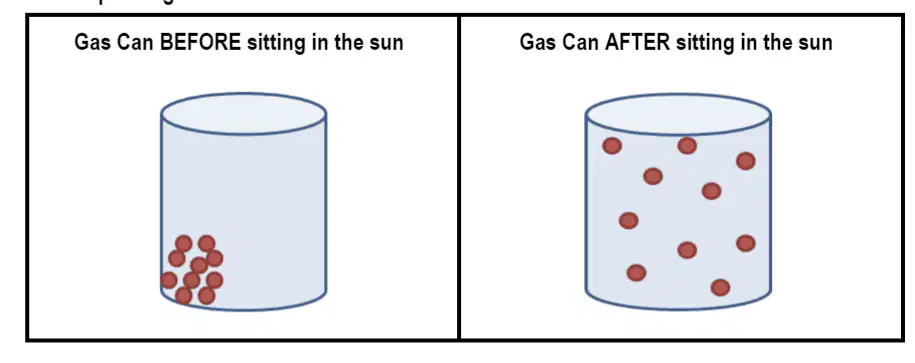
Read the information below to answer the question. Rafael’s dad filled a plastic gas can half full at the gas station. He left the closed gas can in the sunshine while he mowed the lawn. When it was time to fill the lawn mower, the sides of the gas can were pushing out. Which answer best explains why the gas can changed shape?
The sun’s heat causes the molecules to spread out, leading to the expansion of the can.
The gas molecules in the can began to create more molecules because it is not moving which caused the can to fill up and swell.
There is a conservation of molecules in every change of the state of matter.
Matter has weight and can have shape depending on the type of container.
Andrew claims that air is made up of many tiny particles that have mass but are too small to see. Which observations can be used as evidence to support his claim? Select the two statements that best support his claim.
leaves blowing on a windy day
rain falling from the clouds
blowing into a balloon to inflate it
temperature rising on a summer day
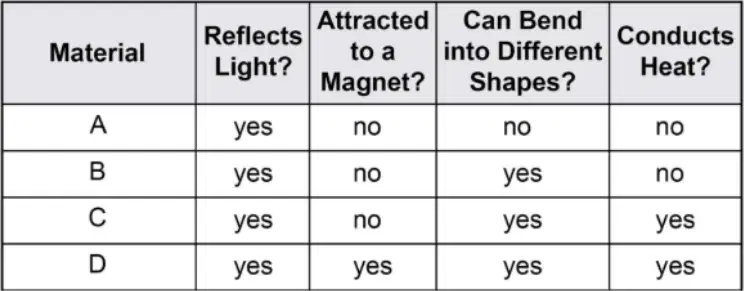
Use the information below to answer questions 3a and 3b. During a field trip to the Howard B. Owens Science Center a group of students conducted an investigation in which they observed several properties of four different materials. The students recorded their observations in the table. Select the material that is most likely a metal.
Material A
Material B
Material C
Material D
Since metals always _______________, this means that the material most likely to be a metal has this property. Since very few non-metal objects ____________________, an object that has this property is probably a metal. Select the answer choice that best represents the correct order to complete the statements above and support the answer to Part A.
Conduct heat; bend into different shapes
Bend into different shapes; are attracted to a magnet
Conduct heat; are attracted to a magnet
Conduct electricity; are shiny
Are attracted to a magnet; bend into different shapes
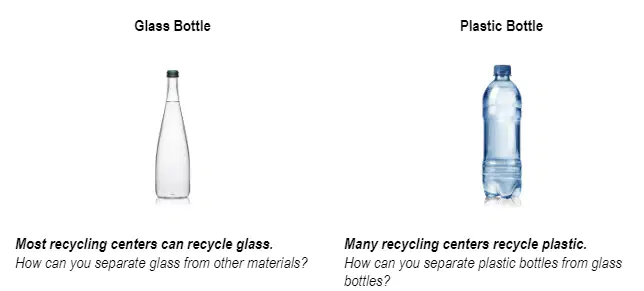
Stephen was tasked with identifying possible solutions for this problem. He remembered that under pressure, glass breaks easily, and plastic will squeeze into a smaller shape. He researched the melting temperatures of each and found that plastic melts at around 170°C, while glass melts at temperatures from 1400°C to 1600°C! He proposed five possible solutions for separating glass bottles from plastic ones. Select two of the following solutions that will work.
Run the bottles through a crushing (smashing) device.
Separate the bottles by weight.
Heat the bottles to 180°C.
Put the bottles in water to see which one will float.
Place the bottles in acid to see which one dissolves.
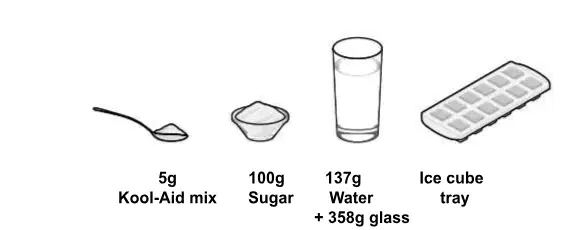
Ethan and Rachel measured each material before stirring them together. The students slowly stirred the Kool-Aid® mix and sugar into the glass of water. The Kool-Aid® mix and sugar both seemed to disappear. They thought the amount of matter changed when the Kool-Aid® mix and sugar disappeared. Ethan and Rachel decide to measure the mixture to find out if the amount of matter changed. Which statement best explains which tool should be used to show what happens to the amount of matter after the mixture is stirred?
They should use a scale that will show that the total weight stayed the same.
They should use a scale that will show that the total weight decreased.
They should use a measuring cup, which will show that the total volume stayed the same.
They should use a measuring cup, which will show that the total volume decreased.
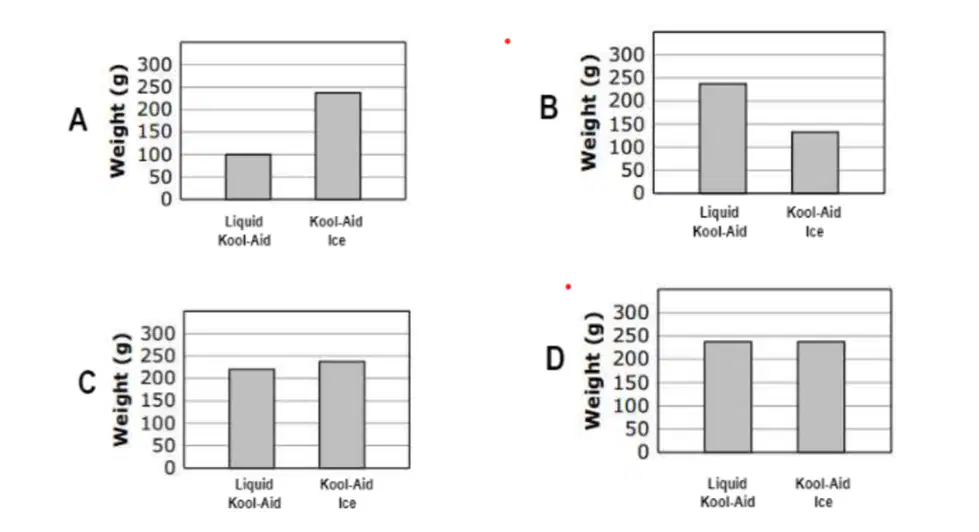
They removed the Kool-Aid® ice from the ice cube tray and measured the total weight of all the Kool-Aid® ice cubes and graphed their data. Which graph shows the total weight of the liquid Kool-Aid® before it was poured into the tray and the total weight of the lemon ice removed from the tray?
Graph A
Graph B
Graph C
Graph D
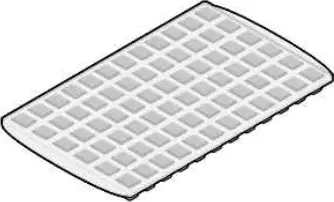
Ethan and Rachel got distracted by their friends playing outside and left the Kool-Aid® ice on the counter. When they returned the Kool-Aid® ice melted. They then poured all the liquid into a different ice cube tray. The drawing below shows this new tray.
Altogether, the new Kool-Aid® ice weighed less than the Kool-Aid® ice made the first time.
Each new Kool-Aid® ice cube had the same weight as each Kool-Aid® ice cube made the first time.
Each new Kool-Aid® ice cube contained more matter than each Kool-Aid® ice cube made the first time.
Altogether, the new Kool-Aid® ice contained the same amount of matter as the Kool-Aid® ice made the first time.
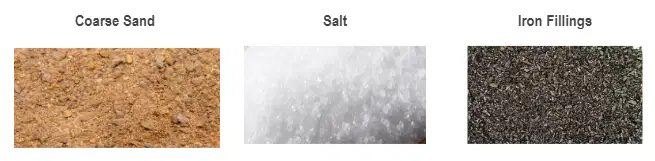
Sylena mixed together sand, salt, and iron filings in 150 mL of water. Which series of steps will most easily separate out each of the substances?
Heat the solution and filter out the sand and salt.
Filter out the sand and iron filings. Attract the iron with a magnet. Heat and evaporate off the water from the salt.
Attract the iron filings with a magnet. Filter out the salt. Evaporate the water from the coarse sand.
Filter out the salt and attract the iron filings with a magnet.
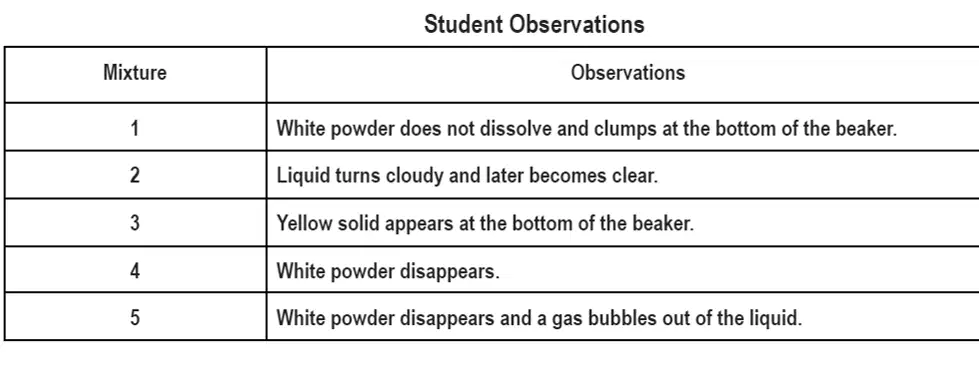
Read the information below to answer the question. A student poured five different clear, colorless liquids into five different beakers. Each beaker was half-filled with the liquid. The student added 1 gram of a white powder and stirred each mixture. The student’s observations are recorded in the data table. In which two mixtures was a new substance formed?
Mixture 1 and Mixture 2
Mixture 2 and Mixture 3
Mixture 3 and Mixture 5
Mixture 4 and Mixture 5

