
 Worksheets
7th Grade TCAP Review
Total questions: 100
Worksheet time: 2hrs 17mins
The name "Ming" means-
Mongol
Brightness
New China
Strong wall
The Ming Dynasty followed the collapse of the Mongol ___________ dynasty.
Yuan
Song
Tang
Han
The Forbidden City is located in the heart of China's capital-
Beijing
Nanjing
Tokyo
New Delhi
This was an educated person with a government position who came back into importance during the Ming Dynasty-
Mongol Ascendancy
tribute
Buddhism
scholar-official
Which statement is not true regarding the Forbidden City?
Located in the center of the Imperial City
Had beautiful gardens and palaces with 1000's of rooms
Only the Emperor and the court could live there
Any Chinese citizen could enter
Still exists today

The Ming emperors built what for themselves, families, members of the court, and government?
Forbidden City
a new capital city
new pleasure boats like the Sui
new weapons
Zheng He's voyages took him to
the Americas.
Europe.
Japan and Korea.
Southeast Asia, India, and East Africa.
The belief that it is best for a nation to protect its borders and stay away from other countries is-
nationalism
Confucianism
isolationism
capitalism

Zheng He and the treasure ships carried-
horses and wheat
slaves
soldiers and prisoners
silk and porcelain
The Ming Dynasty was responsible for completing what major constructional landmark?
Silk Road
The Great Wall of China
Grand Canal
The Great Wall of Tacos
Use of the Silk Road resulted in cultural diffusion by spreading _______________.
knowledge and ideas
books and letters
disease
rules and laws
What is a caravan?
A type of vehicle
A single traveler
A group of people that travel together
A place to stay during travel
What does the term "Dynasty" refer to?
A type of ancient sculpture
A series of rulers from the same family
A traditional dance form
A historical document
Why was Constantinople such a prosperous city?
located at the crossroads of trade
Great architecture
Strong autocratic rulers
The pope lives there
The Greek Roots of the Byzantine empire are reflected in it's
Language - Greek
Art - Mosaics
Engineering - Hagia Sophia
Economy - Trade


What emperor had the law code re-written and organized?
Charlemagne
Justinian
Theodora
Constantine
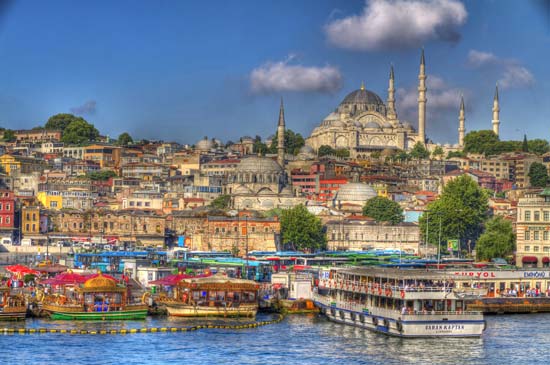
Why was Justinian's Code of laws important?
It established all rules regarding taxation.
It established codes regarding the Eastern Orthodox Church.
It formed the basis of European Law.
It established what entertainment acts were at Hippodrome.
What is the title of the head of the Roman Catholic Church?
King
Pope
Tsar
Emperor

Who was Theodora?
Constantine's wife
Justinian's niece
Constantine's sister
Justinian's wife
Theodora's influence on Justinian resulted in:
Limiting the people's freedoms
Increasing the number of gladatorial games
The creation of laws that protected women and children
The creation of laws that banned most religions
What is the name of a landmass that is surrounded on 3 sides by water?
Delta
Peninsula
Harbor
Plateau
What is the Hagia Sophia?
A marketplace
A temple to Zeus
A Church
A grainhouse
What religion did Constantine promote in the Empire?
Christianity
Islam
Zoroastrianism
Polytheism
What did Justinian do after modernizing the military?
Reclaimed conquered lands
Disbanded the military
Invaded Asia
Formed an aliiance with Egypt
What led Justinian to revise the legal system of the Empire?
There was no legal system
The legal system was a mess
The legal system was already perfect
Justinian disliked law
Who is considered one of the best emperors of the Byzantine Empire because of his accomplishments in law and military?
Constantine
Justin I
Constantius I
Justinian
Where did Islam originate?
Arabian peninsula
North Africa
China
India
The followers of Islam are calld
Christians
Muslims
Hindus
None of the above
Muslims pray _________ times a day.
3
7
1
5
According to the Islamic religion, Muslims believe _________ was the prophet.
Yathrib
Medina
Muhammad
none of the above
The sacred text is called the
Mosque
Quran
Torah
Sheikh
The Arabic word for "God" is..
God
Buddah
Allah
Muhammad
A ____________________ is a building where Muslims worship.
Mosque
Synagogue
Ramadan
Arabia
Where did Muhammad and his followers leave to when they were forced out of Mecca?
Medinah
Afghanistan
Mecca
Jerusalem
What is the holy text of Islam that is written in Arabic?
Qur'an (Koran)
Bible
Torah
Vedas
-Faith
-Prayer
-Charity
-Fasting
-Pilgrimage
What is being described?
Eightfold Path
Five Pillars of Islam
Four Nobel Truths
Ten Commandments
Who do Muslims considered to be the Messenger of Allah?
Jesus
King David
Abraham
Muhammad
Which river is not in Africa?
Niger
Nile
Tigris
Congo
Most people in Africa are ______ or _______.
Christian
Jewish
Muslim
Buddhist
Which of these is NOT found in Africa?
Tundra
Moutains
Lakes
Savannas
The (a) desert is the largest hot desert in the world.
This is the semi-arid desert and dry grassland between the Sahara desert and the southern rainforest terrain:
Rocklands
The Sahel
Great Plains
What was the Niger river used for?
Trade and transportation
Competitive swimming
Fishing only

What ocean is WEST of Africa?
Atlantic Ocean
Arctic Ocean
Indian Ocean
Pacific Ocean
What ocean is EAST of Africa?
Atlantic Ocean
Arctic Ocean
Indian Ocean
Pacific Ocean

What enormous desert stretches across much of north Africa?
Kalahari Desert
Sahara

What is the red line going across the Earth?
Prime Meridian
Pacific Ocean
Borderline
Equator

What is Human Geography?
It is the study of people and how they
interact with planet earth.
It is the study of natural and physical characteristics of our planet.

What is physical geography?
It is the study of natural and physical characteristics of our planet.
It is the study of people and how they
interact with the Earth.

A ______________ shows directions on a map
continent
meridian
compass
scale

What is the name of the geographic feature numbered 3?
Africa
Europe
Asia
Australia

What is the name of the geographic Feature numbered 5?
Asia
Antarctica
Indian Ocean
Africa
Which of the following is NOT one of the four oceans?
Atlantic Ocean
Pacific Ocean
African Ocean
Arctic Ocean
The smallest continent in the world is _________.
Rhode Island
South America
Antarctica
Australia
Spirit or god who represents a force of nature in traditional Japanese religion
Daimyo
Kami
Shinto
Bushido
Local landowning lord in feudal Japan
Shogun
Figurehead
Daimyo
Samurai
Traditional religion of Japan; "way of the gods"
Bushido
Shinto
Kami
Archipelago
Powerful Japanese military leader who often had more power than the emperor
Shogun
Figurehead
Samurai
Daimyo
A strict code of conduct that guides samurai behavior; "way of the warrior"
Shinto
Samurai
Kami
Bushido
Group of Islands
Peninsula
Kami
Archipelago
Ring of Fire
Highly trained warrior in feudal Japan
Samurai
Daimyo
Shogun
Knight
"Ruler" of Japan, top of the social structure
Daimyo
Shogun
Emperor
Samurai
Lowest class: farmers of the lord's land
Daimyo
Peasant
Samurai
Shogun
Lowest class; traders, make money off the work of others
Peasants
Craftsmen
Artisans
Merchants
Lowest class; craftsmen: like blacksmiths or carpenters
Artisans
Samurai
Peasants
Merchants
Which of the following best describes the Shoguns?
Business executives
Powerful military leaders
The navigators on ocean liners
All of the above
Who was Lady Murasaki Shikibu?
She wrote The Tale of Genji
Tom Sayer
Starbucks Owner
A lady who owned Wal-Mart


a written plan of government with a set of rules that leaders agree to follow
embassy
constitution
regent
novel

Why have Japanese farmers built terraces?
to grow crops on hilly surfaces
to escape the summer heat
to grow crops in areas with salt water


archipelago
a narrow piece of land linking two larger pieces of land
chain of islands; an expanse of water with many scattered islands
an area of high, mostly flat land

