wayground logo

Free Printable Worksheets

NEW

Font size

S
M
L
XL
Worksheets

ESS 2 - Lesson 4 review

Total questions: 48

Worksheet time: 2hrs 26mins

Name
Class
Date
1.

Earth's crust is broken into blocks called _______?

a)

Plates

b)

Earthquakes

c)

Faults

d)

Richter scale

2.

Plates float on top of a layer of the Earth called _________?

a)

Inner Core

b)

Mantel

c)

Outer Core

d)

Space

3.

A sudden release of energy within the Earth's crust causes _______?

a)

Earth

b)

Asteroid

c)

Floods

d)

Earthquake

4.

Deep with in the crust there is a place where the energy is released which is called the _____ ?

a)

Epicenter

b)

Focus

c)

Richter Scale

d)

Faults

5.

On the Earth's surface we call this spot the _________ of the earthquake?

a)

Epicenter

b)

Fault

c)

Focus

d)

Plates

6.

There are breaks or giant cracks in the Earth's crust called ________?

a)

Plates

b)

Earthquake

c)

Epicenter

d)

Faults

7.
The area around the Pacific Ocean where lots of earthquakes and volcanoes happen is called the ____________.
a)
Ring of Earth
b)
Ring of Fire
c)
Ring of Stone
d)
Ring of Diamond
8.
Earthquakes under the water can cause _________________________________.
a)
tornadoes
b)
tsunamis
c)
lightening
d)
hailstorms
9.
What is the outermost layer of the Earth called?
a)
Core
b)
Mantle
c)
Crust
10.
What are the puzzle pieces of the Earth's surface called?
a)
Tectonic plates
b)
Puzzles
c)
Earthquakes
11.
What occurs when two plates move, bump or slide past each other?
a)
An Earthquake
b)
Nothing
c)
Movement
12.
What are the two types of earthquake waves?
a)
P and S waves
b)
Surface and Underground waves
c)
Fast and Slow waves
13.
The place where the earthquake is felt on the Earth's surface is called...
a)
Epicenter
b)
Hypocenter (focus)
c)
Surface
d)
Crust
14.
What are the three types of plate boundaries?
a)
Transform, Convergent, Divergent
b)
Apart, Together, Slide
c)
Slide, Pull away, Push together
15.

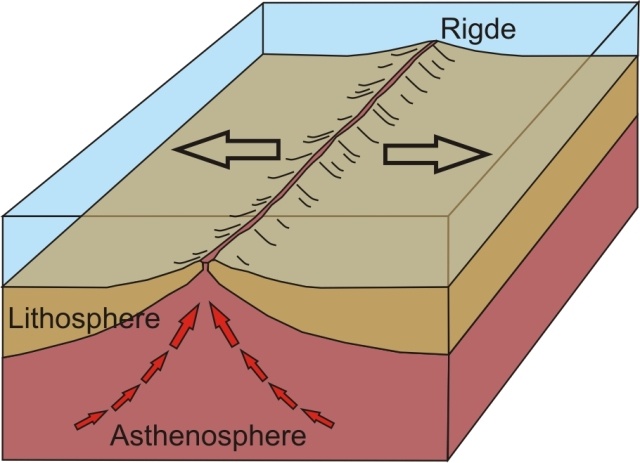
What type of boundary is shown in the diagram?

a)

Divergent

b)

Convergent

c)

Transform

d)

Prodigent

16.

What type of boundary is shown in the diagram?

a)

Divergent

b)

Convergent

c)

Transform

17.

What type of boundary is shown in the diagram?

a)

Divergent

b)

Convergent

c)

Transform

18.
At what plate boundary will a strike slip fault be found?
a)
divergent
b)
transform
c)
convergent
d)
all of them
19.

What type of boundary is pictured ?

a)
normal 
b)
reverse
c)
strike slip
d)
fold
20.
Many earthquakes happen along the borders of...
a)
Countries
b)
Tectonic Plates
c)
Climate Zones
d)
None of the above.
21.

Forces that changes rock shape or volume is called

a)

tension

b)

compression

c)

stress

22.

________________ pulls on crust which results in a normal fault.

a)

tension

b)

compressions

c)

stress

23.

According to Wegener's hypothesis of continental drift, _____________________.

a)

Earth's surface is made up of seven major landmasses

b)

the continents do not move

c)

Earth is slowly cooling and shrinking

d)

the continents were once joined together in a single landmass

24.

A place where two plates slip past each other, moving in opposite directions, is known as a ___________________.

a)

transform boundary

b)

divergent boundary

c)

convergent boundary

d)

rift valley

25.

A collision between two pieces of continental crust at a converging boundary produces a

a)

mid-ocean ridge

b)

deep-ocean trench

c)

rift valley

d)

mountain range

26.

Which type of stress squeezes rock until if bends or breaks?

a)

tension

b)

shearing

c)

strike-slip

d)

compression

27.

Which layer has the highest temperature?

a)

Crust

b)

Mantle

c)

Outer Core

d)

Inner Core

28.

What is the difference between the inner core and the outer core?

a)

The inner core is solid and the outer core is liquid

b)

The inner core is liquid and the outer core is solid

c)

The inner core is rock and the outer core is metal

d)

The inner core is metal and the outer core is rock

29.

Which layer has the LEAST pressure?

a)

Crust

b)

Mantle

c)

Outer Core

d)

Inner Core

30.

The crust and upper mantle are called...

a)

the continental crust

b)

the oceanic crust

c)

lithosphere

d)

the core

31.

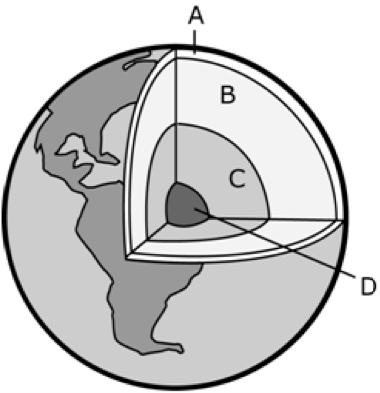
Which letter in the diagram identifies the layer of Earth made up of solid nickel and iron?

a)

layer A

b)

layer B

c)

layer C

d)

layer D

32.

What is the thinnest layer?

a)

Mantle

b)

Crust

c)

Outer Core

d)

Inner Core

33.

What is the hottest layer?

a)

Crust

b)

Outer Core

c)

Inner Core

d)

Mantle

34.

The lithosphere is ______ and the asthenosphere is _______.

a)

both brittle

b)

brittle, plastic/flexible

c)

plastic/flexible, brittle

d)

both plastic/flexible

35.
What happens to pressure as we move from the crust down into the inner core?
a)
Pressure Decreases
b)
Pressure Increases
c)
Nothing
36.

Which crust is thicker

a)

oceanic

b)

continental

c)

bread

d)

pizza

37.

The lithosphere combines what two layers?

a)

Athenosphere & Crust

b)

Crust & Upper Mantle

c)

Mantel & Asthenosphere

38.
Which layer of Earth has the GREATEST density?
a)
crust
b)
mantle
c)
outer core
d)
inner core
39.

This zone divides the upper and lower mantle and is a layer of soft and weak rock

a)

Crust

b)

Middle mantle

c)

Lithosphere

d)

Asthenosphere

40.
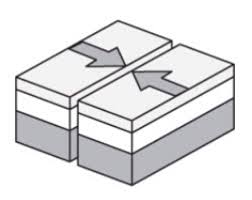
What kind of plate boundary is shown here?
a)
divergent
b)
convergent
c)
transform
d)
subducting
41.
What kind of plate boundary is shown here?
a)
divergent
b)
convergent
c)
transform
d)
strike slip
42.
What geologic feature/event you be most likely to find at a transform boundary?
a)
Earthquakes
b)
Volcanoes
c)
Mountains
d)
Rift Valleys
43.
What geologic feature/event would you most likely to find at a divergent boundary between two pieces of oceanic crust?
a)
Rift Valley
b)
Mid-Ocean Ridge
c)
Island Arc
d)
Flat land
44.
What geologic feature/event would you most likely to find at a divergent boundary between two pieces of continental crust?
a)
Mid-Ocean Ridge
b)
Mountain
c)
Rift Valley
d)
Island Arc
45.
What geologic feature/event would you most likely to find at a convergent boundary between two pieces of continental crust?
a)
Volcano
b)
Mountain
c)
Rift
d)
Island Arc
46.
A subduction zone is formed...
a)
when one tectonic plate sinks below another
b)
at every type of convergent plate boundary
c)
at every type of divergent plate boundary
d)
at transform boundaries
47.
Name the boundary
a)
convergent boundary
b)
divergent boundary
c)
transform boundary
d)
sergent boundary
48.
Plates move towards one another at ______________ boundaries.
a)
divergent
b)
convergent
c)
transform
d)
detergent