
 Worksheets
GU1-6A 2024-2025 Review (Poly, Proofs, Cong, Sim, RightTri, Cir)
Total questions: 500
Worksheet time: 88hrs 2mins

[GU1-6A 2024-2025 Review (U1 Poly 11-19 | U2 Parallel Line Proofs 20-62 | U3 Congruence 1-10 and 63-82 | U4 Investigating Similarity 83-104 Dilations ... 105-150 Ratios, Proportions, Similar Figures, Similarity Theorems ... 151-177 Triangle Proportionality, Similarity Proofs ... 178 - 220 U4 Investigating Similarity Test Review U4TR | U5 Right Triangle Trigonometry ... 221-240 Intro to Trig Ratios & Missing Sides ... 241-260 Finding Missing Sides and Angles with Trig Ratios 261-270 Complementary Angles ... 271-310 U5 Right Triangle Trigonometry Quest Review U5TR | U6 Circles 311-339 Circle Language ... 340-359 Central and Inscribed Angles ... 360 - 379 Angles Inside and Outside Circle ... 380-399 Triangles and Quadrilaterals Inscribed in Circles + Tangents ... 400-419 Arc Length and Sector Area ... 420-439 Equation of A Circle ... 440-500 U6A Circles Test Review U6ATR]
[BEGIN U3: Exploring Congruence (Transformations)]
What is the rule for the following reflection?
Reflection across
y = −1
Reflection across
y = 1
Reflection across
x = −1
Reflection across
x = 1
Triangle EFG has vertices E(3,2), F(2,5), and G(-1,2). If it is translated by <-1,-4>, then E' is ...
(-4,-6)
(2,2)
(-2,2)
(2,-2)

Triangle ABC will be translated 3 units right and 6 units up. What will be the coordinates of the image of point A?
A'(-4,7)
A'(-4,-7)
A'(4,7)
A'(4,-7)

What is the angle of the clockwise rotation?
90°
180°
270°
0°

Identify the transformation from ABC to A'B'C'.
90o clockwise rotation
90o counter-clockwise rotation
Reflection across the x-axis
Translation (x, y-2)

Identify the transformation from ABC to A'B'C'.
T(x+8, y+4)
T(x-8, y-4)
T(x+4, y+8)
T(x-4, y-8)

Describe the sequence of transformations shown (from A to A' to A").
Reflect across the x-axis, then rotate 90 degrees clockwise around the origin
Rotate 90 degrees clockwise around the origin, then reflect across the line y = x.
Reflect across the x-axis, then reflect across the y-axis.
Translate up 8 units, then rotate 90 degrees counterclockwise about the origin.

Describe the sequence of transformations that map ABC to A'B'C' to A"B"C".
translate 5 units up and 1 left, then reflect over the y-axis
translate 5 units down and 1 unit left, then reflect over the y-axis
reflect over the line y = x, then translate left 8 units
reflect over the x-axis, then rotate 90 degrees clockwise

Choose the sequence of transformations that map ABC to A'B'C' to A''B''C''.
Translate right 1 unit, down 4 units, and then reflect over the y-axis
Translate right 6 units, and then reflect over the x-axis
Reflect over the line y = x, and then translate up 4 units, then right 2 units
Reflect over the y-axis, then left 1 unit and up 1 unit

[END U3: Exploring Congruence (Transformations)] Which best describes the sequence of transformations from ABC to A'B'C' to A''B''C''?
Rotate triangle ABC 90° clockwise, then reflect across the y-axis
Reflect triangle ABC over the y-axis, then rotate 90° clockwise about the origin
Reflect triangle ABC over y-axis, then rotate 90° counterclockwise about the origin
Rotate triangle ABC 90° counter-clockwise, then reflect across the y-axis
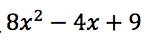
[BEGIN U1: Exploring Polynomial Expressions Through Geometry] Classify the following polynomial
quartic polynomial
quadratic polynomial
quartic trinomial
quadratic trinomial
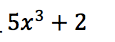
(4a3 - 8a - 4a2) + (7a3 - 7 - 6a)
(r + 7)(r − 7)
(3x – 1)(x + 5)

Find the area of the given rectangle.
42x3+28x2
42x2+28x
42x3+4x2
13x3+11x2

Find the area of the given rectangle.
18x2−48x+6
18x3−48x+6x
18x3−48x2+6x
9x3−14x2+7x

[END U1: Exploring Polynomial Expressions Through Geometry] The following image is a square. Find the PERIMETER AND AREA of the polygon.
PERIMETER: 16x3 AREA: 16x6
PERIMETER: 16x6 AREA: 16x3
PERIMETER: 8x3 AREA: 8x6
PERIMETER: 8x6 AREA: 8x3

[BEGIN U2: Geometric Foundations, Constructions, and Proofs] Name that figure!
Point
Line
Line segment
Ray

Name that figure!
Point
Line
Line segment
Ray

Name that figure!
Point
Line
Line segment
Ray

Name that figure!
Point
Line
Line segment
Ray

What does this symbol mean?
less than
greater than
congruent
similar

In angle ABC, B is the...
rays
plane
compass
vertex
In angle ABC, BA and BC are...
rays
plane
compass
vertex

Line m and Line l are...
parallel
perpendicular
plane
paired

What is the relationship of the angle pair?
Acute
Supplementary
Vertical
Complementary

What is the relationship of the angle pair?
Acute
Supplementary
Vertical
Complementary

What is the relationship of the angle pair?
Linear
Supplementary
Vertical
Complementary

Name that figure!
acute angle
right angle
obtuse angle
straight angle

Name that figure!
acute angle
right angle
obtuse angle
straight angle

Name that figure!
acute angle
right angle
obtuse angle
straight angle

Given the diagram, which is correct?
BC+CD=BD
BD+BC=CD
CD+BC=BD
BC+BD=CD
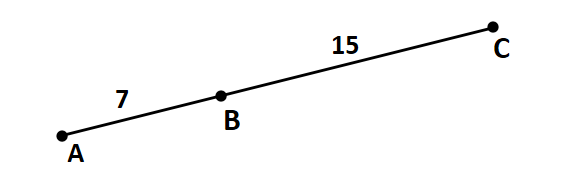

If HJ=7x-27, find the value of x.
4
5
6
7


37
143
143
37


49
131
49
131

110
110
70
70


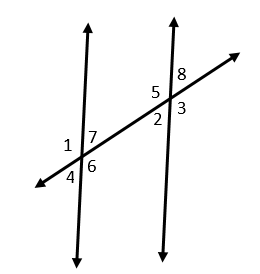
1) Given the two parallel lines cut by a transversal.
What is the vertical angle to angle 4?
Angle 2
Angle 6
Angle 8
Angle 7
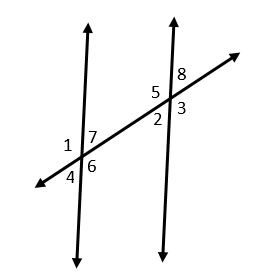
3) Given the following two parallel lines cut by a transversal.
Which pair of angles represents alternate interior angles?
∠3 and ∠8
∠7 and ∠2
∠7 and ∠8
∠4 and ∠8
2) Given the following two parallel lines cut by a transversal.
Which pair of angles represents corresponding angles?
∠1 and ∠6
∠6 and ∠5
∠7 and ∠8
∠4 and ∠8

7) Given the following two parallel lines that have been cut by a transversal.
True or False, ∠6 and ∠4 are vertical angles?
False
8) Given the following two parallel lines that have been cut by a transversal.
∠1 and which angle make up Alternate Interior angles?
∠6
∠5
∠3

9) Given the following two parallel lines that have been cut by a transversal.
Choose all the options that represent corresponding angles.
∠3 and ∠8
∠2 and ∠7
∠6 and ∠4
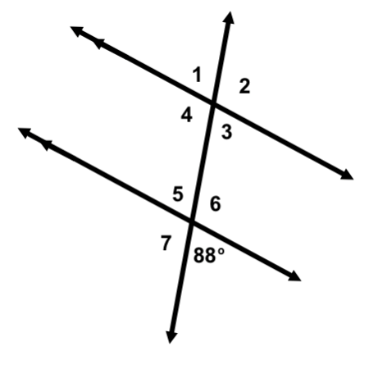
10)Given the two parallel lines cute by a transversal,
What is the measure of ∠5 ?
(a)

Solve for x
49
58
70
94

Solve for x
65
74
37
64

Solve for x
70
23
120
130

[END U2: Geometric Foundations, Constructions, and Proofs] Solve for x
105
78
110
25
[RESUME U3: Exploring Congruence (SEE Q1-Q10)] What does SAS stand for?
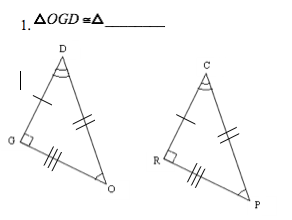
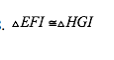
<F = ___

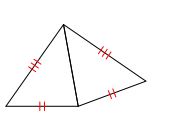
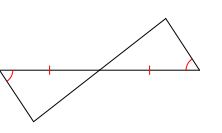
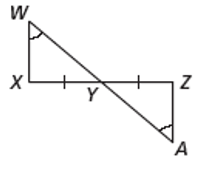

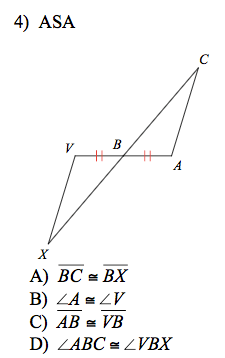
Which of the following are NOT sufficient to prove two triangles are congruent? Choose all that apply.
SSS
AAA
ASA
SSA
AAS
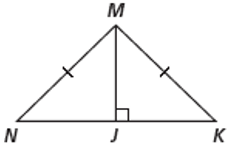
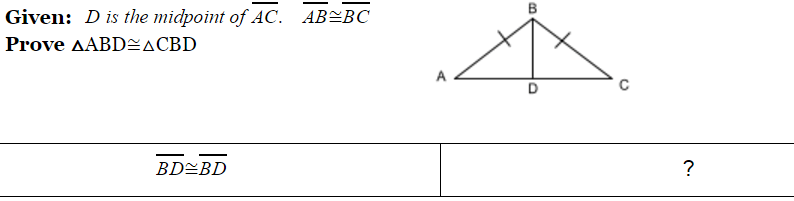
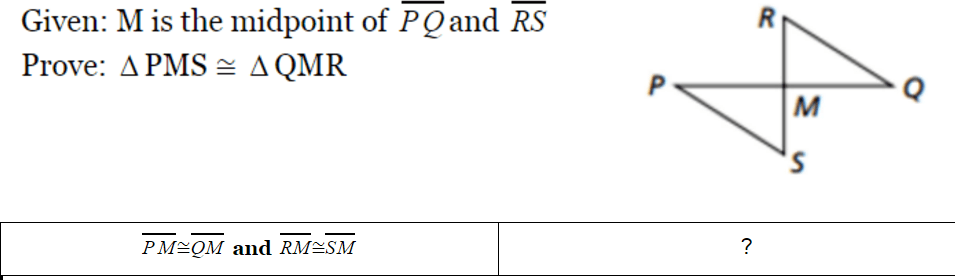
Identify the missing statement or reason
Reflexive Property
Definition of Midpoint
Given
Vertical Angles Theorem

A
B
C
D

Which statement is true for
ΔABC≅ΔDEF∠A≅∠B
∠A≅∠F
∠A≅∠D
∠A≅∠E
[END U3: Exploring Congruence (SEE Q1-Q10)] Which statement is true for
ΔABC≅ΔDEF
BC≅DE
BC≅EF
BC≅DF
[BEGIN U4: Investigating Similarity] An object before transformation is called the _______.
image
pre-image
post-image
answer
An object after transformation is called the _______.
image
pre-image
post-image
answer
A transformation that does not change object side lengths is _______.
rigid
solid
excellent
efficient
The shrinking or enlargement of an object is called a _______.
SuperSize Me
"Mario Mushroom"
dilation
reflection
A dilation's _________ indicates how much the figure will enlarge or shrink.
player rating
square root
scale factor
translator
Dilate the figure by a scale factor of 3 (with the origin as the center of dilation). What are the coordinates of the image?
A(3,3) B(6,6) C(9,3)

Choose the correct scale factor (from NDMP to N'D'M'P'):
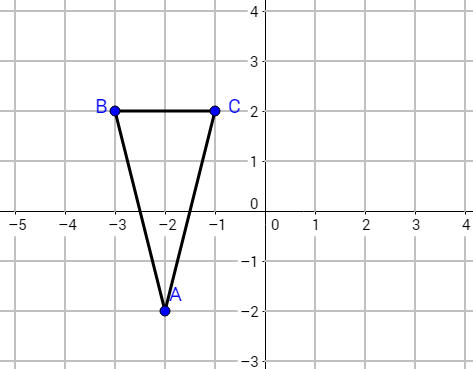
Dilate point B by a scale factor of 1/2
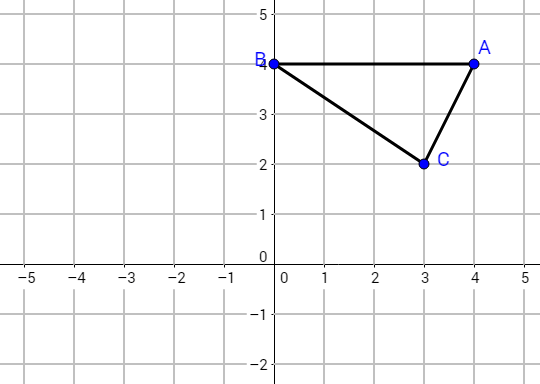
Dilate point B by a scale factor of 3:
Which of the following are dilations?


Dilate point C by a scale factor of 1/2.
(-1, -2.5)
(12, 6)
(3, -1.5)
(0, 1.5)
Dilate point C by a scale factor of 4.
(1.5, -0.75)
(0, 12)
(-8, -20)
(24, -12)
Dilate point B by a scale factor of 1/3.
(0, 1)
(-1, 0)
(2, -1)
(0, 9)

Find the scale factor for the dilation (from EFGHI to E'F'G'H'I').
3
1/3
1/2
2
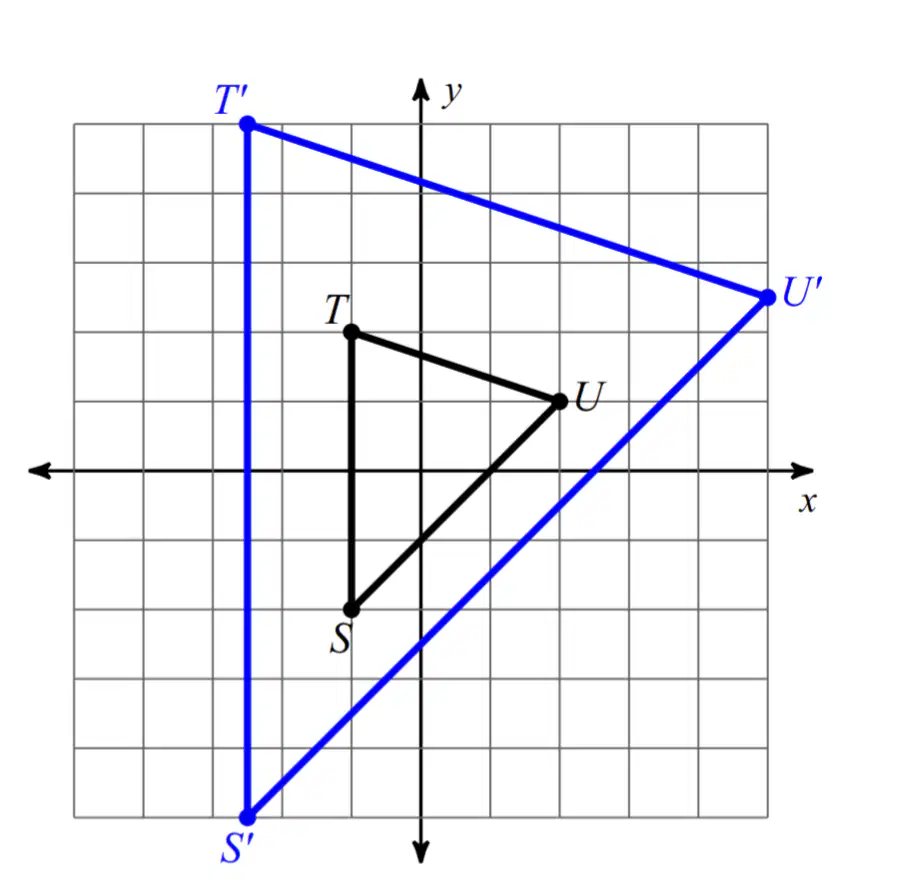
What is the scale factor of this dilation?
3
2
5
2.5

Find the scale factor for the dilation (from UDAJ to U'D'A'J').
2.5
1.5
3.5
4
The point A (8, 12) was dilated to become point A' (2, 3). What was the scale factor?
½
¼
4
2
[END U4L1 (Dilations)] The point B (2, 1) was dilated to become point B' (6, 3). What was the scale factor?
1/3
2
3
1/2
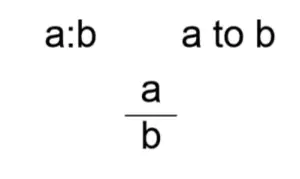
[BEGIN U4L3 (Similar Figures + Similarity Transformations)] A comparison of related quantities (like a:b or "a to b" or 1/2) is called a _______.
mystery
ratio
pre-image
IDK
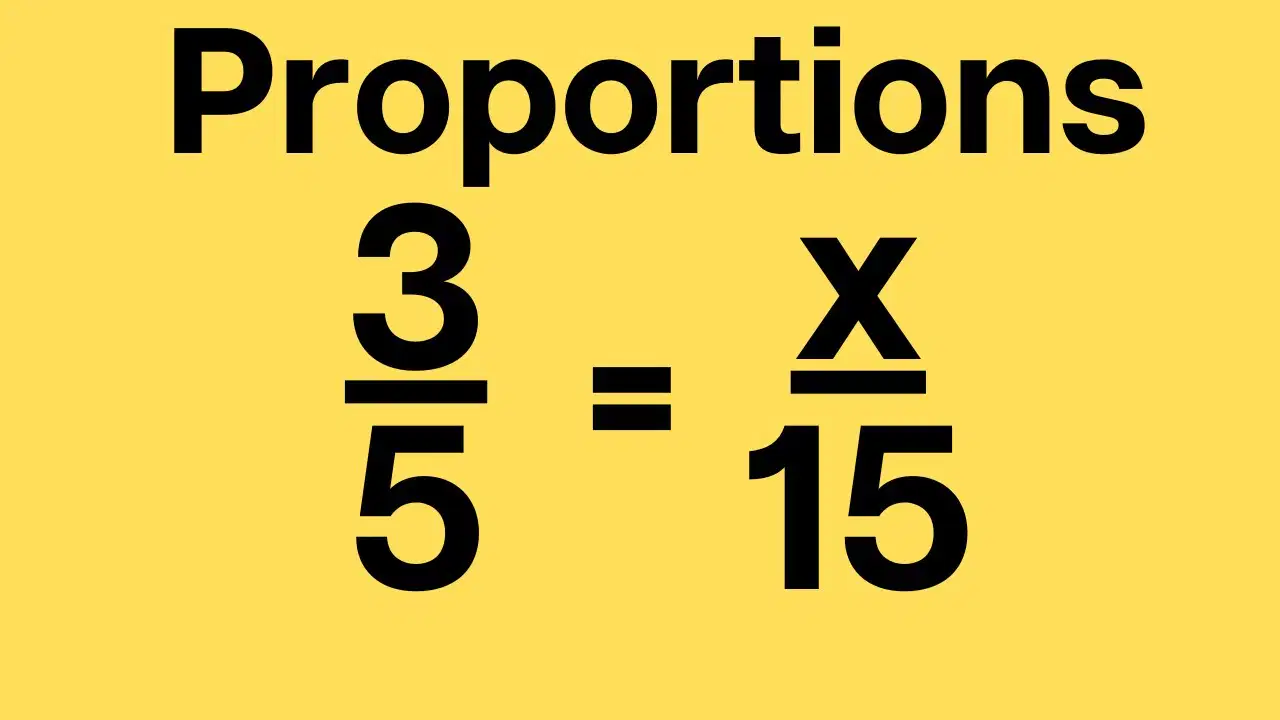
A proportion is an ___________ that compares two ratios.
equation
congruence statement
proof
definition
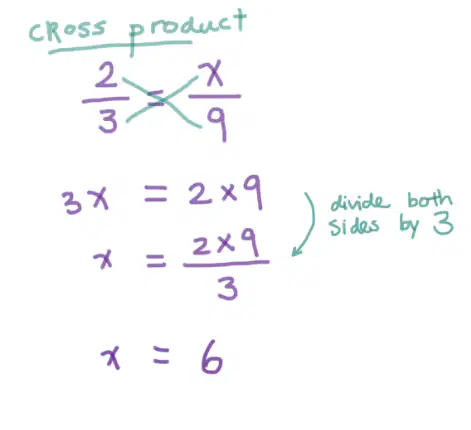
We solve proportions by using the ____________.
cross-product property
property of equality ("whatever I do to one side of the equation, I must do to the other side of the equation")
Pythagorean Theorem
triangle congruence theorem
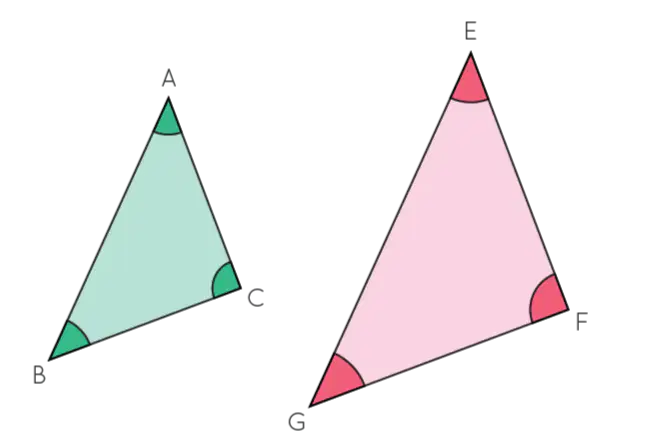
Polygons that have congruent corresponding angles and proportional corresponding sides are _______.
similar
congruent
the same
equal


What is the ratio of triangles to squares?
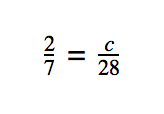


If the Rangers won 100 games and lost 60, what is the simplified ratio of wins to losses?


The triangles are similar. Solve for the question mark.
Two objects that are the same shape but not the same size are _______.
Congruent
Vertical
Similar
Complementary

Determine if the triangles are similar. If they are, identify the triangle similarity theorem(s) that prove(s) the similarity.
AA ~ Theorem
SAS ~ Theorem
SSS ~ Theorem
Not similar

Determine if the triangles are similar. If they are, identify the triangle similarity theorem(s) that prove(s) the similarity.
AA ~ Theorem
SAS ~ Theorem
SSS ~ Theorem
Not similar

Determine if the triangles are similar. If they are, identify the triangle similarity theorem(s) that prove(s) the similarity.
AA ~ Theorem
SAS ~ Theorem
SSS ~ Theorem
Not similar
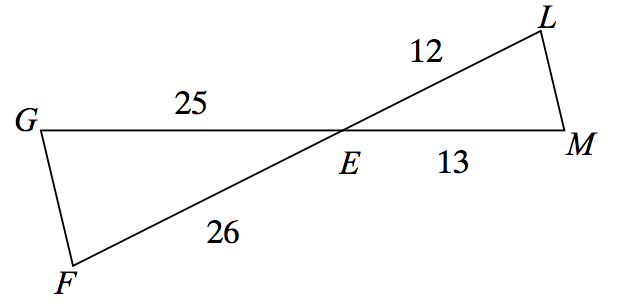
State if the triangles in each pair are similar. If so, state how you know they are similar.
Yes, AA Similarity
Yes, SSS Similarity
Yes, SAS Similarity
Not Similar
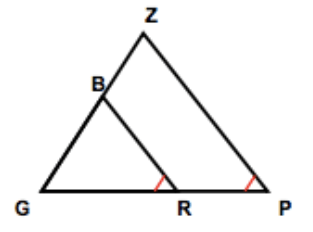
Are these two triangles similar? Which similarity criterion do you use to prove it?
Yes, AA
Yes, SAS
Yes, SSS
Not Similar
Which is not a similar triangle theorem?
ASA∼
SAS∼
SSS∼
AA∼
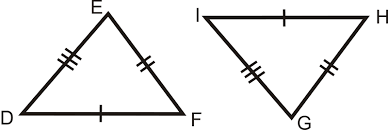


Complete the similarity statement: △ACB ~ _______
△HFG
△HGF
△FHG
△FGH


Are the triangles similar? If so, how?
Similar by AA
Similar by SAS
Similar by SSS
Not similar
Give the reason for similarity
AA
SAS
SSS
Not similar


If the triangles are similar, state why.
AA
SAS
SSS
Not similar
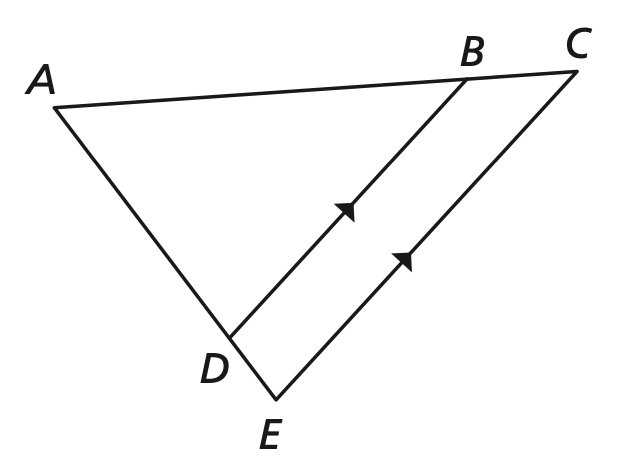
[END U3L3: Similar Figures + Similarity Theorems] Complete the similarity statement: △ADB ~ _______
△ACE
△AEC
△EAC
△ECA
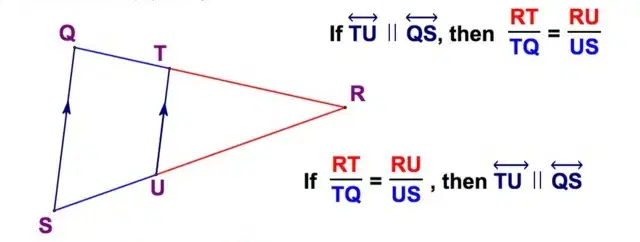
[BEGIN U4L4: Triangle Proportionality, Similarity Proofs] The TRIANGLE PROPORTIONALITY THEOREM says ___________ (check all that apply).
All triangles have 3 angles.
If a line segment divides two sides of a triangle proportionally, then it is parallel to the third side.
If a line segment is parallel to one side of a triangle and intersects the other sides, then it divides those intersected sides proportionally.
All triangles have 3 angles whose sum is 180 degrees.

PROPORTIONAL PARTS AND PARALLEL LINES: If 3 or more parallel lines are intersected by two ________, then the parallel lines divide the ________ proportionally.
perpendicular bisectors
angles
midpoints
transversals
ΔSQR∼ΔSPT. Which choice below lists two corresponding sides?
SP and SR
QS and PT
PS and RS
TP and RQ

AB / BM = ? / CD

Which proportion could be used to prove that HJ∥KL ?
HJKL=LGKG
KGKH=LJLG
JLHK=GKLG
HKGK=LJGL


Select the proportion that shows the Triangle Proportionality Theorem.
276=x7
216=x7
67=27x

What is the height of the flag pole?
Show your work.
205
105
230
135


If the triangles are similar, state how.
SSS
SAS
AA
Not similar.

Determine whether the triangles are similar by AA~, SSS~, SAS~, or not similar.
AA
SSS
SAS
no similar

(Hint: Look for non-labeled parts!)


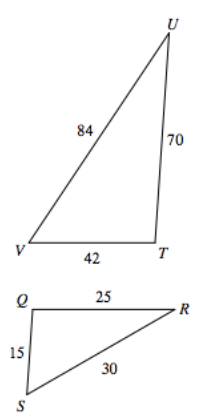
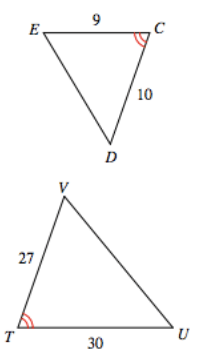
(Hint: Look for non-labeled parts!)


(Hint: Look for non-labeled parts!)


[END U4L4: Triangle Proportionality, Similarity Proofs] Give the reason for similarity.
[BEGIN U4 Investigating Similarity Test Review U4TR][LANGUAGE] What word was used a lot in this unit?
[LANGUAGE] Which of the following is NOT a rigid transformation?
dilation
translation
rotation
reflection
[LANGUAGE] Which statement describes a dilation?
ALWAYS makes a figure larger
preserves side lengths and angles
changes angles and side lengths
preserves angles, but changes side lengths
[LANGUAGE] What statement(s) best describe the difference between similar and congruent?
They are the same!
Similar means "alike in some ways", and congruent means "exactly the same"
Similar is harder to pronounce, and congruent is harder to spell
The similar operator is ~ ... the congruent operator is ≅
[LANGUAGE] A dilation's scale factor is used to perform what arithmetic operation?
addition
multiplication
subtraction
square roots
[LANGUAGE] A (a) is an explanation of why something is true.
[BEGIN U4: Investigating Similarity] An object before transformation is called the _______.
image
pre-image
post-image
answer
An object after transformation is called the _______.
image
pre-image
post-image
answer
Dilate point B by a scale factor of 1/2
Dilate point B by a scale factor of 3:
Which of the following are dilations?
[END U4L1 (Dilations)] The point B (2, 1) was dilated to become point B' (6, 3). What was the scale factor?
1/3
2
3
1/2
[BEGIN U4L3 (Similar Figures + Similarity Transformations)] A comparison of related quantities (like a:b or "a to b" or 1/2) is called a _______.
mystery
ratio
pre-image
IDK
A proportion is an ___________ that compares two ratios.
equation
congruence statement
proof
definition
We solve proportions by using the ____________.
cross-product property
property of equality ("whatever I do to one side of the equation, I must do to the other side of the equation")
Pythagorean Theorem
triangle congruence theorem
Polygons that have congruent corresponding angles and proportional corresponding sides are _______.
similar
congruent
the same
equal
The triangles are similar. Solve for the question mark.
Determine if the triangles are similar. If they are, identify the triangle similarity theorem(s) that prove(s) the similarity.
AA ~ Theorem
SAS ~ Theorem
SSS ~ Theorem
Not similar
State if the triangles in each pair are similar. If so, state how you know they are similar.
Yes, AA Similarity
Yes, SSS Similarity
Yes, SAS Similarity
Not Similar
Complete the similarity statement: △ACB ~ _______
△HFG
△HGF
△FHG
△FGH
Are the triangles similar? If so, how?
Similar by AA
Similar by SAS
Similar by SSS
Not similar
[END U3L3: Similar Figures + Similarity Theorems] Complete the similarity statement: △ADB ~ _______
△ACE
△AEC
△EAC
△ECA
[BEGIN U4L4: Triangle Proportionality, Similarity Proofs] The TRIANGLE PROPORTIONALITY THEOREM says ___________ (check all that apply).
All triangles have 3 angles.
If a line segment divides two sides of a triangle proportionally, then it is parallel to the third side.
If a line segment is parallel to one side of a triangle and intersects the other sides, then it divides those intersected sides proportionally.
All triangles have 3 angles whose sum is 180 degrees.
PROPORTIONAL PARTS AND PARALLEL LINES: If 3 or more parallel lines are intersected by two ________, then the parallel lines divide the ________ proportionally.
perpendicular bisectors
angles
midpoints
transversals
AB / BM = ? / CD
Which proportion could be used to prove that HJ∥KL ?
HJKL=LGKG
KGKH=LJLG
JLHK=GKLG
HKGK=LJGL
Select the proportion that shows the Triangle Proportionality Theorem.
276=x7
216=x7
67=27x
What is the height of the flag pole?
Show your work.
205
105
230
135
Determine whether the triangles are similar by AA~, SSS~, SAS~, or not similar.
AA
SSS
SAS
no similar
(Hint: Look for non-labeled parts!)
[END U4L4: Triangle Proportionality, Similarity Proofs] Give the reason for similarity.

[BEGIN U5L1 Intro to Trig Ratios & Missing Sides]
What side is opposite ∠ J?
9
40
41
none
What side is adjacent to ∠ J?
9
40
41
none
What side is the hypotenuse of the triangle?
9
40
41
none
What is the sine ratio?
hypotenuseadjacent
hypotenuseopposite
opposite adjacent
adjacent opposite
What is the cosine ratio?
hypotenuseadjacent
hypotenuseopposite
opposite adjacent
adjacent opposite
What is the tangent ratio?
hypotenuseadjacent
hypotenuseopposite
opposite adjacent
adjacent opposite
What is a common way to remember the definitions of the trig ratios?
SAH COH TOA
SOA COH TOA
SOH CAH TOA
ADJ OPP HYP

What is cosA ?
2029
2921
2920
2021
What is tanA ?
2029
2921
2920
2021
What is tan C ?
2120
2921
2920
2021
Which trig function does not include the hypotenuse?
Which trig function includes the opposite side and hypotenuse?
Which trig function includes the adjacent side and hypotenuse?

Find tan( α ) in the triangle.
2921
2920
2021
2120

Find sin( α ) in the triangle.
3512
3735
1235
3712

Find the cos( α ) in the triangle.
2021
2920
2921
2120

In the diagram above, which of the following is true?
sin(e) = 1712
cos(e) = 1712
sin(e) = 1217
tan(e) = 1217


[END U5L1 Intro to Trig Ratios & Missing Sides]
Find tan(C).

[BEGIN U5L2 Finding Missing Sides and Angles with Trig Ratios]
Find tan(X).


Find sin(C).


Find the missing side.

Relative to angle B, what is side AB?
Opposite
Adjacent
Hypotenuse
Relative to angle B, what is side AC?
Opposite
Adjacent
Hypotenuse

Solve for the missing distance.
18.9 meters
19.5 meters
47.2 meters
27.5 meters


Solve for the missing angle ...
HINT 1: Which side lengths have values?
HINT 2: What trig ratio should be used?
HINT 3: How do we find the ANGLE?
32°
44°
61°
50°

Solve for the missing angle ...
HINT 1: Which side lengths have values?
HINT 2: What trig ratio should be used?
HINT 3: How do we find the ANGLE?

Solve for the missing angle ...
HINT 1: Which side lengths have values?
HINT 2: What trig ratio should be used?
HINT 3: How do we find the ANGLE?
9.4°
55.2°
20.15°
19.4°


Solve for the missing angle ...
HINT 1: Which side lengths have values?
HINT 2: What trig ratio should be used?
HINT 3: How do we find the ANGLE?

Solve for the missing angle ...
HINT 1: Which side lengths have values?
HINT 2: What trig ratio should be used?
HINT 3: How do we find the ANGLE?
50.2°
93.1°
12.6°
42.2°


[END U5L2 Finding Missing Sides and Angles with Trig Ratios]
Solve for the missing angle ...
HINT 1: Which side lengths have values?
HINT 2: What trig ratio should be used?
HINT 3: How do we find the ANGLE?
30.8°
32.1°
34.3°
36.9°

[BEGIN U5L3 Complementary Angles] Find the measure of the angle x.
95°
85°
35°
45°
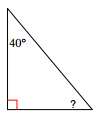
Solve for the missing angle ...
HINT 1: Which side lengths have values?
HINT 2: What trig ratio should be used?
HINT 3: How do we find the ANGLE?
Supplementary angle measures = (a) degrees.
Complementary angle measures = (a) degrees.
Find the complementary angle measures.
75 and 105
75 and 15
25 and 65
34 and 146
38 and 52

Find the missing angle.
72°
68°
90°
78°
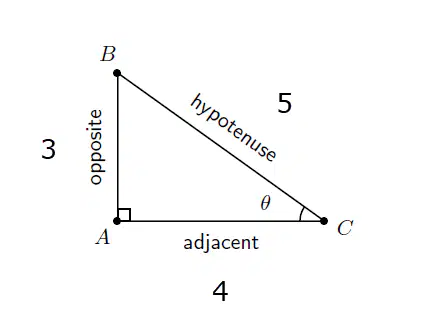
Sine is the ratio of the opposite leg / hypotenuse.
Cosine is the ratio of the adjacent leg / hypotenuse.
Tangent is the ratio of the opposite leg / adjacent leg.
In Right Triangle ABC with right angle A ...
If the cos C = 4 / 5, what is sin B?
3 / 5
3 / 4
4 / 5
5 / 4
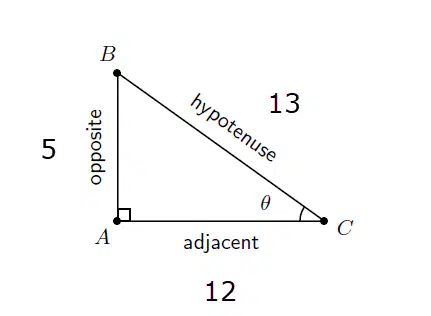
Sine is the ratio of the opposite leg / hypotenuse.
Cosine is the ratio of the adjacent leg / hypotenuse.
Tangent is the ratio of the opposite leg / adjacent leg.
In Right Triangle ABC with right angle A ...
If the sin C = 5 / 13, what is cos B?
13 / 5
5 / 13
5 / 12
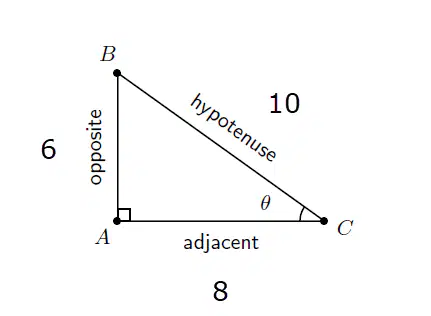
Sine is the ratio of the opposite leg / hypotenuse.
Cosine is the ratio of the adjacent leg / hypotenuse.
Tangent is the ratio of the opposite leg / adjacent leg.
In Right Triangle ABC with right angle A ...
If the cos C = 8 / 10, what is sin B?
10 / 8
6 / 10
8 / 10
[END U5L3 Complementary Angles]
---
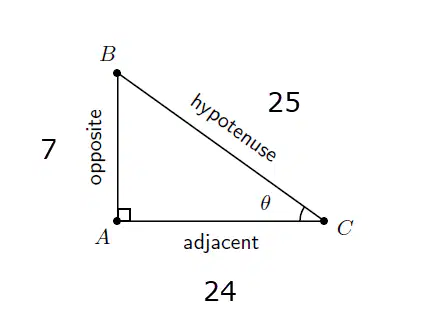
Sine is the ratio of the opposite leg / hypotenuse.
Cosine is the ratio of the adjacent leg / hypotenuse.
Tangent is the ratio of the opposite leg / adjacent leg.
In Right Triangle ABC with right angle A ...
If the sin C = 7 / 25, what is cos B?
7 / 25
7 / 24
24 / 25
[BEGIN U5TR U5L1 Intro to Trig Ratios & Missing Sides]
---
[LANGUAGE] What word was used a lot in this unit?
[LANGUAGE] What is another word was used a lot in this unit?
What side is opposite ∠ J?
9
40
41
none
What side is the hypotenuse of the triangle?
9
40
41
none
What is the sine ratio?
hypotenuseadjacent
hypotenuseopposite
opposite adjacent
adjacent opposite
What is the cosine ratio?
hypotenuseadjacent
hypotenuseopposite
opposite adjacent
adjacent opposite
What is the tangent ratio?
hypotenuseadjacent
hypotenuseopposite
opposite adjacent
adjacent opposite
What is a common way to remember the definitions of the trig ratios?
SAH COH TOA
SOA COH TOA
SOH CAH TOA
ADJ OPP HYP
What is cosA ?
2029
2921
2920
2021
What is tanA ?
2029
2921
2920
2021
What is tan C ?
2120
2921
2920
2021
Which trig function does not include the hypotenuse?
Find tan( α ) in the triangle.
2921
2920
2021
2120
Find sin( α ) in the triangle.
3512
3735
1235
3712
[END U5TR U5L1 Intro to Trig Ratios & Missing Sides]
Find tan(C).
[BEGIN U5TR U5L2 Finding Missing Sides and Angles with Trig Ratios]
Find tan(X).
Find the missing side.
Solve for the missing angle ...
HINT 1: Which side lengths have values?
HINT 2: What trig ratio should be used?
HINT 3: How do we find the ANGLE?
32°
44°
61°
50°
Solve for the missing angle ...
HINT 1: Which side lengths have values?
HINT 2: What trig ratio should be used?
HINT 3: How do we find the ANGLE?
Solve for the missing angle ...
HINT 1: Which side lengths have values?
HINT 2: What trig ratio should be used?
HINT 3: How do we find the ANGLE?
9.4°
55.2°
20.15°
19.4°
Solve for the missing angle ...
HINT 1: Which side lengths have values?
HINT 2: What trig ratio should be used?
HINT 3: How do we find the ANGLE?
Solve for the missing angle ...
HINT 1: Which side lengths have values?
HINT 2: What trig ratio should be used?
HINT 3: How do we find the ANGLE?
50.2°
93.1°
12.6°
42.2°
[BEGIN U5TR U5L3 Complementary Angles] Find the measure of the angle x.
95°
85°
35°
45°
Solve for the missing angle ...
HINT 1: Which side lengths have values?
HINT 2: What trig ratio should be used?
HINT 3: How do we find the ANGLE?
Supplementary angle measures = (a) degrees.
Complementary angle measures = (a) degrees.
Find the complementary angle measures.
75 and 105
75 and 15
25 and 65
34 and 146
38 and 52
Find the missing angle.
72°
68°
90°
78°
Sine is the ratio of the opposite leg / hypotenuse.
Cosine is the ratio of the adjacent leg / hypotenuse.
Tangent is the ratio of the opposite leg / adjacent leg.
In Right Triangle ABC with right angle A ...
If the cos C = 4 / 5, what is sin B?
3 / 5
3 / 4
4 / 5
5 / 4
Sine is the ratio of the opposite leg / hypotenuse.
Cosine is the ratio of the adjacent leg / hypotenuse.
Tangent is the ratio of the opposite leg / adjacent leg.
In Right Triangle ABC with right angle A ...
If the sin C = 5 / 13, what is cos B?
13 / 5
5 / 13
5 / 12
Sine is the ratio of the opposite leg / hypotenuse.
Cosine is the ratio of the adjacent leg / hypotenuse.
Tangent is the ratio of the opposite leg / adjacent leg.
In Right Triangle ABC with right angle A ...
If the cos C = 8 / 10, what is sin B?
10 / 8
6 / 10
8 / 10
[END U5L3 Complementary Angles]
[END U5TR]
---
Sine is the ratio of the opposite leg / hypotenuse.
Cosine is the ratio of the adjacent leg / hypotenuse.
Tangent is the ratio of the opposite leg / adjacent leg.
In Right Triangle ABC with right angle A ...
If the sin C = 7 / 25, what is cos B?
7 / 25
7 / 24
24 / 25
[BEGIN U6AL1 (Circle Language)] If you are given a radius, how can you find the diameter?
Divide the radius by 2
Square the radius
Multiply the radius by 2
Take the square root of the radius

What part of the circle is present?
Tangent
Secant
Chord
Diameter

What part of the circle is present?
diameter
radius
chord
secant
Can a secant be a tangent?
yes - they are both the same line
yes - they are both parts of a circle
no - secants intersect circles twice, and tangents intersect circles once
no - neither of them have nothing to do with circles
Line segments with both endpoints on a circle are called _____.

The line segment from the center of a circle to the boundary of a circle (half of the diameter).
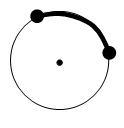
What part of the circle is present?
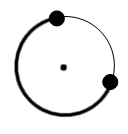
What part of the circle is present?
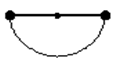
What part of the circle is present?
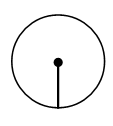
What part of the circle is present?
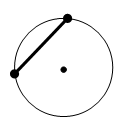
What part of the circle is present?
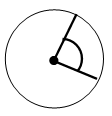
What part of the circle is present?
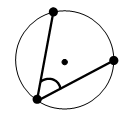
What part of the circle is present?

What is this called?
Chord
Minor arc
Secant
Diameter

What is this called?
Tangent Line
Secant
Chord
Diameter

What is this called?
Diameter
Secant
Tangent Line
Radius

What is this called?
Major Arc
Minor Arc
Circumference
Perimeter
The perimeter of a circle is called...
circumference
arc
radius
tangent
A line that goes through a circle intersecting the circle at two points.
diameter
chord
tangent
secant
A line that touches the circle only once.
diameter
radius
tangent
chord
A line segment with 2 endpoints on the circle (select every correct answer).
A line segment that runs through the center of the circle (the longest chord).
[END U6AL1 (Circle Language)] The distance from the center of a circle to the boundary of a circle (half of the diameter).

[BEGIN U6AL2 (Central and Inscribed Angles)] Angle a is a(n) ___ angle.
central
inscribed
Angle b is a(n) ___ angle.
central
inscribed

Find the measure of the marked angle.
52
104
26
13

Find the measure of the marked arc.
15
30
60
7.5

Find the measure of the marked arc.
90
22.5
45
180

Find the measure of the marked angle.
22
44
11
66

Find the measure of the marked angle.
130
65
260
50

Find the measure of the marked angle.
140
70
35
210
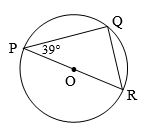
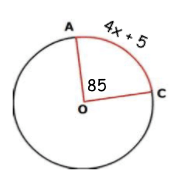

Find the measure of arc NM
192o
217o
186o
124o

Find the measure of the missing angle (?).
115o
50o
124o
95o

Find the measure of the missing arc (?).
98o
140o
85o
94o
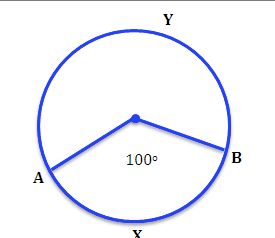

Find the value of y.
(a)

Find the value of x.
(a)
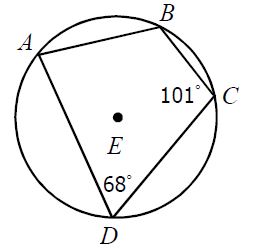
What is the measure of angle A?
34°
180°
112°
79°
[END U6AL2 (Central and Inscribed Angles)] In a circle (or congruent circles), the measure of an arc is:

[BEGIN U6AL3L4 (Angles Inside and Outside Circle)] Find the measure of angle ABD.


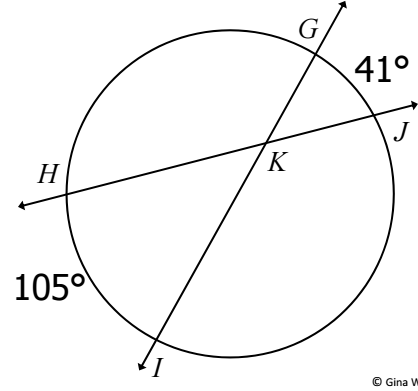

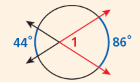

Find the angle indicated.
123
56
324
95

Find the arc indicated.
55
175
115
285

Find the arc indicated.
112
143
53
127

Find the arc indicated.
110
-12
105
234

Find the arc indicated.
78
51
-78
102

Find the angle indicated.
105
255
360
75

Find the angle indicated.
70
50
60
55

Find the angle indicated.
53
65
62
3

Find the angle indicated.
128
52
76
58

Find the arc indicated.
147
41
277
65

Find the angle indicated.
145
140
75
70

Find the angle indicated.
52
103
63
117

Find the angle indicated.
180
55
80
40

[END U6AL3L4 (Angles Inside and Outside Circle)] Find the arc indicated.
185
75
110
100

[BEGIN U6AL6 (Triangles and Quadrilaterals Inscribed in Circles + Tangents)] AB is a diameter. The measure of angle B is 58 degrees. Find the m < A.
32
128
90
There is not enough information to determine m∠A

AB is a diameter. The measure of angle C is 90 degrees and angle A is 79 degrees. Find the m < B.
101
90
11

AB is a diameter. The measure of angle C is 90 degrees and angle B is 68 degrees. Find the m < A.
90
112
22

AB is a diameter. The measure of angle C is 90 degrees and angle A is 17 degrees. Find the m < B.
73
163
90

The m < B = 123 degrees. Find the m < D.
180
90
57

The m < C = 27 degrees. Find the m < A.
180
153
127

Find the m < x.
112 degrees
98 degrees
132 degrees

Find the m < y.
112 degrees
82 degrees
144 degrees

b=93 degrees
b=74 degrees
b=106 degrees
b=87 degrees

In the inscribed quadrilateral ABCQ, opposite angles are
congruent
supplementary
complementary
sum to 360o
What is the measure of angle A?
34°
180°
112°
79°
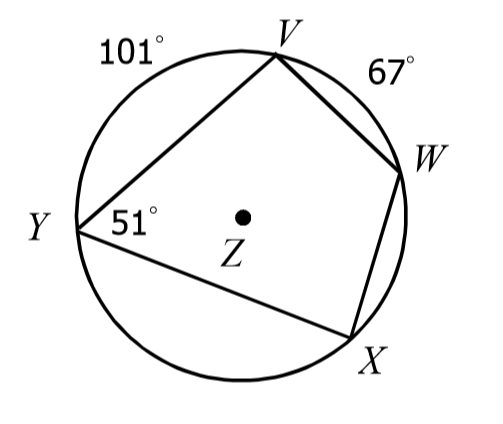
96°
129
84°
49°
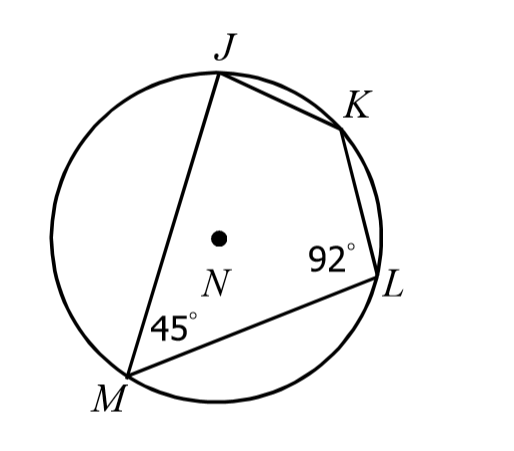
∠J=
88°
45°
135°
108°

∠W=
129°
96°
84°
49°

Determine if a tangent line is shown in the picture.
Yes
No
Not sure

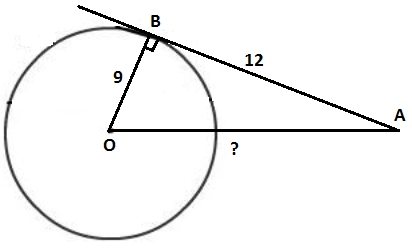
Assume that the lines that appear to be tangent are tangent. O is the center of the circle. Find the value of x to the nearest tenth.
11.7
10.8
13.0
14.2

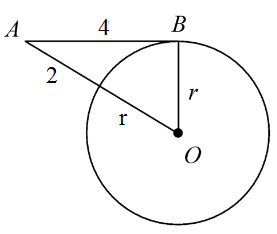
[END U6AL6 (Triangles and Quadrilaterals Inscribed in Circles + Tangents)] Find x. Assume that segments that appear to be tangent are tangent.

[BEGIN U6AL8 (Arc Length and Sector Area)] Find the arc length of arc AB.




[END U6AL8 (Arc Length and Sector Area)] What is the area of the indicated region?
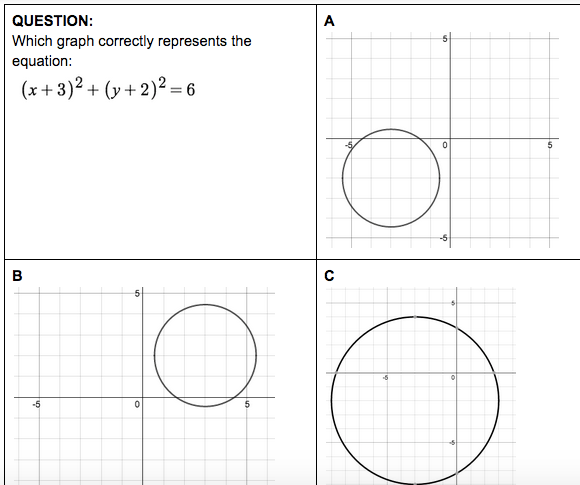
[BEGIN U6AL9 (Equation of Circle)] In the equation (x - 3)2 + (y - 2)2 = 16, the center of the circle is...
(3, 2)
(-3, -2)
(-2, -3)
(2, 3)
In the equation (x - 4)2 + (y - 3)2 = 25, the radius is
4
3
5
25
In the equation (x - 4)2 + (x - 3)2 = 25, the center of the circle is at...
(-3, -4)
(4, 3)
(-4, -3)
(3, 4)
In the equation (x - 3)2 + (y + 4)2 = 121, the radius of the circle is
3
11
121
4
(x - 7)2 + y2 = 9
x2 + (y -7)2 = 9
(x - 7)2 + y2 = 3
x2 + (y -7)2 = 3

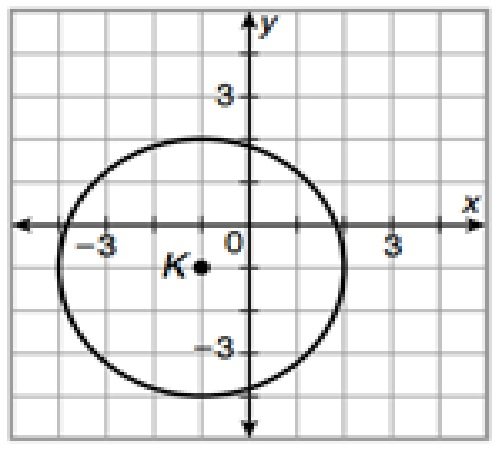
(x + 1)2 + (y + 1)2 = 3
(x + 1)2 + (y - 1)2 = 3
(x + 1)2 + (y + 1)2 = 9
(x - 1)2 + (y - 1)2 = 9


What is the radius of the circle with this equation of (x - 5)² + (y + 7)² = 8?
4
8
4√2
2√2
(x - 5)2 + (y + 2)2 = 144
(x - 5)2 + (y + 2)2 = 36
(x + 5)2 + (y - 2)2 = 36
(x + 5)2 + (y - 2)2 = 144
What does (h,k) tell us in the standard circle equation?
(h,k) is the center of the circle
(h,k) is a point on the circle.
(h,k) is a point that we guess and find
(h,k) is the distance of the circle
What does the r in the standard equation stand for?
r is the distance of the circle
r is the radius of the circle
r is the x coordinate of the center of the circle
r is the y coordinate of the center of the circle
Find the center of the circle if the endpoints of a diameter of the circle are at (-11, -7) and (3, 5)
(-4, -1)
(-8, -2)
(-7, -6)
(4, 1)

(x-3)2+(y-2)2=16, the center of the circle is...
(7, 0) with radius 3.
[END U6AL9 (Equation of Circle)] What is the center of the circle with this equation is (x+2)²+(y-4)²=41?
[BEGIN U6AL10 Circles Test Review U6ATR][BEGIN U6AL1 (Circle Language)]
If you are given a radius, how can you find the diameter?
Divide the radius by 2
Square the radius
Multiply the radius by 2
Take the square root of the radius
What part of the circle is present?
Tangent
Secant
Chord
Diameter
What part of the circle is present?
diameter
radius
chord
secant
What part of the circle is present?
What part of the circle is present?
What part of the circle is present?
What part of the circle is present?
A segment that goes through a circle intersecting the circle at two points.
diameter
chord
tangent
secant
[END U6AL1 (Circle Language)] The distance from the center of a circle to the boundary of a circle (half of the diameter).
[BEGIN U6AL2 (Central and Inscribed Angles)] Angle a is a(n) ___ angle.
central
inscribed
Angle b is a(n) ___ angle.
central
inscribed
Find the measure of the marked angle.
52
104
26
13
Find the measure of the marked arc.
15
30
60
7.5
Find the measure of the marked angle.
22
44
11
66
Find the measure of the marked angle.
140
70
35
210
Find the measure of arc NM
192o
217o
186o
124o
Find the value of x.
(a)
[END U6AL2 (Central and Inscribed Angles)] In a circle (or congruent circles), the measure of an arc is:
[BEGIN U6AL3L4 (Angles Inside and Outside Circle)] Find the measure of angle ABD.
Find the arc indicated.
55
175
115
285
Find the arc indicated.
112
143
53
127
Find the arc indicated.
78
51
-78
102
Find the angle indicated.
70
50
60
55
[END U6AL3L4 (Angles Inside and Outside Circle)] Find the arc indicated.
185
75
110
100
[BEGIN U6AL6 (Triangles and Quadrilaterals Inscribed in Circles + Tangents)] AB is a diameter. The measure of angle B is 58 degrees. Find the m < A.
32
128
90
There is not enough information to determine m∠A
AB is a diameter. The measure of angle C is 90 degrees and angle A is 79 degrees. Find the m < B.
101
90
11
AB is a diameter. The measure of angle C is 90 degrees and angle B is 68 degrees. Find the m < A.
90
112
22
AB is a diameter. The measure of angle C is 90 degrees and angle A is 17 degrees. Find the m < B.
73
163
90
The m < B = 123 degrees. Find the m < D.
180
90
57
The m < C = 27 degrees. Find the m < A.
180
153
127
Find the m < x.
112 degrees
98 degrees
132 degrees
Find the m < y.
112 degrees
82 degrees
144 degrees
In the inscribed quadrilateral ABCQ, opposite angles are
congruent
supplementary
complementary
sum to 360o
96°
129
84°
49°
Determine if a tangent line is shown in the picture.
Yes
No
Not sure
Assume that the lines that appear to be tangent are tangent. O is the center of the circle. Find the value of x to the nearest tenth.
11.7
10.8
13.0
14.2
[END U6AL6 (Triangles and Quadrilaterals Inscribed in Circles + Tangents)] Find x. Assume that segments that appear to be tangent are tangent.
[BEGIN U6AL8 (Arc Length and Sector Area)] Find the arc length of arc AB.
[BEGIN U6AL9 (Equation of Circle)] In the equation (x - 3)2 + (y - 2)2 = 16, the center of the circle is...
(3, 2)
(-3, -2)
(-2, -3)
(2, 3)
In the equation (x - 4)2 + (y - 3)2 = 25, the radius is
4
3
5
25
(x - 7)2 + y2 = 9
x2 + (y -7)2 = 9
(x - 7)2 + y2 = 3
x2 + (y -7)2 = 3
(x + 1)2 + (y + 1)2 = 3
(x + 1)2 + (y - 1)2 = 3
(x + 1)2 + (y + 1)2 = 9
(x - 1)2 + (y - 1)2 = 9
(x - 5)2 + (y + 2)2 = 144
(x - 5)2 + (y + 2)2 = 36
(x + 5)2 + (y - 2)2 = 36
(x + 5)2 + (y - 2)2 = 144
[END U6AL10 Circles Test Review U6ATR]
[END U6AL9 (Equation of Circle)]
What is the center of the circle with this equation is (x+2)²+(y-4)²=41?

