
Font size
S
M
L
XL
 Worksheets
Hard Tissue Injuries #1
Total questions: 14
Worksheet time: 10mins
Name
Class
Date
1.
Which of the following is a hard tissue injury?
a)
Grade 2 ankle sprain
b)
Shoulder dislocation
c)
Hamstring tear
d)
ACL tear
2.
A 'broken' bone is correctly called
a)
A break
b)
A fracture
c)
A dislocation
d)
An overuse injury
3.
Which of the following is NOT a category of fractures?
a)
Open
b)
Complicated
c)
Closed
d)
Contained
4.
An Open fracture is where:
a)
The bone has broken into two complete pieces
b)
The bone has not broken the entire way through
c)
The bone has pierced the skin
d)
The bone has been broken into 3 or more pieces
5.
A complete fracture is where:
a)
The bone has broken into two pieces
b)
The bone has not broken the entire way through
c)
The bone has been broken into 3 or more pieces
d)
The bone has broken through the skin
6.
A complicated fracture is where:
a)
The fracture has caused damage to other soft tissue such as nerves, blood vessels and/or organs
b)
When the athlete doesn't know what caused the fracture
c)
The fracture has also caused a dislocation
d)
The fracture is contained within the skin
7.
What should be done in the management of a fracture? Tick all that apply
a)
Carefully apply pressure to stop any bleeding
b)
Immobilize the limb with a splint or sling
c)
Monitor the ahtlete for shock
d)
Seek medical help (such as pain management and an X-Ray)
8.
A dislocation is where:
a)
There is a separation between two bones
b)
The joint becomes swollen
c)
An athlete gets a large bruise
d)
The ligaments are stretched
9.
Which of the following could be signs of dislocation? Tick all that apply
a)
Deformity at the joint
b)
Swelling
c)
Bruising at or near the joint
d)
Pain
e)
Loss of feeling or sensation
10.
What should be done in the management of a dislocation? Tick all that apply.
a)
Help to relocate the joint for the athlete
b)
Immobilize the joint
c)
Support the joint with a sling where possible
d)
Apply ice
e)
Seek medical attention
11.
What is a comminuted fracture?
a)
A fracture that has not broken the skin
b)
When a bone has broken (fracture) in two or more places
c)
When there is a dislocation and a fracture
d)
When the cartilage is damaged in the injury
12.

Which most accurately describes the injury observed in the image?
a)
Soft Tissue - Fracture
b)
Soft Tissue - Dislocation
c)
Hard Tissue - Fracture
d)
Hard Tissue - Dislocation
13.
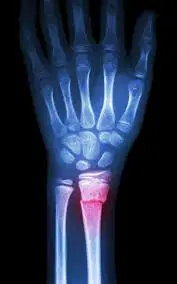
Which of the following most accurately describes the injury observed in the image.
a)
A complete open fracture
b)
A complete, closed fracture
c)
A comminuted open fracture
d)
A comminuted closed fracture
14.
Organize these options relating to fractures into the right category
Categorize the following
Hearing a crack
Pain
Redness
Loss of function
Deformity
Bruising
Swelling
Bleeding
Bone breaking the skin
Symptoms of a Closed Fracture
Not symptoms of a Closed Fractu
Reset

