
 Worksheets
11STEM2419_MINERALS AND ROCKS
Total questions: 30
Worksheet time: 23mins
Which type of rocks are characterized by the absence of banding or layering?
Foliated metamorphic rocks
Igneous rocks
Sedimentary rocks
Non-foliated metamorphic rocks
Which type of rocks are formed on or near the Earth's surface?
Volcanic rocks
Sedimentary rocks
Metamorphic rocks
Igneous rocks
What is the characteristic that describes how the particles of a mineral hold together or resist separation?
Brittleness
Malleability
Ductility
Tenacity
What is the process by which rocks are broken down into smaller fragments due to physical or chemical means?
Deposition
Erosion
Weathering
Lithification
____________ are characteristics of minerals that can be observed or measured.
physical properties
chemical composition
external properties
internal properties
How is luster classified?
Scale of 1 to 10.
Metallic or non-metallic
Amorphous or non-amorphous
Depends on its direction of breakage.
You bought a necklace with a clear & crystal pendant, and you want to find out if the pendant is diamond. What would be the easiest way to do this without breaking it?
Assess for its streak
Test for its specific gravity
Scratch it against other rocks
Check for its chemical composition
In the Mohs Scale of Hardness, apatite has a rating of 5 while quartz’s rating is 7. What can you infer about the hardness of apatite?
Apatite is harder than quartz.
Apatite is the weakest mineral
Apatite has about the same hardness as quartz
Apatite has a lower hardness rating than quartz.
What is the difference between cleavage and crystal habit?
Both are dictated by crystal structure
Cleavage is the weak plane while crystal habit is the natural shape of the mineral
Cleavage is the external shape while crystal habit is the weak point
Both are the same
Diamond is a mineral that is formed as an individual element. It is non-conductive. What is the other characteristic of a diamond?
metal
semi-metal
non-metal
none of the choices
Miya found a necklace with a stone looked like a diamond. Her friend thought the stone was glass. Which test would best help Miya determine if the stone was a diamond or glass?
Color
Luster
Streak
Hardness
All minerals share the following characteristics EXCEPT that of ________________.
being solids
having the atoms within the mineral arranged in a pattern
being formed from living organisms
being formed by natural resources

If a mineral can scratch topaz what is it's hardness range?
8.5 - 10
7.5 - 1
8
unknown
What is metamorphism in mineral formation?
Metamorphism is caused by the rotation of minerals in the Earth's crust.
Process where existing minerals are altered by high pressure, temperature, or chemical changes to form new minerals.
Metamorphism is the process of erosion in mineral formation.
Metamorphism occurs due to the presence of organic matter in minerals.
Which of these statements is true?
Weathering and erosion affects all rocks on the earth's surface
Weathering and erosion only affects sedimentary rocks on the earth's surface
Weathering and erosion affects all rocks under the earth's surface
Rocks are unaffected by weathering and erosion
What geologic process changes pieces of rocks, minerals, and other material into sedimentary rock?
Compacting and cementing
Cooling
Heat and pressure
Melting
Identify the series of geologic processes that can transform magma into granite, granite into sand, and sand into sandstone.
Cooling; weathering and erosion; compacting and cementing
Melting; heat and pressure; cooling
Weathering and erosion; compacting and cementing; cooling
Weathering and erosion; compacting and cementing; heat and pressure

The Mount Rushmore National Monument is carved from the granite of South Dakota's Black Hills. What type of rock is granite?
Igneous
Metamorphic
Sedimentary
None of the above
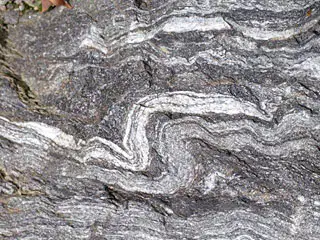
Which characteristic is common to metamorphic rocks?
Fossils
Gas bubbles
Glassy surface
Ribbonlike layers
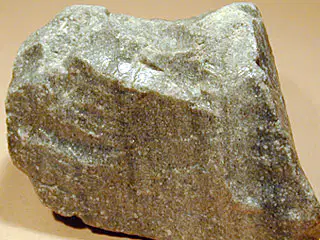
Which characteristic is common to extrusive igneous rocks?
Crystals
Fossils
Glassy surface
Ribbonlike layers
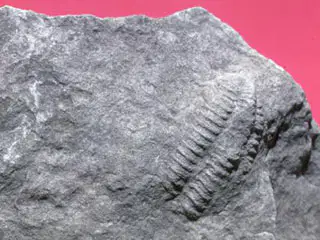
Which characteristic is found in sedimentary rocks?
Crystals
Fossils
Gas bubbles
Glassy surface

Which of the following is an extrusive igneous rock?
basalt
granite
shale
silt
What do you call the process that turns weathered and eroded rocks into sedimentary rocks?
compaction
sedimentation
cementation
lithification
This type of rock is made up of organic sediments (shells, leaves, bones, stems) being layered and cemented.
Clastic Sedimentary Rock
Organic Sedimentary Rock
Chemical Sedimentary Rock
This type of rock is determined by the size and type of sediments (mud, pebbles, sand) being layered.
Clastic Sedimentary Rock
Organic Sedimentary Rock
Chemical Sedimentary Rock
This type of rock is formed by the evaporation of lake or by chemical processes.
Clastic Sedimentary Rock
Organic Sedimentary Rock
Chemical Sedimentary Rock
These are fragmental rocks usually associated with violent or explosive type of eruption.
intrusive
pyroclastic
extrusive
plutonic
A student is observing a rock. She needs to evaluate what kind of rock it is and give her reasons why she identified it as igneous, metamorphic, or sedimentary rock. To help her identify, the teacher gave this statement, "This rock has an observable layer. It formed due to processes like melting, heat and pressure, with materials like sand, dead matter, and other particles." Given the statement, what could be the BEST answer of the student?
The rock is an example of igneous rock that undergoes processes like melting, heat, and pressure.
The rock is an example of sedimentary rock which is made up of sand, dead matter, and other particles but they are not formed by melting.
The rock is an example of sedimentary rock made up of sand, dead matter, and other particles and is formed due to melting, heat and pressure.
The rock is an example of metamorphic rock where it can change due to melting, heat, and pressure and it is not made up of sand, dead matter, and other particles.

