
 Worksheets
PHC413 Adsorption
Total questions: 21
Worksheet time: 11mins
Adsorption is a bulk phenomenon.
True
False
Physical adsorption involves Van der Waals forces.
True
False
Chemical adsorptions permit only the formation of a monolayer af adsorbates on the adsorbent.
True
False
Chemical adsorption is easily reversible.
True
False
Adsorption is an endothermic process.
True
False
Complex structures are more easily adsorbed than simpler ones.
True
False
Adsorption processes proceed more rapidly at higher temperatures.
True
False
Increasing the surface area of the adsorbent increases the adsorption.
True
False
Adsorption isotherm is the process by which the adsorbate is adsorbed on the adsorbent as a function of its pressure (if gas) or concentration (if liquid) at constant temperature.
True
False
Freundlich isotherm provided a theoretical relationship between the amount of gas adsorbed by a unit mass of solid adsorbent and pressure at a particular temperature.
True
False
Freundlich isotherm characterises physical adsorption.
True
False
At high temperature, Freundlich isotherm always seem to approach saturation.
True
False
Langmuir isotherm is also known as type I isotherm.
True
False
Type I isotherm characterises chemical adsorption.
True
False
Langmuir adsorption isotherm assumes that the adsorbed molecules interact with each other, as well as with the adsorbent molecules.
True
False
Langmuir adsorption isotherm assumes that the adsorption occurs through various different mechanisms.
True
False

The figure shows a
Type I isotherm
Type II isotherm
Type III isotherm
Type V isotherm
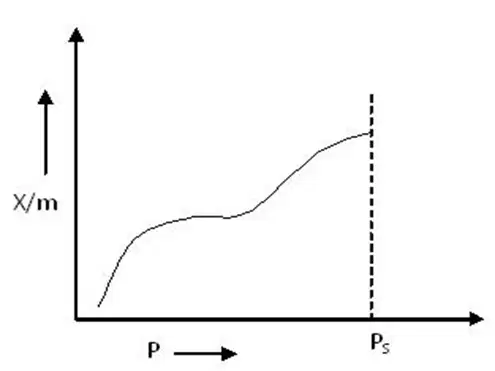
The figure shows a
Type I isotherm
Type II isotherm
Type III isotherm
Type IV isotherm
The greater the surface area of the adsorbent, the lesser is the volume of gas adsorbed.
True
False
A gas is more liquefiable it will be less easily adsorbed.
True
False
Adsorption decreases with the increase of temperature.
True
False

