
 Worksheets
Solar System Review 24-25
Total questions: 50
Worksheet time: 25mins

Which object orbits object X?
Object A
Object B
Object C
What is responsible for keeping planets in orbit around the sun?
density
gravity
photosynthesis
The planets orbit around the sun because the sun has the greatest ____________.
weight
diameter
mass
Which happened first to form the solar system?
Orbital paths began to form.
Particles began to clump together in the orbital paths.
There was a large cloud of particles and dust.

What does this model of the solar system show?
how the planets orbit the sub
the relative size of each planet
the gravitational force exerted by each planet
What keeps the moon in orbit around Earth?
tension
magnetism
gravity
Which statements correctly describe a difference in our solar system's inner planets and outer planets due to gravitational effects?
inner planets are larger
outer planets are larger
inner planets are more spread apart
outer planets are more spread apart
What is the solar system?
The sun
The planets
The sun and planets ONLY
The sun, planets, and all other objects that orbit the sun
Which planet is the closest to our sun?
Mars
Earth
Mercury
Venus
Which planet is the farthest away from our sun?
Mars
Jupiter
Neptune
Uranus
Is Pluto still considered a planet?
Yes, Pluto is still a planet because it still orbits the sun
Yes, Pluto is considered a planet because it is big enough to be a planet
No, pluto is not considered a planet because it is too small, and it its orbit is affected by another star
No, because pluto does not have any moons.
One AU stands for Astronomical Unit. An Astronomical Unit (AU) is the distance between The Sun and the Earth, or 150 million meters. If Jupiter is 5 AU away from the Sun, how far way is Jupiter from the sun in Meters?
5 million meters away from the sun
1000 million meters away from the sun
750 million meters away from the sun
7500 million meters away from the sun
If Earth is 1 AU away from the sun, and Neptune is 30 AU away from the sun, what does this mean?
Neptune is 30 years older than the Earth
Neptune is 30 times larger than Earth
Neptune is 30 times farther away from the sun than the Earth
Why do scientists use scale to study the Solar System?
The solar system is too large to study without using scale
The solar system is too small to study without using scale
Scientists don't need to use scale because we have satelites
All of the above
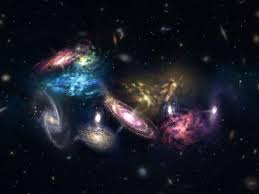
Galaxies are:
groups of asteroids
groups of planets
groups of stars, gas and dust.
group of satellites
What takes up 99.8% of the mass in the solar system?
The moon
The sun
Jupiter
Saturn
This marks the boundary of our solar system.
Asteroid Belt
Kuiper Belt
Comet Belt
Oort Cloud
What belt separates the Rocky Planets and the Gas Giants ?
Kuiper Belt
Asteroid Belt
Comet Belt
Joivian Belt
The average distance between the Earth and the Sun
Prograde
Retrograde
Light Year
Astronomical Unit
A planet passes a point in its orbit on August 31, 1997. The next time it passes the same point in its orbit is September 24, 2081. About how long is a year for that planet?
42 Earth years
76 Earth years
84 Earth years
Cannot be determined
What two factors cause the seasons?
Rotation and tilt of the Earth
Earth's distance to the Sun and it's revolution
Earth's orbit and it's tilt relative to the Sun
Solar intensity and the atmosphere

What type of eclipse is occuring in the image?
Tidal Eclipse
Solar Eclipse
Annual Eclipse
Lunar Eclipse

The image below shows a total lunar eclipse. What image shows the corresponding positions of the Earth, Moon and Sun?


When the Moon is in the position shown, how would the Moon look from Earth?


What is the best explanation of Moon phases?
As the Moon passes behind Earth it is covered by Earth's shadow.
As the Moon orbits Earth we see different amounts of the illuminated side of the Moon.
Clouds in the sky block parts of the Moon from view.
The Moon is brighter when it is closer to the Sun.

When the Moon is in the position shown, how would the Moon look to an observer on the North Pole?


When a celestial object turns on an axis what is that movement called?
Rotation
Revolution
Round
Spinning
Which of the following is NOT true about Earth's rotation?
Earth's rotation takes approximately 24 hours.
Earth's rotation determines 1 day on Earth.
Earth's rotation causes predictable day and night cycles.
The Earth is rotating in clockwise direction. This causes the Sun on Earth to rise in the east and set in the west each day.
The motion of objects in the solar system revolving or traveling completely around other objects including the Earth and Moon can be referred to as what?
Rotation
Revolution
Orbit
Hovering
Approximately how many days is Earth's revolution?
365
365.50
365.24
364
Which planet is so light that it can float on water?
Mercury
Earth
Jupiter
Saturn
Which of these is true about outer planets? Select all that apply.
Larger than inner planets
Mainly made of gas
Known since Ancient times
All have rings
All have been better explored than inner planets
Which is the hottest planet in our solar system?
Mercury
Mars
Venus
Uranus
Which is the coldest planet in our solar system?
Neptune
Saturn
Jupiter
Mars
Which one is NOT an Outer Planet Characteristic?
more dense
made of mostly gases
further away
larger
When mass increases, Gravity _______________?
increases
decreases
stays the same
is not affected
When the distance increases between 2 objects, the gravitational pull _________________.
decreases
increases
stays the same
is not affected
What is at the middle of a Heliocentric system?
Mars
Moon
Sun
Earth
What is at the middle of a Geocentric system?
Sun
Neptune
Earth
The Universe
What does the Geocentric system look like?
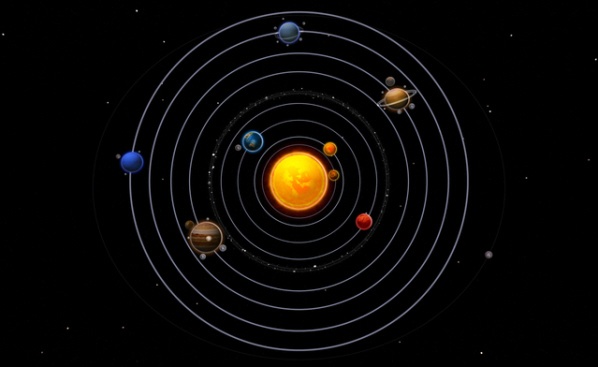
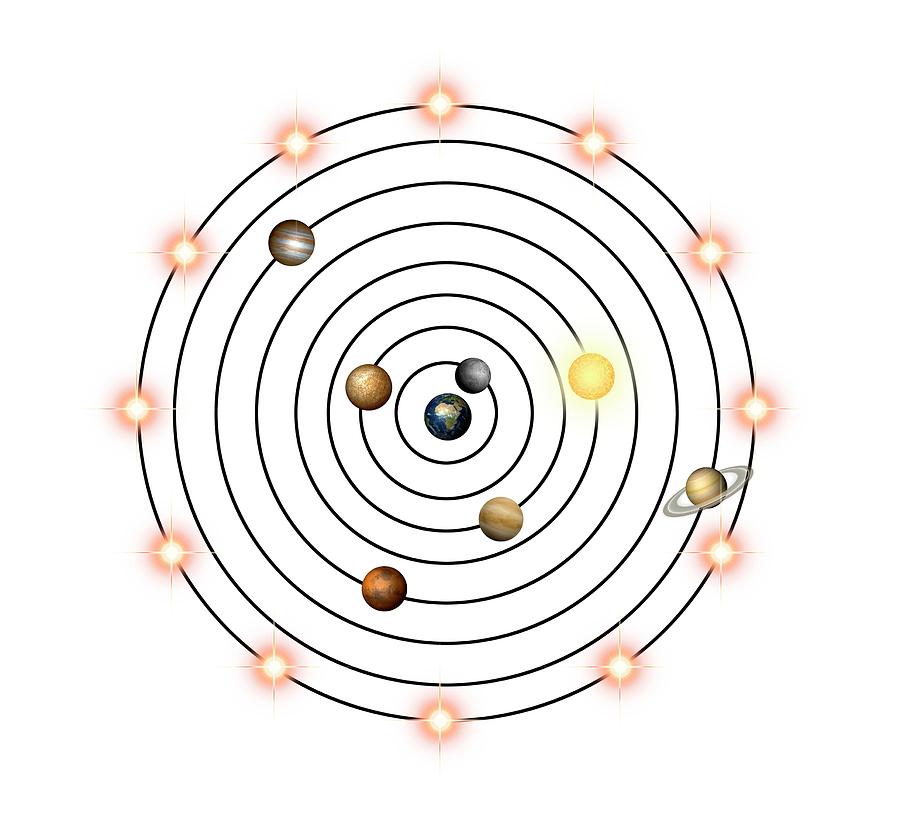
What does the Heliocentric system look like?


What is the primary reason for the phases of the Moon?
The Moon's rotation on its axis
The Earth's shadow covering the Moon
The Moon's orbit around the Earth
The Sun's position relative to the Earth
What is the main component of the Sun?
Oxygen
Hydrogen
Carbon
Helium

