
 Worksheets
Test Review
Total questions: 39
Worksheet time: 39mins
When is work done on an object?
When an object has a net force applied to it.
When an object moves while a net force is being applied to it
When an object doesn't move while a net force is applied to it
When an object is moving without a net force being applied to it

What just happened in this picture?
The weight lifter did work by lifting the barbells from the floor to above his head.
The weight lifter did not do work when lifting the barbells above his head.
The weight lifter did no work because he is just a table for weights.
The barbells did work on the weight lifter when lifted from the ground to above the weight lifters head.
How do you calculate power?
Amount of work done divided by the time interval during which the work is done.
Amount of net force applied to an object multiplied by the distance the object moves
Mass multiplied by acceleration
Amount of momentum gained multiplied by the time interval in which the momentum was gained
To find gravitational potential energy on Earth we use which of the following equations?
PE = m*g*h
PE = m*v*d
PE = m*g*s
PE = m*g/h
PE = m*v/g

The kinetic energy of an object increases by what factor if the velocity is doubled?
a factor of one half
a factor of double
a factor of triple
a factor of quadruple

At which point of the roller coaster is potential energy the greatest?
W
X
Y
Z


if you push a cart with a force of 60 N for 2 m... how much work have you done
120 J
30 J
120 N
30 N


speed of a male polar bear is 11.0 m/s, how much KE does it have?

Which of the following statements is correct?
The car has less kinetic energy because it has more mass than the girl.
The car has the most kinetic energy because it has more mass than the girl.
The car and the girl have the same amount of kinetic energy because they are moving at the same speed.
The girl has the most kinetic energy because she has less mass than the car.
The Law of Conservation of Energy states that energy is never _____________ or ____________, only transformed.
created, destroyed
created, subtracted
added, subtracted
destroyed, subtracted
An 86 kg boulder rests at the top of a 90 m cliff and falls to the bottom, how much energy leaves the system as heat and sound?
77,400 J
It is impossible to determine
7486 J
95,000 J
What is the connection between work and energy
There is no connection between work and energy
The energy in a system (Em) stays the same UNLESS work is done to add or remove energy from the system
Work always adds energy to a system
Work always removes energy from a system
It takes 20 N of force to move a box a distance of 10 m. How much work is done on the box in Joules?
200 J
20.0 J
100 J
10 J


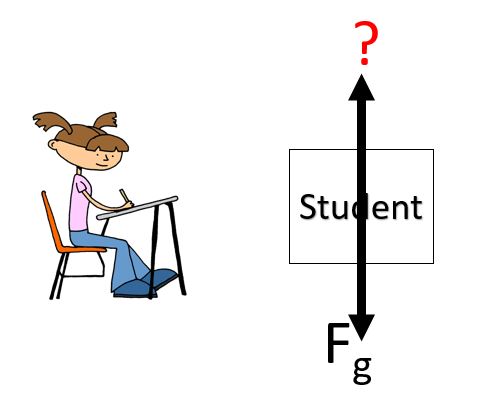
Newton's first law applies
to both moving and nonmoving objects
only to moving objects
only to objects that are not moving
Find the net force: 15 N to the right, and another 15 N to the right.
0 N Right
0 N Left
30 N Left
30 N Right
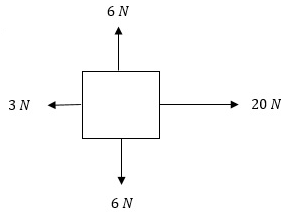
What is the NET FORCE of this diagram?
17 N, right
17 N, left
23 N, right
12 N, up
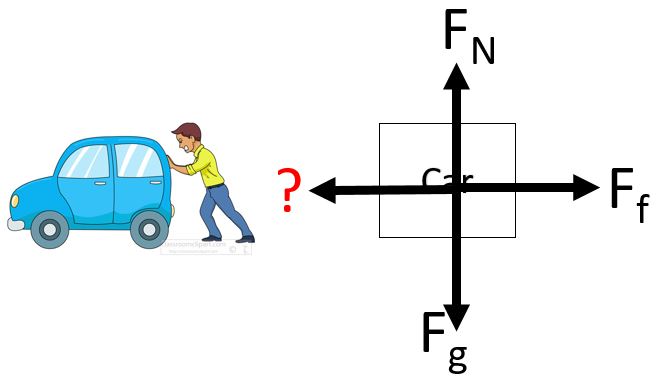


Where will be the center of gravity of a uniform rod lie?
At its end
At its middle point
At its centre of its cross sectional area
Depends upon its material
The force of water pushing outward that makes your rocket launch from the platform is ____________.
Drag
Thrust
Aerodynamics
Gravity
The friction force on the rocket's fall downward was called _________________.
Air resistance
Static Friction
Kinetic Friction
Gravity Friction
Which rocket component increases air resistance?
nose cone
parachute
Which rocket component provides stability?
fins
bottle opening
nose cone
What forces act on rockets?
thrust
gravity
lift
air resistance
What is the acceleration of a rocket with a 0.13 kg mass and a net force of 27 N?
-0.0048 m/s2
0.0048 m/s2
-207.69 m/s2
207.69 m/s2
Which is Newton's Third law?
For every action force, there is an equal and opposite reaction force
F=ma
an object at rest will remain at rest, and an object in motion will remain in motion unless acted upon by an outside force
Force is an action done to an object that may change the object's motion



