
NEW
Font size
 Worksheets
6th Grade SS QRTLY
Total questions: 65
Worksheet time: 38mins
How many years separate 325 BC and AD 325 on a timeline?
649 years
650 years
325 years
32 years
How many years separate 40 BC and AD 40 on a timeline?
79 years
80 years
180 years
240 years
249
How many years passed between 1945 CE and 449 BC
2,393
2,394
2,449
A(n) _______________ is a human made object such as a tool, button, or old vase.
artifact
secondary source
bias
question
The Shang dynasty in ancient China started around 1600 BCE and ended around 1000 BCE. About how long did it last?
2600 years
60 years
600 years
500 years
If you need to calculate the years between two different Eras (Opposite sides BC and AD)
Subtract them and -1
Add them and -1
Add them
Just subtract
If both events are in BCE/BC (SAME SIDE)
Take the number of the older event (Larger #) and SUBTRACT the more recent event (Smaller #)
If both events are in CE/ADTake the number of the older event (Larger #) and ADD the more recent event (Smaller #)
Which hominin group is the oldest?
Handy Man
Wise Man
Upright Man
Lucy and Her Relatives
Neanderthal Man
This hominin group created fire for the first time.
Handy Man
Wise Man
Upright Man
Lucy and Her Relatives
Neanderthal Man
Which hominin group are we, the modern humans, related to?
Handy Man
Wise Man
Upright Man
Neanderthal Man
This hominin group used simple tools used for digging, chopping, and cutting.
Handy Man
Wise Man
Upright Man
Neanderthal Man
This hominin group created fire for the first time.
Handy Man
Wise Man
Upright Man
Neanderthal Man
Which sentence best describes why building shelters was important for hominins to survive?
Building shelters allowed hominins to adapt to different areas.
Building shelters helped them create more art.
Building shelters helped them to celebrate more rituals.
All of the above.
10 years is a
millenium
century
decade
a very long time
People who move from place to place regularly are called
Nomads/Migrants
Systematic Agriculture
Hunter-gathers
Neolithic

Which ocean is the star located on?
Southern Ocean
Pacific Ocean


What is this a picture of?
Latitude Lines
Political Map
Longitude Lines
Physical Map

What does this map show?
Mountains
Longitude Lines
Canyons
Latitude Lines

What ocean is H4?
Pacific Ocean
Atlantic Ocean
Artic Ocean
Indian Ocean

What continent is located at I 3?
North America
Europe
Asia
Australia
Latitude lines measure:
North and South
East and West
Longitude lines measure
East and West
North to South
Who studies the Earth's history, including its physical materials such as rocks, minerals, and soil?
Geologists
Linguists
Anthropologists
Geographers
Who studies the past based upon what earlier people left behind?
Linguists
Archaeologists
Geographers
Geneticists
Who studies humans and their development, including human culture and behavior?
Archaeologists
Geologists
Anthropologists
Geneticists
Who studies the Earth's physical and cultural features?
Archaeologists
Geographers
Geneticists
Linguists
What are fossils?
Objects made and used by humans
The remains or imprints of things that were once alive
A method of calculating the age of artifacts
Layers of rock or soil

A diary is a...
primary source
secondary source

A photograph is a...
primary source
secondary source

A fossil is a...
primary source
secondary source

A biography is a ...
primary source
secondary source

A phone recording/ video is a...
primary source
secondary source

What is shown and colored-in above?
The southern hemisphere
The northern hemisphere
The longitude
The atlas
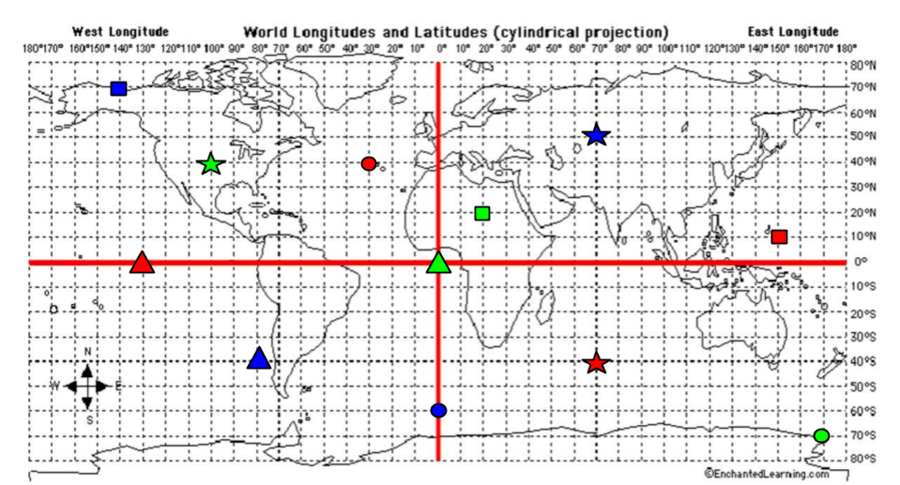
What are the coordinates for the BLUE Square?
40*S, 80*W
60*S, 0*
70*N, 140*W
50*N, 70*E
What are the coordinates for the BLUE Circle?
40*S, 80*W
60*S, 0*
70*N, 140*W
50*N, 70*E
What are the coordinates for the BLUE Star?
40*S, 80*W
60*S, 0*
70*N, 140*W
50*N, 70*E
How old was Rosa Parks (1913 CE - 2005 CE)?
39 years
42 years
78 years
92 years
How many years separate Hammurabi's Code (1750 BCE) and U.S. Constitution (1788 CE)?
38 years
3,537 years
3,538 years
3,837 years
How many years separate End of World War II (1945 CE) and the Persian War (449 BCE)?
1,496 years
1,500 years
2,393 years
2,394 years
How many years separate King Tut (1334 BCE) and Ashoka (268 BCE)?
1,066 years
1,334 years
1,602 years
2,000 years
Put these four events in the order that they happened:
1. 3500 BCE: Cuneiform invented, 1334 BCE: King Tut begins rule, 64 CE: Great Fire of Rome, 1765 CE: American Revolution
2. 1334 BCE: King Tut begins rule, 3500 BCE: Cuneiform invented, 64 CE: Great Fire of Rome, 1765 CE: American Revolution
3. 64 CE: Great Fire of Rome, 1765 CE: American Revolution, 3500 BCE: Cuneiform invented, 1334 BCE: King Tut begins rule
4. 3500 BCE: Cuneiform invented, 64 CE: Great Fire of Rome, 1334 BCE: King Tut begins rule, 1765 CE: American Revolution
How old was Augustus (63 BCE - 14 CE)?
36 years
49 years
76 years
94 years
Australopithecus afarensis was known as
Neanderthals/Wise Man
Lucy
Upright Man
Early Modern Man
Homo habilis was known as
Lucy
Upright Man
Early Modern Man
Handy Man
Homo erectus was known as
Lucy
Upright Man
Neanderthals/Wise Man
Early Modern Man
Homo sapiens neanderthalensis were known as
Neanderthals/Wise Man
Lucy
Upright Man
Handy Man
Homo sapiens sapiens were known as
Early Modern Man
Handy Man
Lucy
Upright Man
Which of the following was the earliest known hominid?
Homo habilis
Homo sapiens neanderthalensis
Australopithecus afarensis
Homo erectus
Which type of hominid first used fire?
Homo habilis
Homo erectus
Homo sapiens
Neanderthals
What is the special capability of Homo sapiens sapiens?
making fire
living in a community
making tools
making art
What were the two main capabilities of Homo habilis?
Living in large groups and making simple tools from rocks.
Traveling together and building shelters.
Caring for one another and making stronger weapons.
Creating art and cutting meat.
According to our readings, what could Homo habilis do that Australopithecus afarensis could not do?
raise children
swim well
make stone tools
walk upright
Which type of hominid lived closest to modern times?
Homo habilis
Homo sapiens neanderthalensis
Australopithecus afarensis
Homo erectus
Which hominids used tools?
Homo habilis
Homo sapiens neanderthalensis
Homo erectus
All of the above
What do Homo sapiens and Australopithecus afarensis have in common?
same level of intelligence
used tools
bipeds
built shelter
Hunting in well-organized groups and caring for the sick and injured was a capability of which group of hominids?
Homo habilis
Homo sapiens neanderthalensis
Australopithecus afarensis
Homo erectus
Latitude lines measure how far away something is from the:
Prime Meridian.
Equator
International Date Line.
Arctic Circle
Longitude Lines measure how far away something is from the:
Equator
International Date line
Arctic Circle
Prime Meridian
What is located at 0* Longitude
Prime Meridian
Equator
What is located at 0* Latititude
Prime Meridian
Equator
Latitude line are often called _______, while Longitude lines are often called _______.
Parallels, Meridians
Meridians, Parallels
Fatitude, Fongitude

