
 Worksheets
Electromagnetic radiation and Atomic spectra
Total questions: 39
Worksheet time: 40mins
It is a particle of electromagnetic radiation with zero mass and a quantum of energy.
Write the answer in CAPITAL LETTERS.
(a)
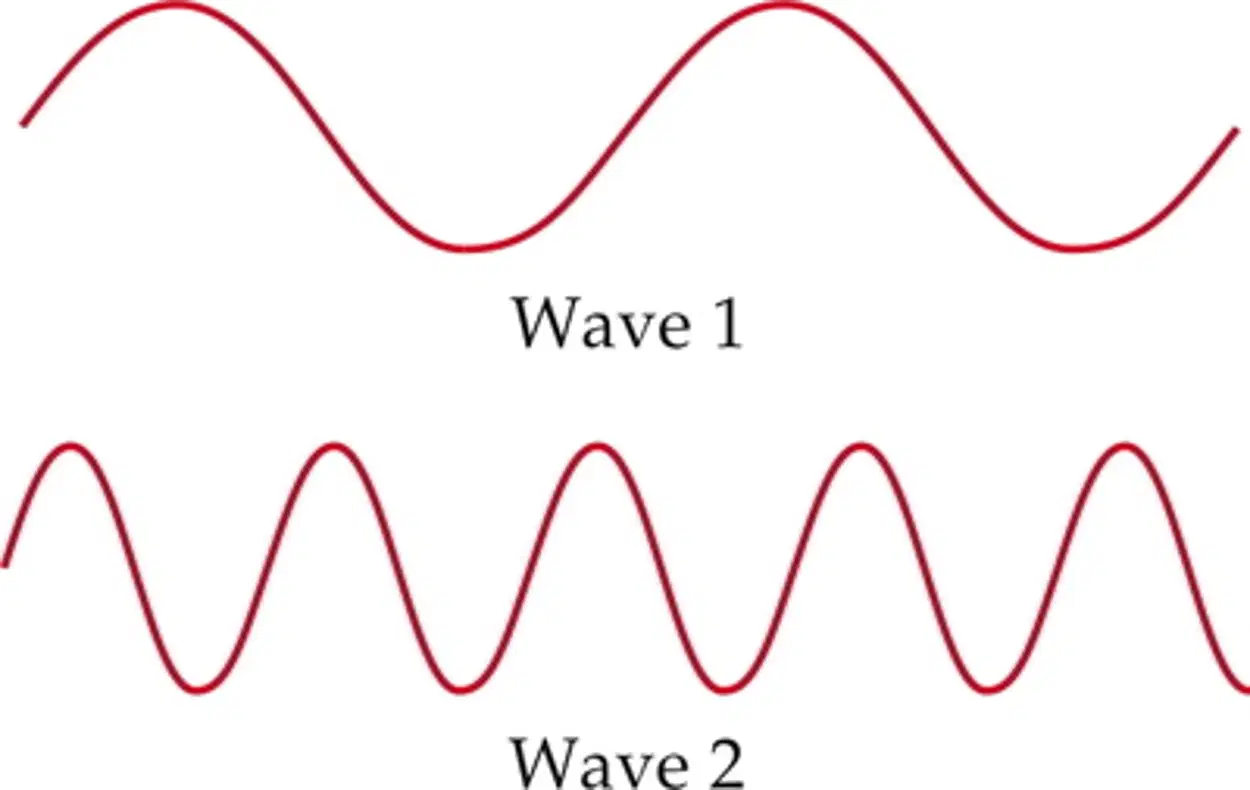
Wave 1
Wave 2
Wave 1
Wave 2
Wave 1
Wave 2
Wave 1
Wave 2

the diagram show
the formation of continous spectrum
the formation of line spectrum

Which of the following give off infrared radiation?
people
light bulbs
stars
teletubbies
a heated / glowing stovetop burner
Which shows an impossible electron configuration?
1s2 2s22p6 3s23p6
1s2 2s22p62d10 3s23p6
1s2 2s22p6 3s23p63d5
1s2 2s22p6 3s23p63d3 4s2
Mass spectrometry is not a spectroscopy technique because
It absorbs light
It emits light
Does not absorb light
Uses electromagnetic radiation
How many electrons can fit in a p-orbital?
1
2
6
10

Which wave has a low frequency, a long wavelength, and low energy?
A
B
Not enough information to determine

When bombarded with light, lithium emits a light with a frequency of 4.29 x 10¹⁴ Hz. Calculate the wavelength and use the chart to predict the color.
blue
green
yellow
red
"Electrons will occupy atomic orbitals of lowest energy first."
This statement is known as
Hund’s rule.
the Pauli exclusion principle.
the Heisenberg uncertainty principle.
the aufbau principle.

What element is represented in this Bohr Model?
Carbon
Hydrogen
Aluminum
Lithium
What element is represented in this Bohr Model?
Carbon
Hydrogen
Aluminum
Lithium
What element is represented in this Bohr Model?
Carbon
Hydrogen
Aluminum
Lithium
What is the LOWEST possible energy level that an electron can occupy?
Excited State
Fundamental State
Ground State
Outermost State
All stars, including our sun, emit ___ spectra when viewed through a spectroscopy telescope.
bright-line (or emission)
absorption (or dark-line)
continuous
multiple
The study of the way matter emits and absorbs radiation is called ___.
astronomy
chemistry
spectroscopy
atomic theory
What are line spectra, and how are they used?
Line spectra are observed when pure samples of individual elements are heated. They can be used to identify elements.
Line spectra are observed when atoms interact with visible light. They can be used to determine the energy levels of atoms.
Line spectra are observed when atoms interact with visible light. They can be used to infer important information about atoms.
Line spectra are observed when pure samples of individual elements are heated. They can be used to determine the wavelengths of light.
The atomic mass of an element is the ___.
average of the mass number and the atomic number for the element
weighted average of the masses of the isotopes of the element
total mass of the isotopes of the element
total number of subatomic particles in the nucleus
What is the difference between an absorption spectrum and an emission spectrum?
An absorption spectrum is formed by a solid or dense gas, while an emission spectrum is formed by a hot, thin gas
An absorption spectrum is a continuous spectrum, while an emission spectrum is a pattern of missing colors
An absorption spectrum is produced by passing white light through a cool, thin gas, while an emission spectrum is produced by heating a gas
An absorption spectrum consists of bright lines, while an emission spectrum consists of dark lines
Spectrum is a group of.......
Wavelengths
Frequencies
Both wavelength and frequency
None of the above


What do spectroscopes do?
Collect light to identify elements
Refract light
Absorb light
Transmit light

A “particle of light” is called a ______
electron
proton
neutrino
photon

Read the following statements:
I. It explains the origin of the emission spectrum for Hydrogen only.
II. It is impossible to know both the position and the momentum of the electron
III. It does not specify the position of the electron in the atom.
What options correspond to deficiencies of the Bohr's atomic model?
I and II
I and III
II and III
I, II and III

True or False: The ground state is the highest energy state of an atom.
True
False
Which scientist described a positively charged core (“nucleus”) in the middle of a lot of empty space?
Rutherford
JJ Thompson
Chadwick
Bohr
a kind of radiation including visible light, radio waves, gamma rays, and X-rays, in which electric and magnetic fields vary simultaneously.
atomic emission spectra
electromagnetic radiation
photon
quantum
The basic unit of a chemical element is referred to as the
proton
electron
neutron
atom

