
 Worksheets
Unit 4-Rational Functions Study Guide
Total questions: 65
Worksheet time: 2hrs 18mins
Simplify the radical expression:
128a3b4
8ab22a
2a8ab2
2ab64ab
64ab22a
Simplify the radical expression:
27m7p4
3m3m3p2
3m3p23m
9mp3m
9m3p23m
Simplify the radical expression:
92a2b3
23ab2b
2ab23b
4ab23b
4a2b223b
Simplify the radical:
25x65x
25x3
5x3
5x4
y²⁄ ³


3√125x6y18

Multiply then simplify the radicals.
24x5y6
4x5y63
2x2y36x


x+4=0
(a)
5=−2x−1+15
(a)
3x−1−9=0
(a)
16=736x+28+30
(a)
532x+1=25
(a)
−3=4310x−3+9
(a)
x=9x−20
(a)

Which function matches the graph?
A
f(x) = √(x - 4) - 2
B
f(x) = √(x + 2) - 4
C
f(x) = √(x - 2) - 4
D
f(x) = √(x + 4) - 2

What is the Range for the graph?
A
-4 ≤ y < ∞
B
− ∞ < y ≤ -2
C
-2 ≤ y < ∞
D
− ∞ < y ≤ -4
What is the Domain for the graph?
A
-4 ≤ x < ∞
B
− ∞ < x ≤ -2
C
-2 ≤ x < ∞
D
− ∞ < x ≤ -4

Which function matches the graph?
A
f(x) = √(x - 1) + 3
B
f(x) = − √(x + 1) + 3
C
f(x) = √(-x + 1) + 3
D
f(x) = − √(x + 3) − 1

Which function matches the graph?
A
f(x) = ∛(x + 3) + 2
B
f(x) = − ∛(x - 3) + 2
C
f(x) = ∛(x - 3) + 2
D
f(x) = ∛(x - 2) + 3

What is the Range for the graph?
A
2 ≤ y < ∞
B
− ∞ < y ≤ 3
C
3 ≤ y < ∞
D
− ∞ < y < ∞


What is the range of this function?
[-4,∞)
[0, ∞)
(-∞, 4]
(0,∞)

What is the x-intercept of this function?
(3,2)
(2,3)
(0,11)
(11,0)

What is the y-intercept of the graph?
(-1,0)
(0,-1)
(0,3)
(3,0)
What is the conjugate of:
5+7
18
5+7
5−7
32
Multiply:
(4+2)(4−2)
16−2
4−2
14
18
What should you multiply 1−56 by to rationalize the denominator?
-4
1−5
1+5
−2(3−35)
Rationalize the denominator:
1214
114
121484
112
1212121
What should you multiply 1−56 by to rationalize the denominator?
-4
1−5
1+5
−2(3−35)
∛x⁷
y²⁄ ³
y¹⁄ ³

Write the above expression in exponential form.


What is the root index for the square root of 9?
1
2
3
4
√23
Simplify.
(2n4 )( 5n4)
7n4
10n16
10n8
none of the above

Simplify.
a8b13
a2b7
a15b30
none of the above

Simplify the expression with positive exponents


simplify the expression (53x2y4)0
5xy
1
0
5
Simplify (2a4b6c−2)3 . Your answer should not have any negative exponents.
6a12b18c−6
8a12b18c6
c68a12b18
8a7b9c
(21)2 ×(21)3
(21)6
(21)5
(21)1
Simplify . Your answer should contain only positive exponents.yx31⋅xy23
x34y25
x32y21
x31y23
x32y34
Simplify . Your answer should contain only positive exponents. 4v32⋅v−1
4v31
v314
4v31
4v311

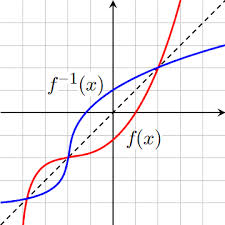
Which of the following is NOT TRUE about inverse functions?
Inverse functions are reflections of each other over the line y = x.
You find the inverse by switching x and y in the equation.
The domain of a function always becomes the domain of its inverse.
The domain of a function always becomes the range of its inverse.
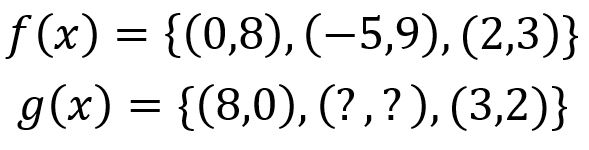
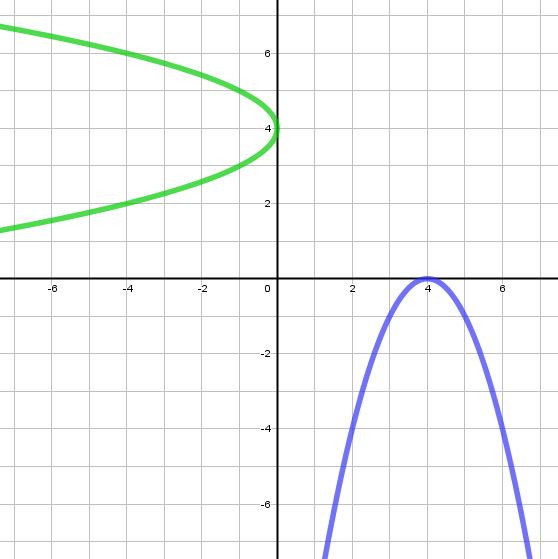
What is the best description?
They are both functions, but not inverse functions.
They are inverse functions.
They are reflected over y=x, but they are not both functions.
They are not reflected over y=x, and they are not both functions.
f(x) = -4x - 12
What is f-1(x)?
f-1(x) = 4x - 3
f−1(x)=−41x−3
f−1(x)=41x+3
f-1(x) = -4x - 3
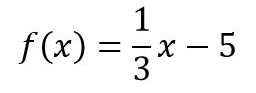
Which is f -1(x)?
f -1(x) = 3x + 5
f -1(x) = 3x - 5
f -1(x) = 3x - 15
f -1(x) = 3x + 15
What is the inverse of the points (1,3)(2,4)(6,2)?
Find the inverse.
f(x)=2x-2
switch the x's and y's
divide the x's and y's by 2
make the x's and y's negative
make the x's and y's the same

