
Font size
 Worksheets
2nd Six Weeks Art Test 24
Total questions: 42
Worksheet time: 23mins
What was the primary aim of Impressionist painters?
To capture detailed and precise portraits
To express their academic knowledge of art
To capture their immediate feelings towards their subjects
To recreate famous historical events
How did Claude Monet contribute to Impressionism?
By creating sculptures
Through his painting "Woman with a Parasol"
By writing art critiques
Through architectural designs
Which of the following is a characteristic of Impressionist paintings?
Dark and muted colors
Precise and detailed lines
Bright colors and expressive brush strokes
Realistic and lifelike images
What was the public's initial perception of Impressionist art?
It was praised for its realism
It was seen as innovative and beautiful
It was viewed as unfinished and ugly
It was ignored and forgotten
Why did Impressionists prefer painting outdoors?
To follow the traditional art methods
To capture impressions and the benefits of natural light
To avoid the distractions of indoor environments
To save on studio rental costs
What is a unique technique used in Impressionist paintings?
Using charcoal for shading
Applying paint thinly in layers
Using quick and thick brush strokes
Painting with a palette knife
What is the intended viewer experience of Impressionist paintings?
To analyze the technical skills of the artist
To appreciate the historical accuracy
To feel the emotions and impressions of the scene
To compare it with traditional art styles
What were the two factors that influenced the distinct style of Impressionism compared to traditional art?
Use of light and color
Focus on everyday scenes
Incorporation of abstract elements
Emphasis on historical subjects
Which of the following subjects would an Impressionist most likely paint?
A historical battle scene
A detailed portrait in a studio
A landscape with changing light
A still life of fruit indoors
Who were the creators of oil pastels in the 1920s?
Pablo Picasso and Henri Sennelier
Rinzo Satake and Shuku Sasaki
Sakura Cray-Pas and Pablo Picasso
Henri Sennelier and Rinzo Satake
Which artist's endorsement helped oil pastels gain popularity in the 1940s?
Henri Sennelier
Rinzo Satake
Shuku Sasaki
Pablo Picasso
What is the technique called when you scratch through a heavily applied area to reveal layers beneath?
Sgraffito
Impasto
Glazing
Scumbling
Which technique involves creating forms with short, directional lines?
Blending
Feathering
Heavy Pressure
Sgraffito
Which of the following is NOT typically associated with Rembrandt's artwork?
Use of chiaroscuro
Detailed landscapes
Portraits and self-portraits
Bright and vibrant colors
In which century did Rembrandt primarily create his artwork?
15th century
16th century
17th century
18th century
Rembrandt's work is often characterized by its:
Minimalism
Dramatic lighting
Abstract forms
Monochrome palette
What subject matter is commonly found in Rembrandt's paintings?
Mythological creatures
Everyday life scenes
Surreal landscapes
Futuristic cities
Rembrandt is best known for his mastery in painting which of the following?
Historical events
Still life
Self-portraits
Abstract patterns
Which artistic movement is Rembrandt most closely associated with?
Baroque
Romanticism
How did Rembrandt often convey emotion in his portraits?
Through vivid colors
Through facial expressions and light
Through abstract shapes
Through geometric patterns
What is a significant characteristic of Rembrandt's later works?
Simplified compositions
Increased use of color
More detailed and realistic features
Use of digital techniques
What was the primary art movement with which Andy Warhol was associated?
Impressionism
Cubism
Pop Art
Surrealism
Which of the following is NOT one of Warhol's famous works?
"Campbell's Soup Cans"
"The Starry Night"
What technique did Warhol popularize that allowed him to produce multiple copies of the same image?
Etching
Silkscreen printing
Lithography
Woodcut
Which of the following describes Warhol's studio, "The Factory"?
A quiet retreat for solitary artists
A hub for artists, musicians, and celebrities
A traditional art gallery
A place for producing sculptures only


Which of the paintings below were painted by Monet?


Which painting below was by Monet?


Which painting below represents Surrealism?


Name the artist that painted "The Anatomy Lesson of Dr. Nicolaes Tulp".
Monet
Warhol
Disney

Name the artist that painted "The Descent from the Cross"
Monet
Warhol
Disney
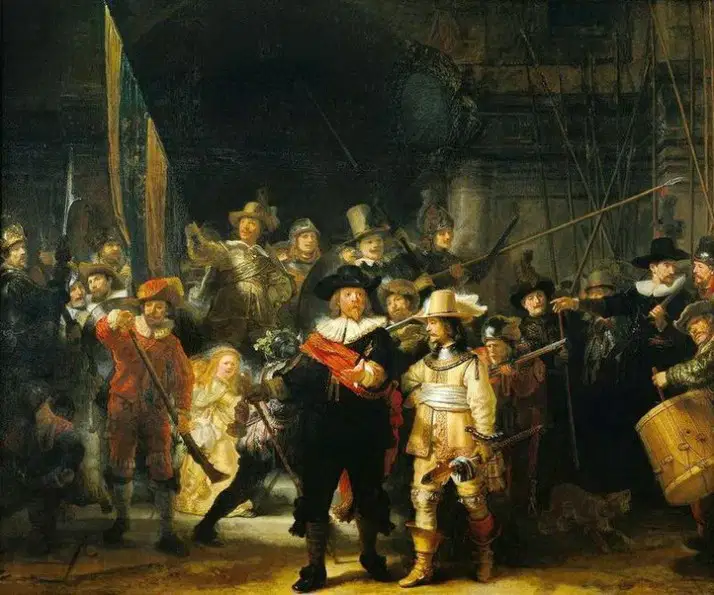
True or False- the artist that painted "The Night Watch" is Andy Warhol.
True
False

This is an example of Pop Art.
True
False
Which of the following is an example of pop art? Check all that apply.


Which art movement is associated with Salvador Dali
Impressionism
Cubism
Surrealism
Expressionism
What was the main goal of the Surrealism movement in the 20th century?
To promote political ideologies
To create and explore using the unconscious mind
To enhance scientific understanding
To develop new painting techniques
What is the foundation of Surrealism?
The interpretation of reality
The interpretation of dreams
The interpretation of nature
The interpretation of modern art

This piece titled The Persistence of Memory, created in 1931, was made by the artist.
Frida Kahlo
Salvador Dali
Rene Magritte
Which of the following is NOT a surreal piece by Salvador Dali?



