
 Worksheets
Ensci_ Adaptations and Biomes
Total questions: 110
Worksheet time: 2hrs 45mins
Which statement is true?
There are a few number of animals that live in the rain forest, and they belong to a small number of species.
The population of animals in the rainforest is large and diverse.
Many animals live in the rainforest, but there are just a few species that can survive there.
There are many species living in the rainforest, but their populations are usually very small.
What might happen to the earth’s atmosphere if the rainforest disappeared?
We’d have less oxygen and more carbon dioxide.
We’d have more oxygen and less carbon dioxide.
We’d have more oxygen and more carbon dioxide.
We’d have less oxygen and less carbon dioxide.
The tropics can be found…
Throughout the pacific ocean.
On every continent.
Only in the southernmost regions of the earth.
Near the equator.
Which of the following most likely supports the most sustainable ecosystem?
The habitat with the greater number of green plants
The habitat with the greatest variety of living things
The habitat with the warmest average temperature
The habitat with the greatest number of consumers
What is biodiversity?
The plants that makeup an ecosystem
The animals the makeup an ecosystem
The differences between plants and animals in an ecosystem
Both a and b
Which of the following contributes most to promoting sustainability in an ecosystem?
Lack of decomposers
A balanced water table
Variety of organisms
A narrow temperature range
A tree in the Grasslands that is home to more than 20 different species of organisms is called a ____
Biome
Sustainability
Microhabitat
Tree home
Which of the following is considered a BIOTIC factor?
Rocks
Sun
Water
Tree
What is the name of an area that has a large variety of flora and fauna in which that it makes up?
Habitat
Biome
Abiotic Factors
Biotic Factors
Which of the following biomes is considered the most biodiverse?
The ocean
The tundra
The rainforest
The grasslands
Fauna are ____________ and Flora are ____________
Plants, Animals
Animals, Plants
Biotic Factors, Abiotic Factors
Abiotic Factors, Biotic Factors
Under which biome would an Alpine and the Arctic fall under?
Tundra
Aquatic
Desert
Grasslands
In which biome would you most likely find fish?
Tundra
Desert
Grasslands
Forests
What is an Abiotic Factor?
Living things that shape an ecosystem
The fauna and flora that make up and ecosystem
Non-living chemical and physical parts of the environment that affect living organisms and the functioning of ecosystems.
The microhabitats within an ecosystem.
Which of these makes up 70% to 71% of the planet?
Ocean
Forests
Tundra
Grasslands
Biotic factors of an ecosystem are:
non-living things
always plants
living things
soil
Which of the following animals would you NOT find in a desert biome?


Select all options below that describe a desert biome. (Attention! There is more than 1!)
Covers 20% of the world's land
Very dry soil
30-50 inches of rain (medium quantity)
Hot during the day, cold at night
Terrestrial biomes are defined by their...
precipitation and temperature
country
humidity
economy
Match the following tupes of leaves

coniferous

braded leaf

tundra
Which biome, because of its climate, has the largest number of species of plants and animals?
tundra
desert
tropical rainforest
chaparral
Which major biome is home to cacti, mesquite, white thorn, pack rats, small reptiles, and coyotes?
desert
taiga
rainforest
grassland
Which biome contains large populations of grazing herbivores, few species of birds, and deep, rich soil?
Boreal Forest
Tundra
Deciduous Forest
Grassland

Northern biome with many coniferous trees; very cold temperatures in the winter months.
Taiga (Boreal Forest)
Savanna
Desert
Temperate Rainforest
Identify an a example of an abiotic factor?
Panda
Turtle
Butterfly
sunlight
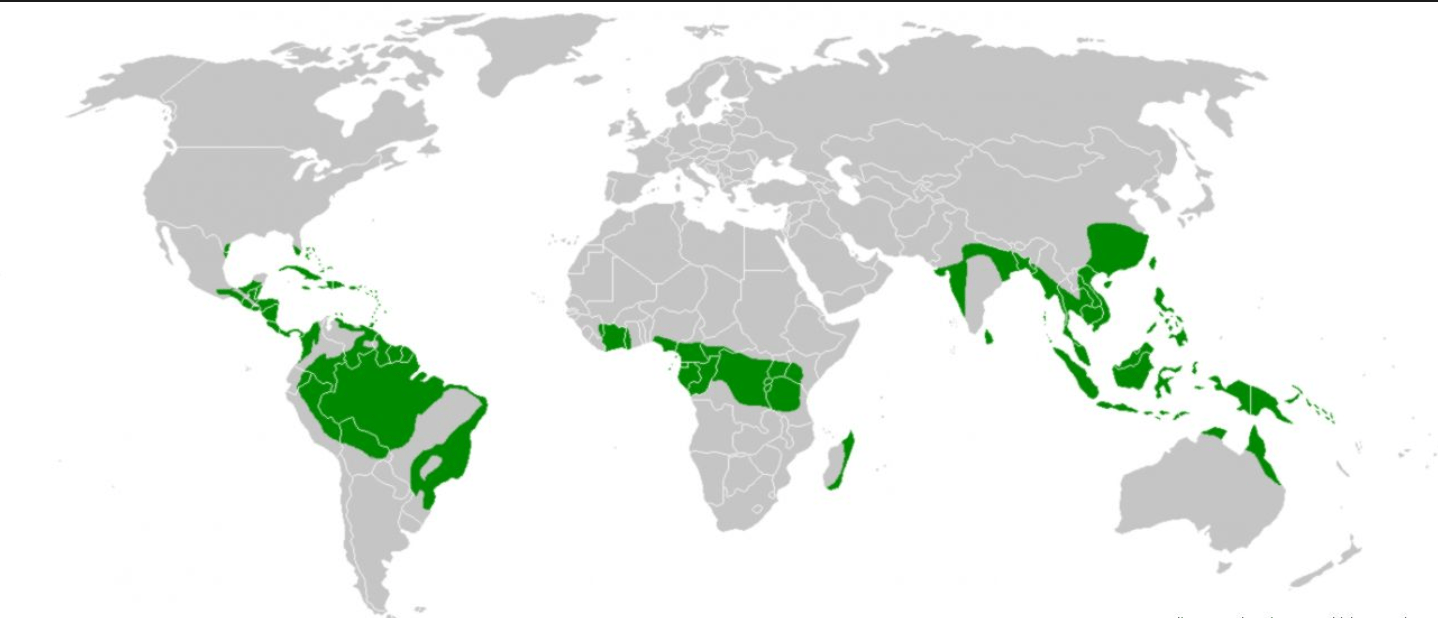
Which biome covers most of the land mass near Earth's equator?
tundra
desert
grassland
tropical rainforest

Which biome has deciduous trees (that lose their leaves in the fall)?
Temperate Forest
Rainforest
Grasslands
Taiga

Which biome has 4 seasons?
Taiga
Tundra
Tropical Rainforest
Temperate Forest

Which biome is highlighted in the picture?
Desert
Taiga
Temperate Forest
Tropical Rainforest
Which biome has less than 25cm of rain each year?
Grasslands (Savanna)
Temperate Deciduous Forest
Desert
Rainforest

The three-toed sloth is adapted to living in a hot, humid climate with lush vegetation and no seasons. What biome would you most liked find this organism?
Temperate Deciduous Forest
Tropical Rainforest
Grasslands
Taiga (Boreal Forest)

Which biome do we live in?
Grasslands
Taiga
Rainforest
Temperate Forest

Which biome is represented by the rainfall amounts in letter C?
desert
prairie
deciduous forest
tropical rainforest

Which best explains why there are fewer plants on the forest floor than in the canopy of the tropical rain forest?
more precipitation
less protection from animals
more human interference
less sunlight

What can you infer about animals that live in the desert?
Most of them are quite large
Most of them are warm-blooded
Most are unable to withstand temperatures below 90 degrees Fahrenheit
Most can survive on very little water
Which biome has deciduous trees (that lose their leaves in the fall)?
Temperate Forest
Rainforest
Grasslands
Taiga

In a tropical rain forest, the layer which forms an umbrella effect with trees is called the ____________ and the layer of shorter trees and vines underneath that layer is called the ____________.
canopy; understory
understory; canopy
top; middle
green; brown

What biome is located on the map?
tropical rainforest
taiga
temperate rainforest
desert
________ are large regions of the world with specific types of plants, animals, and climate patterns.
Communities
Ecosystems
Biomes
Cities
These biomes are open, fairly flat areas that cover one fourth of the world's land. They can be found on every continent except Antarctica
Taiga
Desert
Grassland
Tropical Rainforest

Which type of biome is it?
Temperate grassland
Taiga
Desert
Savanna grassland
Taiga
Savanna
Desert
Temperate Rainforest

Match the following
when a plant or animal changes physical or behavioral characteristics over many generations to better survive in their environment
adaptation
animals or birds that move depending on the season
migratory
the long-term temperature, humidity, precipitation, wind, etc in an area
climate
have similar ecosystems, climates, vegetation, and wildlife
biome
Match the biomes
Forest
Tropical Rainforest
Grassland
Savanna
Aquatic
Ocean
Which of these is NOT an abiotic part of an ecosystem?
water
soil
atmosphere
populations
Which of the following is correct?
A biome is part of an ecosystem. An ecosystem is part of the biosphere.
An ecosystem is part of the biosphere. The biosphere is part of a biome
A biosphere is part of a biome. A biome is part of an ecosystem.
An ecosystem is part of a biome. A biome is part of the biosphere.
Which statement is true?
Biomes have clearly defined borders.
Biomes can influence each other.
Biomes do not contain abiotic factors.
Ecosystems must be either aquatic or terrestrial, never both.
What is a biome?
the living and nonliving things in one place
the parts of the Earth and the surrounding atmosphere where there is life
a large region on Earth with a specific climate, physical features, plants, and other organisms.
none of the above
When an ecosystem changes, the results are____.
all positive
all negative
neither positive nor negative
mixed between positive and negative
A carrying capacity is anything that restricts the number of individuals in a population
True
False
Would the carrying capacity of an area for a species be affected by the other species that live in the same area?
No, each species is separate
Only if the species in question and the second species eat the same food
Only in the winter when food and shelter are more scarce
Yes, all populations in a community affect each other
Each organism has its own unique way to survive, obtain food and shelter, and avoid danger. This is called that organism's ______.
habitat
niche
symbiont
community
When two species interact in a way that is beneficial to both species, this is a _______ relationship.
parasitic
mutualistic
commensal
community
When two species interact in a way that is beneficial to one but harms the other species, this is a _______ relationship.
parasitic
mutualistic
commensal
community
Drought, fewer plants, and fewer nesting sites are examples of ________factors.
biotic
abiotic
limiting
carrying
Where do producers obtain energy?
from the sun and chemicals in the environment
from eating plants
from sunlight and moonlight
from the minerals in the ground where they are growing
An organism that cannot convert light or chemical energy into food must obtain its energy in what way?
eat food
drink water
stay in the sun
soak it up from the soil
In deep oceans, where there is no light for photosynthesis, where do some producers get the energy to make food energy?
other producers
eat consumers
chemicals from volcanic vents
There are no producers where there is no sunlight
A producer makes energy from the environment. A consumer eats the producer and is eaten by another consumer and so on. As the energy is transferred each time, what happens?
The amount of available energy stays the same.
The amount of available energy increases
The amount of available energy decreases
The effect on the amount of available energy varies

Why are there fewer organisms in each level as you go up the energy pyramid shown below?
There is more energy available at higher levels
Higher levels have more mean animals
There is less energy available at higher levels
Coyotes get hungrier
Which of the following does not follow a cycle in the environment?
oxygen
carbon
energy
water

A baby turtle crawling towards the ocean right after it's born is called?
mimicry
camouflage
instinct behavior
Why would a bunnies fur be brown in the summer and white in the winter?
The rabbit likes to change fur color
The bunny learned it from his parents
The changing of fur color help the bunny blend in with it's surroundings.
What is NOT a physical adaptation?
A turtle having a hard thick shell.
Herons having long legs to wade in the water.
A bird having a sharp beak to help them catch their prey.
Baby Cheetahs learning to hunt from their mom.

According tho the graph, which animal travels the longest distance?
Hummingbirds
Snow Geese
Seals
Monarch Butterflies

Hibernation, migration, and dormancy or all examples of ___________ adaptations.
behavioral
physical
special
environmental

Both animals and people are born with ___________, like crying.
instincts
experiences
adaptations
dormancy

Camouflage and mimicry are examples of ___________ adaptations.
behavioral
special
physical
predatory
Which of the following responses is a plant growing toward or leaning toward light?
thigmotrophism
phototropism
gravitropism
hydrotropism
Which of the following responses is a plant growing toward or leaning toward touch?
thigmotropism
hydrotropism
phototropism
gravitropism
A plants roots grow thicker towards the stream than away from the stream. To what stimulus is the plant responding to?
thigmotropism
gravitropism
photoropism
hydrotropism
What term refers to a plant growing or moving away from a stimulus?
Touch
Dormancy
Tropism
Development
Plant's roots grow down, anchoring it into the ground. To what stimulus is the plant responding?
thigmotropism
phototropism
hydropism
geotropism
What does the term adaptation mean? Use your own words...
Physical adaptations are ___________ that allow an animal to find and consume food, defend itself, and to reproduce in order to survive.
an organism's actions
body structures or features
learned skills
instinctive behaviors
Camouflage and mimicry are examples of ___________ adaptations.
behavioral
special
physical
predatory
Check all of the behavioral adaptations that ARE instinctive. Remember, these don't need to be taught.
migration
hibernation
finding shelter
mastering hunting skills to catch prey
Which of the following is NOT a behavioral adaptation?
Making a nest in the crevices of buildings
Hunting at night
Collecting food from trash cans
Having large eyes that can see well in the dark

Which of the following is an adaptation that helps a seal survive in the COLD?
blubber
body shape
skin color
sharp teeth
Which adaptation would NOT help a hawk catch a mouse?
hollow bones
excellent eye sight
talons
camouflage

The ears of this fox are an example of...
a behavioral adaptation.
not enough food for the body to grow.
a structural adaptation.
a behavioral learned adaptation.

A baby leopard stays with it's mother and she teaches them how to hunt for food. This is a(n) _________ behavior.
mimicry
camouflage
instinctive
learned
Which is NOT a physical adaptation?
a bear hibernating in the winter
a bird with a sharp beak
a fish with scales on its body
a squid using ink to escape the evil clutches of a predator

Birds have different beaks to help them survive in their habitat, which is a type of ___________ adaptation.
behavioral
physical
learned
migration
Hibernation, migration, and dormancy or all examples of ___________ adaptations.
behavioral
physical
special
environmental

Squirrels gather and store acorns for the winter, which is a ___________ adaptation.
behavioral
structural
physical
environmental
Provide an example of an adaptation you have had to use since COVID-19 changed how we do a lot of things.
What is the best definition of animal adaptation?
Changes to an animal's diet.
Characteristics that help animals survive.
Characteristics of an animal's habitat.
Skills learned in order to hunt.
True or false: All animals have adaptations that help them survive in their habitat.
True
False
Partially true: Not all animals have adaptations
Partially true: adaptations are not for surviving
Animals who travel to warmer habitats in the winter to escape the cold are using which behavioral adaptation?
Mimicry
Camouflage
Hibernation
Migration
True or false: Humans have studied adaptations in order to create technology to survive.
True
False
When animals go into a deep sleep during the winter, they are using which behavioral adaptation?
Hibernation
Mimicry
Migration
Camouflage
Fill in the blanks: A _________ adaptation is the way an animal acts in order to help them survive.
Physical
Behavioral
Simple
Memory
The black bear’s primary diet is fruit, nuts, honey, and berries. However, they also like to eat fish and small mammals. Their long, sharp claws make it possible to climb trees in order to reach some of their food sources. Black bears also have an extremely good sense of smell. Their long nose allows them to smell up to 20 miles away. This is 100 times better than humans can smell. The black bear’s tongue is sticky allowing them to easily eat ants, berries, and nuts. Black bears also have extremely strong legs, allowing them to move rocks and other obstacles out of their way to get to their food. SELECT ONE EXAMPLE OF THE PHYSICAL ADAPTATIONS LISTED ABOVE.
Eating nuts
Sticky tongue
Eating fish and small mammals
Moving rocks
Fill in the blank: A ______________ adaptation is the way an animal looks in order to help them survive.
simple
behavioral
physical
extreme
Some animals are able to copy other animals in order to look more dangerous to get away from predators. What is this called?
Hibernation
Camouflage
Mimicry
Migration
I am a polar bear who lives in the arctic. My fur is a beautiful white, just like the snow I live in. What adaptation is this adaptation called?
camouflage
mimicry
migration
hibernation
I am a grey goose who loves to fly. Every fall when it starts to get cold, I fly south for the warmth. Once my home warms up, I know it is safe to go back home. What adaptation is this?
hibernation
mimicry
camouflage
migration
It is a not learned behavior that allows organisms to survive.
innate behavior
nate behavior
learned behavior
It is an example of an innate adaptation
hibernating
building a nest
hunting
It is an example of an learned adaptation.
finding shelter
breathing
web spinning

