
 Worksheets
Earth in Space
Total questions: 20
Worksheet time: 10mins
Name
Class
Date
1.
What is the difference between Earth's rotation and revolution?
a)
Revolution refers to Earth's spinning on its axis, and rotation refers to Earth's spinning around the Sun.
b)
Rotation refers to Earth's spinning on its equator, and revolution refers to Earth's spinning around the solar system.
c)
Rotation refers to Earth's spinning on its axis, and revolution refers to Earth's spinning around the Sun.
2.
What does Earth's rotation cause?
a)
a year
b)
the seasons
c)
eclipses
d)
day and night
3.
At what angle is the Earth tilted on its axis?
a)
about 5 degrees
b)
about 23.5 degrees
c)
it is not tilted on its axis
4.
Regions of Earth near ____ receive MORE energy from the Sun than regions near ____.
a)
the equator; the poles
b)
the poles; the equator
c)
the arctic; the tropics
5.
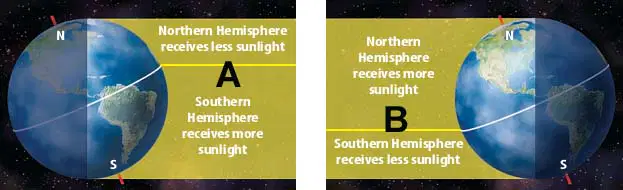
In which figure (A or B) is the Northern Hemisphere experiencing winter and the Southern Hemisphere experiencing summer?
a)
Figure A
b)
Figure B
6.
If you live in the Northern Hemisphere, on which day of the year will your hometown receive the most daylight?
a)
September 21
b)
December 21
c)
March 21
d)
June 21
7.
At which times of the year are the number of daylight and dark hours equal everywhere on the Earth?
a)
during the solstices in June and December
b)
during the equinoxes in March and September
c)
during the winter in the Northern Hemisphere and the summer in the Southern Hemisphere
8.
Which of the following statements are true about the Moon? Check all true statements.
a)
the Moon does not have an atmosphere
b)
the Moon is 1/6 (one-sixth) the mass of the Earth
c)
the Moon is a natural satellite
d)
the Moon emits (gives off) different amounts of light throughout one month
e)
the Earth orbits the Moon
9.
The same side of the Moon always faces Earth because __________.
a)
the motion of the Moon's revolution around Earth and its rotation on its axis take the same amount of time
b)
the motion of Earth's revolution around the Sun and its rotation on its axis take the same amount of time
c)
the motion of Earth's revolution around the Sun and the Moon's rotation on its axis take the same amount of time
10.
Which of the following is true about the waning moon phases?
a)
the light is on the right side of the Moon and the lighted part of the Moon is growing each day
b)
the light is on the left side of the Moon and the lighted part of the Moon is growing each day
c)
the light is on the left side of the Moon and the lighted part of the Moon is shrinking each day
11.
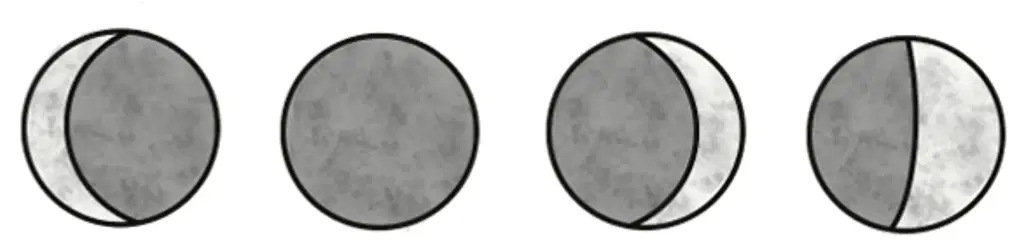
Moving from left to right, what would be the next phase of the Moon?
a)
waxing gibbous
b)
waning gibbous
c)
new moon
12.
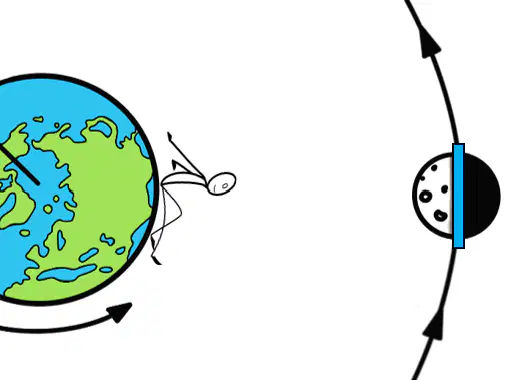
If you were this observer on the Earth looking up at the Moon, what phase of the Moon would you see?
a)
third quarter
b)
new moon
c)
full moon
13.
The Moon is much smaller than the Sun. Why is it possible that the Moon can completely block out the disc of the Sun during a solar eclipse?
a)
The Moon is in a New Moon phase during an eclipse.
b)
The Moon's shadow expands drastically during a solar eclipse.
c)
The Moon's size relative to the Sun is the same as its distance to Earth relative to the Sun.
14.
Why is there not a solar eclipse every time the Moon is between the Earth and the Sun?
a)
Because the Moon's orbit around Earth is tilted 5 degrees from the Earth's orbit around the Sun.
b)
Because eclipses are extremely rare.
c)
Because half of the Moon's surface is always lit by the Sun.
15.
When a solar eclipse happens, who can see it?
a)
Anyone in the Northern Hemisphere
b)
Anyone in the Southern Hemisphere
c)
Anyone around the Equator
d)
Anyone who is in the Moon's shadow
16.
Which statement is true about the tides when the Sun and Moon are aligned?
a)
High tides are higher than normal and low tides are lower than normal. This is called a neap tide.
b)
High tides are higher than normal and low tides are lower than normal. This is called a spring tide.
c)
High tides are lower than normal and low tides are higher than normal. This is called a spring tide.
17.
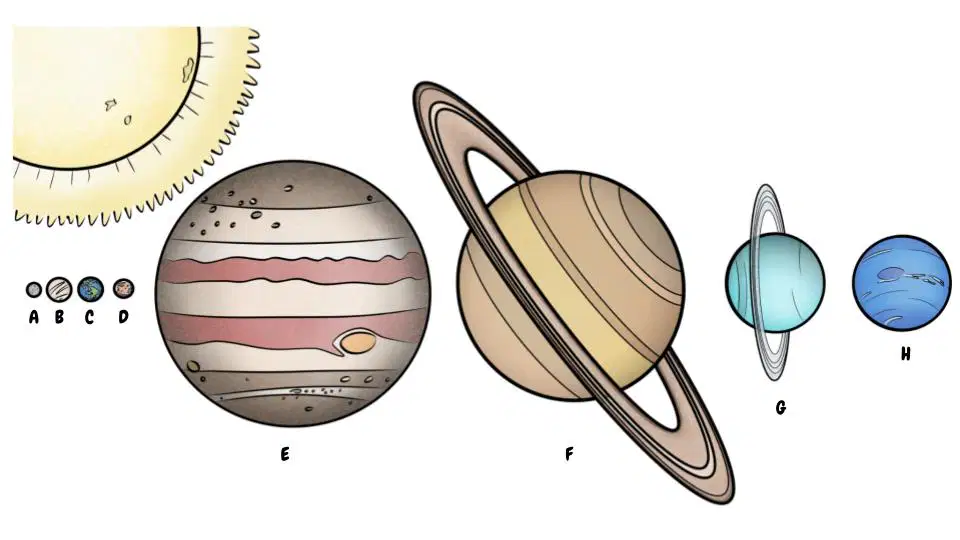
Which planet is labeled G in the diagram?
a)
Mars
b)
Uranus
c)
Venus
d)
Neptune
18.
How are the Terrestrial Planets different than the Gaseous Planets?
a)
The Terrestrial Planets are smaller in diameter
b)
The Gaseous Planets have living creatures
c)
The Gaseous Planets are made of rock
19.
What do all the planets in our solar system have in common?
a)
They all produce their own light
b)
They all orbit the Earth
c)
They all orbit the Sun
d)
They all contain life
20.
The ratio between the measurement on a map or model and the actual measurement is called . . .
a)
distance
b)
scale
c)
model
d)
meter
100 %

