
NEW
Font size
 Worksheets
Química 1er parcial 24-25
Total questions: 46
Worksheet time: 26mins
The smallest portion of matter is called....
ATOM
MOLECULE
FORMULA
ELEMENT

The Periodic Table allows to order.....
FORMULAS
MOLECULES
MATTER
ELEMENTS
What substance was believed to produce fire?
Combustible
Fire
Phlogiston
Burn
What else is Lavoisier known as?

Padre de la Química Moderna
Doctor
Recaudador

Alquimista
The atom presents the following subatomic particles:
Electron, neutron, and positron
Electron, neutron, and proton
Proton, tritium, and electron
Neutron, proton, and tritium

How many ELECTRONS are in the following atom?
75
42
33
108

Choose the correct answer for the number of electrons of the following atom
20
18
19
22

The electron has a charge:
Positive
Negative
Neutral
What is the basic unit of matter?
Molecule
Atom
Neutron
Proton
Which subatomic particle has a positive charge?
Electron
Neutron
Proton
Photon
Who proposed the modern atomic theory in the 19th century?
Democritus
J.J. Thomson
Niels Bohr
John Dalton
What is the electric charge of neutrons?
Neutral
Positive
Negative
Variable

Observe the image and identify which atomic model it corresponds to.
Rutherford Model
Dalton Model
Bohr Model
Thomson Model
Dalton's atomic model


The valence electrons of the chlorine atom in the figure are:
2
8
7
None of the above
The nucleus of an atom is defined as:
The outer part of the atom where electrons are found
The central part of the atom where protons and neutrons are mainly found
The central part of the atom where electrons are found
None of the above
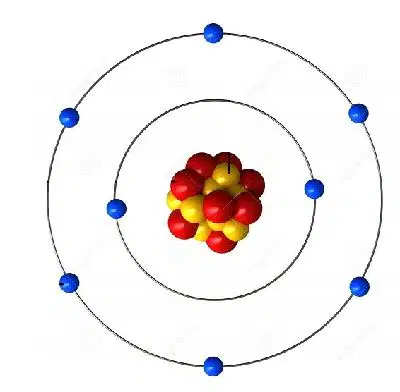
The atomic model represented in the figure corresponds to the model suggested by the scientist:
J.J. THOMSON
ERNEST RUTHERFORD
NIELS BOHR
JOHN DALTON

How many electrons does this image show?
4
5
6
3
According to this philosopher, all matter is composed of a series of tiny, invisible, and indestructible particles called ATOMS, which is the arje of things, we are talking about:
Democritus
Zenon of Elea
Empedocles
Anaxagoras

THE BLUE REGION CORRESPONDS TO
Metals
non-metals
noble gases
metalloids
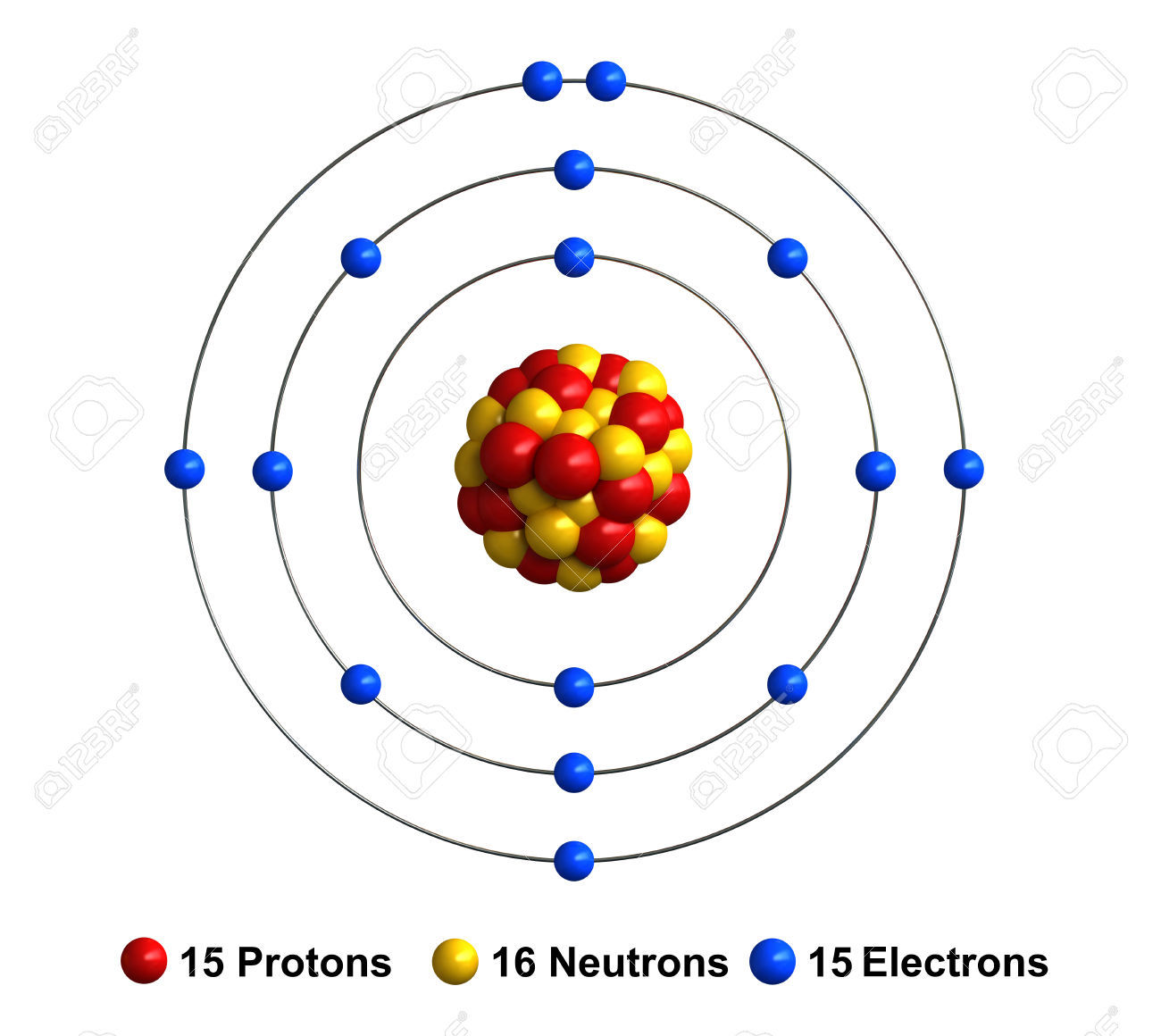
PHOSPHORUS IS:
METAL
METALLOID
GAS
NON-METAL
The vertical columns of the periodic table are called:
Periods or levels
Groups or families
Boxes or cells
Regions or blocks
The horizontal rows indicate the number of levels and are called
Cells or boxes
Regions or blocks
Groups or families
Periods or Levels
The correct symbols for the elements Sodium, Iron, Aluminum, Gold, Lithium respectively are:
Na, Fe, Al, Or, LI
Nd, F, Al, Au, Li
Na, Fe, Al, Au, Li
So, Hi, Al, Au, Li
Is considered the Father of the Periodic Table.
Moseley
Werner
Newlands
Mendeleev
The periodic table consists of
6 columns
7 periods
3 groups
18 periods
The oxygen is a gaseous element whose atomic number is:
4
20
12
8
Silver is a chemical element, which has the symbol:
P
Pt
Pl
Ag
The symbols: "Al" and "Cr" belong to two elements that are metals: What are they?
Aluminum and carbon
Aluminum and calcium
Silver and chromium
Aluminum and chromium
CHEMICAL SYMBOL OF COBALT
Co
CO
cO
COB
CHEMICAL SYMBOL OF MAGNESIUM
Mg
MG
Mn
MN
CHEMICAL SYMBOL OF COPPER
Co
Cu
CO
co
CHEMICAL SYMBOL OF PHOSPHORUS
p
fo
FO
P
Beryllium
He
Be
B
S
Helio
Be
B
He
H
Neon
Ni
Na
n
Ne

Chemical symbol for ZINC
ZN
zc
Zn
NOBLE GASES:.....,.......,......,......,......
BERYLLIUM, MAGNESIUM, CALCIUM
LITHIUM, SODIUM,
RUBIDIUM
HELIUM, NEON, ARGON
FLUORINE, CHLORINE,
BROMINE
Name of the following element Sn
Zinc
Strontium
Tin
Silicon
Manganese symbol
Mg
Mn
Sm
Zn
What is the correct option for the electronic configuration of Ca20?
1S2 2S2 2P6 3S2 3P6 4S2
1S2 2S2 2P6 3S2 3P6 3d2
1S2 3S2 2S2 3P6 2P2
1S2 2S2 2P6 3S2 4S2 3d6
What is the electronic configuration of Carbon (6C)?
1S2, 2S2, 2P2
1S2, 2S2, 2P4
1s2 2s2 2p6 3s1
1s2 2s2 2p3
The correct electronic configuration for nitrogen is
1s22s22p3
1s22p32s2
1s22p32s3
1s22s22p6
The Electronic Configuration refers to:
The distribution of nucleons in levels of an atom
The distribution of protons in levels and sublevels of an atom
The distribution in levels, sublevels, and orbitals of the atom
The distribution of electrons in levels, sublevels, and orbitals that an atom has
The atomic number of an element can indicate the number of
electrons
atoms
levels
quantum numbers

THE OCTET RULE CONSISTS OF
IN TERMS OF ELECTRONS IN AN ATOM, THERE CAN BE NO MORE THAN EIGHT ELECTRONS IN THE OUTERMOST ENERGY LEVEL
REACHING A MORE ELECTRONEGATIVE ELECTRONIC CONFIGURATION
FORMATION OF MOLECULAR STRUCTURES
ALL OF THE ABOVE

