wayground logo

Free Printable Worksheets

Font size

S
M
L
XL
Worksheets

Quiz; Matter, SI Unit and Density

Total questions: 80

Worksheet time: 2hrs 31mins

Name
Class
Date
1.

Which term describes when a substance is changed from a liquid to a gas?

a)

Condensation

b)

Evaporation

c)

Filtration

d)

Precipitation

2.

Which of the following represent physical changes?

a)

fruit ripening

b)

milk turing sour

c)

chopping wood

d)

mixing food color and water

e)

melting butter

3.

Which of the following represent chemical changes?

a)

chopping wood

b)

milk turning sour

c)

breaking a pencil

d)

fruit ripening

e)

roasting a marshmellow

4.
Something that takes up space and has mass.
a)
volume
b)
matter
c)
mass
d)
density
5.
The amount of space something takes up
a)
density
b)
volume
c)
mass
d)
matter
6.
What are the three states of matter?
a)
solid, volume, mass
b)
density, volume, mass
c)
solid, liquid, gas
d)
density, gas, volume
7.
__________ are the building blocks of life.
a)
solids
b)
gases
c)
atoms
d)
nutrients
8.
Sand is a ___________________.
a)
liquid
b)
solid
c)
gas
9.

Yeimel is describing the physical properties of his new gaming chair. Which two physical properties can he determine without using any measuring instruments?

a)

taste and odor

b)

volume and temperatue

c)

texture and color

d)

shape and mass

10.

The image shows a lake.


Why is the lake considered matter?

a)

It is large

b)

It is living

c)

It has mass and volume

d)

It has physical properties

11.

Which term describes when a substance is changed from a liquid to a gas?

a)

Condensation

b)

Evaporation

c)

Filtration

d)

Precipitation

12.

A scientist uses an instrument to study the small particles in a piece of matter. The diagram shows what the scientist sees.


What state of matter is the scientist most likely observing?

a)

gas

b)

solid

c)

liquid

d)

vapor

13.

A scientist uses an instrument to study the small particles in a piece of matter. The diagram shows what the scientist sees.


What state of matter is the scientist most likely observing?

a)

gas

b)

solid

c)

liquid

d)

plasma

14.

A scientist uses an instrument to study the small particles in a piece of matter. The diagram shows what the scientist sees.


What state of matter is the scientist most likely observing?

a)

gas

b)

solid

c)

liquid

d)

vapor

15.

Which is true about all matter? Select all that apply.

a)

All matter has weight

b)

All matter takes up space

c)

All matter can be seen

d)

All matter has fixed volume

16.

All matter is made up of smaller pieces of matter called ____.

a)

particles

b)

space

c)

weight

d)

chemicals

17.

What is a solid?

a)

The particles are close together and locked in position, so they cannot move around each other and can only vibrate.

b)

Shape and volume are not fixed.

c)

Has a fixed volume and shape.

d)

Particles are pretty far apart and able to move around easily.

18.

What is a liquid?

a)

Particles are pretty far apart and able to move around easily.

b)

Shape and volume are not fixed.

c)

The particles are close together but they are able to move about.

d)

Has a fixed volume but does not have a fixed shape.

19.

What is a gas?

a)

The particles are spread apart and move freely in all directions.

b)

Does not have a fixed volume or shape. The amount of space that it takes up can change.

c)

Shape and volume of particles are fixed.

d)

Particles are very tightly packed, can only vibrate.

20.

In which state of matter would you classify butter?

a)

gas

b)

solid

c)

liquid

21.

In which state would you classify helium?

a)

solid

b)

liquid

c)

gas

22.

In which state would you classify vegetable oil?

a)

solid

b)

liquid

c)

gas

23.

How can matter change from state to state? Select all that apply.

a)

Each time matter changes state, it is simply the movement of molecules in them speeding up or slowing down. 

b)

When heat is added to a solid, it turns into a liquid.  When heat is added to a liquid, it evaporates and becomes a gas.

c)

When heat is removed from a gas it condenses and turns back into a liquid.  When a liquid freezes, it turns into a solid.

d)

Matter can't change from state to state.

24.
Iron + oxygen = rust is an example of a ___________.
a)
physical property/change
b)
chemical property/change
c)
mass
d)
volume
25.
Which physical property is measured in liters?
a)
color
b)
length
c)
mass
d)
volume
26.
Which liquid has the greatest density?
a)
lamp oil
b)
karo syrup
c)
water
d)
honey
27.
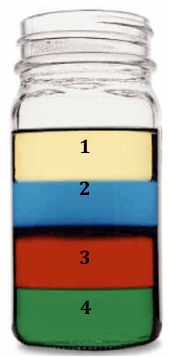
Put the liquids in order from most dense to least dense?
a)
4, 3, 2, 1
b)
1, 2, 3, 4
c)
3, 4, 2, 1, 
d)
4, 3, 1, 2
28.
What is this tool to get volume?
a)
triple beam balance
b)
ruler
c)
thermometer
d)
graduate cylinder
29.
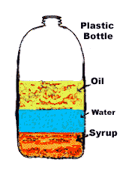
Which liquid is the least dense?
a)
oil
b)
water
c)
syrup 
d)
plastic bottle
30.
Why do the liquids form different layers?
a)
They have different densities.  
b)
They have different masses.  
c)
They have different volumes.  
d)
They are different temperatures.  
31.
A brick sinks in water while a wooden block of the same size floats.  This is because the brick has a
a)
lower volume than the wooden block
b)
lower density than the wooden block
c)
higher volume than the wooden block
d)
higher density than the wooden block
32.
Why do some substances float on water?
a)
they are warmer than water
b)
they are cooler than water
c)
they are more dense than water
d)
they are less dense than water
33.
Metric unit used to record mass.
a)
cm3
b)
grams (g)
c)
miliLiter
d)
liter (L)
34.
The metric unit used to measure the volume of a solid objects.
a)
grams
b)
miliLiter
c)
cm3
d)
Liter (L)
35.
What causes an object to float in a water?
a)
if the object's density is less than the water's density.
b)
if the object's density is the same as the water's density
c)
if the object's density is greater than the water's density
d)
if the object's density is zero
36.
What causes an object to sink in a water?
a)
if the object's density is less than the water's density.
b)
if the object's density is the same as water's density.
c)
if the object's density is greater than water's density.
d)
if the object's density is zero
37.
What property do these tools measure?
a)
volume
b)
mass
c)
length
d)
temperature
38.
What is volume of the water? 
a)
10 mL
b)
15 mL
c)
20 mL
d)
25 mL
39.
What is the volume of the rock?
a)
30cm3
b)
10cm3
c)
40cm3
d)
20cm3
40.

The formula for density is ___________.

a)

D = m / v

b)

M = d / v

c)

V = m / d

d)

D = v / d

41.

_______________________ is a method used to measure the volume of a solid object by placing it in a known amount of liquid.

a)

density

b)

volume

c)

mass

d)

water displacement

42.
Frank has a paper clip. It has a mass of 9g and a volume of 3cm3. What is its density?
a)
3 g/cm3
b)
1/3 g/cm3
c)
27 g/cm3
d)
39 g/cm3
43.
Frank has an eraser. It has a mass of 4g, and a volume of 2cm3. What is its density?
a)
8 g/cm3
b)
2 g/cm3
c)
1/2 g/cm3
d)
24 g/cm3
44.
An object with which of the following densities will float on water?
a)
0.7 g/cm3
b)
1.2 g/cm3
c)
3.5 g/cm3
d)
11.4 g/cm3
45.
Jack has a rock. The rock has a mass of 14g and a volume of 2cm3. What is the density of the rock?
a)
7 mL
b)
7 g/cm3
c)
28 g/cm3
d)
1/7 g/cm3
46.

Which SI unit is used to measure time?

a)

K

b)

s

c)

mol

d)

N

47.

What is the symbol for the prefix kilo-?

a)

L

b)

m

c)

k

d)

kg

48.
What number is the metric system based?
a)
10
b)
20
c)
1
d)
100
49.
2 kilometer = ___ meters
a)
1 meters
b)
1,000 meters
c)
2,000 meters
d)
200 meters
50.

what is the SI unit?

a)

A system that mainly measures mass

b)

a complete metric system of units of measurement for scientists

c)

length-only measuring system

d)

The system just measures temperature

51.

What is the SI base unit for length?

a)

Gram

b)

Meter

c)

Second

d)

Ampere

52.

Which symbol represents the SI base unit for mass?

a)

m

b)

g

c)

s

d)

A

53.

What is the SI base unit for the amount of substance?

a)

Mole

b)

Gram

c)

Liter

d)

Candela

54.

What is the definition of density?

a)

Amount of matter in an object

b)

Mass per unit volume of a material

c)

Distance between two points

d)

Space occupied by an object

55.

Which block has more density?

a)

The one on the right

b)

The one on the left

56.

What is the standard system of measurement used worldwide?

a)

Metric System

b)

Imperial System

c)

International System of Units (SI)

d)

Customary System

57.
Julie is colleting information about the physical properties of a rock. She puts water in a graduated cylinder. Then she puts the rock into the cylinder. What information can Julie collect from the graduated cylinder?
a)
the rocks mass
b)
the rocks temperature
c)
the rocks texture
d)
the rocks volume
58.
When paper is folded to make an origami bookmark, what physical property of the paper changes?
a)
mass
b)
weight
c)
shape
d)
smell
59.
If the mass of an unknown substance is 5.3 grams and the volume is 2 cm3. What would be its density? (round)
a)
2.7 g/cm3
b)
2.5 g/cm3
c)
2.4 g/cm3
d)
2.2 g/cm3
60.
Frank has an eraser. It has a mass of 4g, and a volume of 2cm3. What is its density?
a)
8 g/cm3
b)
2 g/cm3
c)
1/2 g/cm3
d)
24 g/cm3
61.
Calculate the density of the cube.
a)
2 g/cm3
b)
4 g/cm3
c)
6 g/cm3
d)
8 g/cm3
62.
What is the density of water?
a)
0 g/ml
b)
1 g/ml
c)
10 g/ml
d)
100 g/ml
63.

What is the volume of the fish?

a)

18.0 mL

b)

6.0 mL

c)

38.0 mL

d)

32.0 mL

64.

Which scientific tool is shown in the image?

a)

Graduated Cylinder

b)

Triple Beam Balance

c)

Test Tube

d)

Beaker

65.

Find the density of an object with a mass of 144 g and volume of 12 cm3

a)

13 g/cm3

b)

10 g/cm3

c)

12 g/cm3

d)

11 g/cm3

66.

What is the length of the screw?

a)

5.0cm

b)

5.1cm

c)

5.11cm

d)

51mm

67.
You know 1000 mg = 1 g.  Convert 2.5 grams into milligrams.
a)
25 mg
b)
25,000 mg
c)
250 mg
d)
2500 mg
68.

1.Particles cannot change position in a ________

a)

solid

b)

liquid

c)

gas

69.
Mixtures are combinations of two materials that retain their physical qualities.
a)
True
b)
False
70.
Which of the following is a method of separating solutions?
a)
hand seperation
b)
filtering
c)
screening
d)
evaporation 
71.
To separate a mixture of salt and water what separation tool/method is used?
a)
Filter
b)
Screen
c)
Magnet
d)
Evaporation
72.
What happens when sand and water are mixed together?
a)
sand will settle to the bottom
b)
water will change physical properties
c)
the cup will get really cold
73.

The table lists the ingredients of four mixtures. In which mixture do the ingredients not change color?

a)

Mixture 1

b)

Mixture 2

c)

Mixture 3

d)

Mixture 4

74.

The table lists the ingredients of four mixtures.

Which mixture cannot be separated by pouring it through a paper filter?

a)

Mixture 1

b)

Mixture 2

c)

Mixture 3

d)

Mixture 4

75.

A mixture of beads was placed in a container. The beads are of various sizes, and each one is made of either plastic, glass, or steel.

The mixture would be easy to separate, because _____________.

a)

all the beads are less dense than water.

b)

all the beads are solids.

c)

all the beads have the same mass.

d)

all the beads are attracted to a magnet.

76.

The smallest particle of an element. All matter is made up of _____.

a)

properties

b)

mixture

c)

dissolves

d)

atom

77.

Why is cake not a mixture?

a)

It consists of only one ingredient

b)

All of the elements are the same

c)

You cannot separate its ingredients

78.

Which of the following mixture can be separated using a magnet?

a)

sand and salt

b)

sand and iron fillings

c)

sugar and water

d)

Saltwater

79.
What is a homogeneous mixture?
a)
a mixture that is the same throughout.
b)
a mixture that is made up of one type of atom.
c)
a mixture that is made up of one type of compound
d)
a mixture that cannot be separated through physical changes
80.
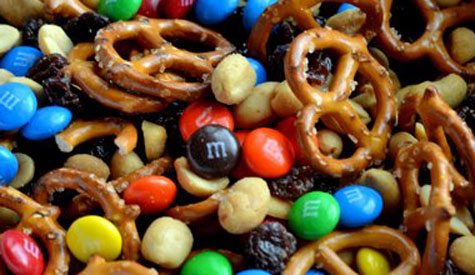
What type of mixture is this?
a)

homogeneous mixture

b)
chemical
c)
heterogeneous mixture 
d)
solid mix