
 Worksheets
Maya chemistry Revision
Total questions: 219
Worksheet time: 2hrs 20mins
When a mixture of rock pieces, salt, and water is filtered, what is the residue?
Rock Pieces
Salt
Water
Salt and Water
When a mixture of rock pieces, salt, and water is filtered, what is the filtrate?
Rock Pieces
Salt
Water
Salt and Water
Out of salt and water, what is the solute?
Salt
Water
Out of salt and water, what is the solvent?
Salt
Water
Solvent + Solute -> (a)
What is the name of the process used to separate an insoluble substance from an a solution?
Filtration
Crystallisation
Sieving
1.What is the name of the process to separate a soluble substance from a solution?
Filtration
Crystallisation
Sieving
What do we call the change of state from a liquid to a gas?
(a)
Particles in a regular arrangement are which state?
(a)
Something that can be compressed is in which state?
Solid
Liquid
Gas
Which one of the following would you use to separate sand from iron filings?
a bar magnet
filter paper
chromatography paper
alum
Which tools are best for separating a mixtures of sand, iron filings, and water?
Hot plate and filter
Tweezers and filter
Filter and magnet
Magnet and hot plate
Which substances, when mixed together, maintain their original physical properties?
gravel and water
wood chips, water and sand
sand and water
all of the above
Which mixture can be separated using a filter?
sand and iron filings
saltwater
sand and water
none of the above
True or False: Each part of a mixture keeps its properties when mixed.
True
False
True or False: Mixtures can be separated by physical processes.
True
False

Lauren wants to separate salt from water. What separation technique should she use?
Distillation
Filtration
Chromatography
Making a mixture results in ___________________ only.
chemical reactions
separate parts
physical changes
two subtances

Salad is an example of a
homogeneous mixture
heterogeneous mixture
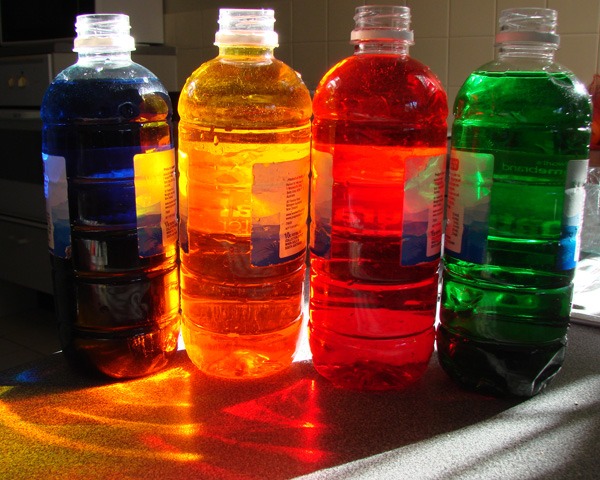
Coloured water is an example of a
homogeneous mixture
heterogeneous mixture
Distillation uses the physical property of (a)
Filtration uses the physical property of (b)
Metal detecting uses the property of (c)
Separation funnel uses the property of (d)
boiling point.
particle size.
magnetism.
density.
mass.
melting point.
freezing point.
Match the mixtures with the best options for separation.

Sand & Water

Salt Water

Coins in Sand

Oil & Water

During the California Gold Rush settlers were searching for gold in the rivers and soil. What separating technique would be best for them to use?
Chromatagraphy
Filtration
Separation Funnel
Distillation
Metal Detecting

Which element has the electron configuration of 2.7?
Krypton
Iodine
Fluorine
Barium
Which alkali metal is most reactive out of the following
rubidium
potassium
sodium
lithium
How many electrons do the alkali metals have in their outer shell?
1
2
8
7
What happens to the reactivity of the alkali metals as you move down the group?
increases
decreases
Which gas is released when the alkali metals react with water?
hydrogen
oxygen
hydroxide
carbon dioxide
What happens to the shielding affect as you go down the group?
increases
decreases
Which of the following is TRUE about an isotope?
same number of protons and neutrons
same number of protons but different number of neutrons
same atomic mass but different atomic number
neutron and electron numbers are the same
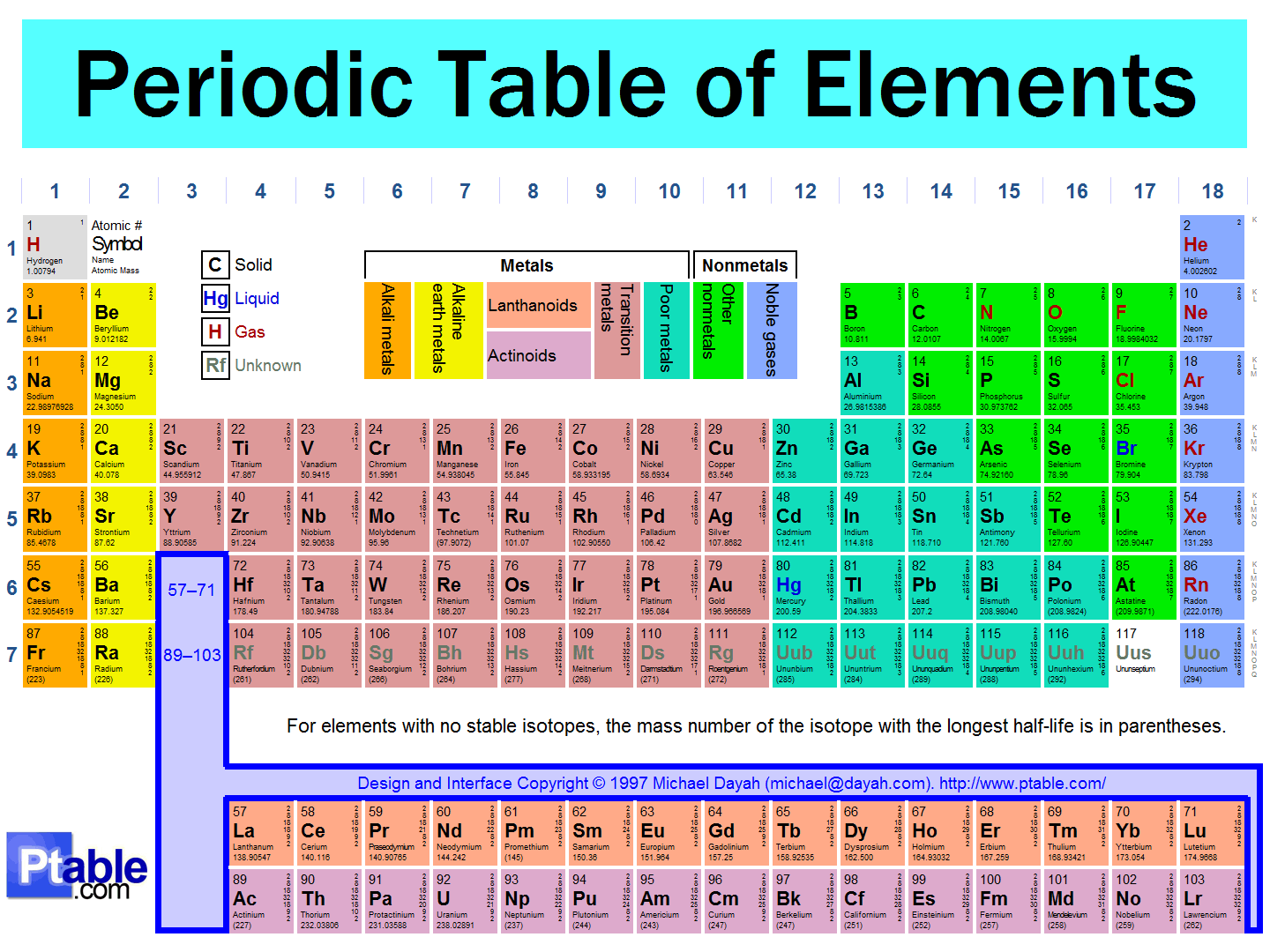
The vertical (up and down) columns in the Periodic Table are called
groups
towers
periods
atomic numbers
The letter, C, is a ... of carbon.
Name
Nickname
Chemical Symbol
Pseudonym
Which of the following are physical properties of metal?
Luster
Conductivity
Malleability
Ductility
True or False: The reactivity of metals tends to decrease as you move from left to right across the periodic table.
True
False
Name this group: These metals are the most reactive.


Name this group: These metals are the second most reactive.


Name this group: These metals are the second most reactive.
Name this group: These metals contain familiar metals such as gold, iron, and copper.


Name this group: These metals, located near the nonmetals, are never found uncombined in nature.


Find these groups: Locate Lanthanides and Actinides.


Which of the following could be properties of nonmetals?
Poor electrical conductivity
Poor thermal conductivity
Dullness
Brittleness
I am a metal
I am in group 2
I am in period 6
I am…
Mo
Re
S
Ba
I am a nonmetal
I am in period 2
I am in group 16/6A
Ba
Si
Ba
O
Find an element with similar chemical properties to Barium (Ba).
Ca an Ra, because they are in the same group and have similar chemical properties.
Cs and La, b/c they are in the same period number.
Ca and Y, b/c they are 90 degree angle and have similiar properties.

Look at the diagram. How many covalent bonds does each carbon atom form in graphite?
(a)

Look at the diagram. How many covalent bonds does each carbon atom form in diamond?
(a)
Tick the properties of diamond
Very hard
Slippery
Conducts electricity
Soft
Does not conduct electricity
Tick the properties of graphite
Very hard
Slippery
Conducts electricity
Soft
Does not conduct electricity
What type of bonding involves metals ONLY?
Ionic
Covalent
Metallic
What type of bonding involves non-metals ONLY?
Ionic
Covalent
Metallic
What type of bonding involves metals and non-metals?
Ionic
Covalent
Metallic
What type of bonding would you expect to see in SODIUM CHLORIDE?
Ionic
Covalent
Metallic
What type of bonding would you expect to see in CARBON DIOXIDE?
Ionic
Covalent
Metallic
Which statement correctly explains why metals conduct electricity?
Metals contain delocalised electrons which can move throughout the structure
Metals contain ions which are free to move throughout the structure
Metals contain an electrical current
Metals are magnetic
Which statement correctly explains why ionic compounds conduct electricity as a LIQUID?
Ionic compounds contain delocalised electrons which can move throughout the structure
Ions are free to move
Ions are fixed in position
Ionic compounds contain an electrical current
Which statement correctly explains why ionic compounds DO NOT conduct electricity as a SOLID?
Ionic compounds contain delocalised electrons which can move throughout the structure
Ions are free to move
Ions are fixed in position
Ionic compounds are not magnetic

How many bonding pairs are present in this covalent molecule?
1
2
3
4
How are covalent bonds formed?
Pairs of electrons are shared
Electrons are transferred from one atom to another
Strong attraction between negative delocalised electrons and positive ions
How are ionic bonds formed?
Pairs of electrons are shared
Electrons are transferred from one atom to another
Strong attraction between negative delocalised electrons and positive ions
Which statement correctly explains why metals are easily bent and shaped?
The metal ions can be squashed
The metal ions can move
The metal ions are in layers which can slide over each other
The metal ions are all the same size
Which statement correctly explains why alloys are harder to shape than pure metals?
The metal ions can be squashed
The metal ions cannot move
The metal ions are in layers which can slide over each other
Different size metal ions disrupt the layers
What is an alloy?
Mixture of elements
Mixture of metals
Pure metal
Mixture of metal and plastic
What is a smart alloy?
An alloy that can change colour
An alloy that returns to its original shape
An alloy that can be used for different purposes
Which are examples of alloys?
Stainless steel
Iron
Copper
Brass
Nitinol
Which ONE is an example of a smart alloy?
Stainless steel
Iron
Copper
Brass
Nitinol
Which statement correctly explains why most covalent substances have low melting/boiling points?
There are strong electrostatic attractions
There are weak intermolecular forces
Covalent bonds are weak
There are no strong bonds
Which statement correctly explains why ionic compounds have high melting/boiling points?
There are strong electrostatic attractions
There are weak intermolecular forces
Ionic bonds are weak
There are strong intermolecular forces
What type of structure do ionic compounds have?
Small, simple molecules
Giant molecule
Giant lattice
Which ion is formed by sodium (Na)?
Na-
Na+
Na+7
Na-7
Which ion is formed by magnesium (Mg)?
Mg-
Mg+
Mg2+
Mg2-
Which ion is formed by oxygen (Mg)?
O-
O+
O2+
O2-
Which ion is formed by Chlorine (Cl)?
Cl-
Cl+
Cl2+
Cl2-
Choose the correct words to complete the sentence:
Ionic compounds can conduct electricity when ____________ or ____________.
solid
aqueous (dissolved)
powdered
squashed
molten
Choose the correct words to complete the sentence:
Metals are excellent conductors of ___________ and _____________.
heat
water
electricity
light

What are the reactants for the reaction of magnesium with oxygen
Magnesium + oxygen --> Magnesium oxide
Magnesium
Oxygen
Magnesium oxide
Magnesium and oxygen
Sulphuric acid + sodium carbonate
-->
Hydrochloric acid + magnesium hydroxide -->
How do we test for hydrogen?
Squeaky pop test
Hydrogen extinguishes a lit splint
Bubbling through lime water
Hydrogen makes a glowing splint relight
Calcium carbonate + hydrochloric acid -->
Calcium chloride + hydrogen
Calcium choride + water
Calcium chloride + carbon dioxide + water
Calcium sulfate + carbon dioxide + water
Copper carbonate + hydrochloric acid -->
Copper chloride + hydrogen
Copper chloride + water
Copper chloride + water + hydrogen
Copper chloride + water + carbondioxide


Hydrochloric acid reacts to form ........ salts.
chloride
hydrochloride
nitrate
sulfate
Nitric acid reacts to form ........ salts.
chloride
nitrite
nitrate
sulfate
Sulfuric acid reacts to form ........ salts.
chloride
nitrite
sulfite
sulfate
acid + base -> salt + ............
carbon dioxide
hydrogen
ammonia
water
acid + metal -> salt + ............
carbon dioxide + water
hydrogen
ammonia + water
water
Which acid reacts with potassium hydroxide to form potassium sulfate?
chloric acid
hydrochloric acid
nitric acid
sulfuric acid
Which acid reacts with calcium hydroxide to form calcium nitrate?
chloric acid
hydrochloric acid
nitric acid
sulfuric acid
Oxides and hydroxides are
bases
carbonates
acids
metals
What are the products formed when zinc + ethanoic acid react?
magnesium chloride and water
aluminium chloride and hydrogen gas
aluminium chloride and water
zinc ethanoate and hydrogen gas

Which of the following describes a precipitate?
a liquid forms when a block of metal is heated
a solid forms when one liquid is poured into another
a gas forms when a solid is placed in a liquid
bubbles form when an acid is poured on a rock
What is the difference between base and alkali
Alkalis are water insoluble bases
Alkalis are water soluble bases
Both are same
Alkali react with acids while bases don't.
Metal ions have which charge?
+
-
Non-metal ions have which charge?
+
-
PANIC - The positve electrode is called the _______
Anode
Cathode
PANIC - The negative electrode is called the _______
Anode
Cathode
Metal ions are attracted to the
Anode
Cathode
Non-metal ions are attracted to the
Anode
Cathode
The rule for products at the anode (positive electrode) is that ____________ always forms unless there are halide (group 7) ions.
O2
H2
OH-
H+

CO32- and OH- are attracted to the positive electrode (anode). What gas forms?
OH-
CO2
O2
H2

NO3- and OH- are attracted to the positive electrode (anode). What gas forms?
OH-
NO3-
O2
H2

SO42- and OH- are attracted to the positive electrode (anode). What gas forms?
OH-
SO42-
O2
H2

PO42- and OH- are attracted to the positive electrode (anode). What gas forms?
OH-
PO42-
O2
H2

Cl- and OH- are attracted to the positive electrode (anode). What gas forms?
OH-
Cl
O2
Cl2

Br- and OH- are attracted to the positive electrode (anode). What gas forms?
OH-
Br
O2
Br2

F- and OH- are attracted to the positive electrode (anode). What gas forms?
OH-
F
O2
F2

The rule at the cathode (negative electrode) is that the ________ reactive metal forms.
least
most

Cu2+ and H+ are attracted to the negative electrode (cathode). Which product forms?
H+(g)
H2 (g)
Cu (s)
Cu2+(s)

Copper chloride solution undergoes electrolysis. Which product forms at the negative electrode (cathode)?
H+(g)
H2 (g)
Cu (s)
Cu2+(s)

Molten copper chloride undergoes electrolysis. Which product forms at the negative electrode (cathode)?
H+(g)
H2 (g)
Cu (s)
Cu2+(s)

Molten lead bromide undergoes electrolysis. Which product forms at the negative electrode (cathode)?
H+(g)
H2 (g)
Pb (s)
Pb2+(s)
Water acidified with sulfuric acid H2SO4 (aq) undergoes electrolysis. Which product forms at the negative electrode (cathode)?
H+(g)
H2 (g)
O2 (g)
OH- (g)

Copper chloride CuCl2 solution undergoes electrolysis. Which product forms at the anode (positive electrode)?
O2 (g)
H2 (g)
Cl2 (g)
OH- (g)
Sodium chloride NaCl solution undergoes electrolysis. Which product forms at the anode (positive electrode)?
O2 (g)
H2 (g)
Cl2 (g)
OH- (g)
A cation is:
A neutral atom
A molecule
A positive ion
A negative ion
Cations form when atoms ...
... gain electrons to form negative ions.
... lose electrons to form positive ions.
... gain electrons to form positive ions.
... lose electrons to form negative ions.
More reactive metals form cations ...
... more readily.
... less readily.
Select the most reactive metal from the options below:
Zn
Ag
K
Fe
Select the most reactive metal from the options below:
Zn
Fe
Cu
Al
In displacement reactions ...
... the more reactive metal is displaced from the compound.
... the more reactive metal displaces the less reactive metal from the compound.
Select the displacement reaction from the options below:
2AgNO3 + Cu → Cu(NO3)2 + 2Ag
HCl + KOH → KCl +H2O
2Na + Cl2 → 2NaCl
CaCO3 + 2HCl → CaCl2 + H2O + CO2
Displacement reactions are an example of ...
... neutralisation.
... redox reaction.
... combustion.
... disproportionation reaction.
In redox reactions:
Electrons are lost.
Electrons are gained.
Electrons are lost and gained.
There is no movement of electrons.
Gold is found uncombined in the Earth’s crust because it is...
Unreactive
Reactive
Plentiful
Shiny
Select the metal which must be extracted by electrolysis.
Copper
Aluminium
Iron
Silver
Select the metal which can be extracted by reduction by carbon.
Aluminium
Sodium
Potassium
Iron
Select the metal which is likely to be found uncombined in the Earth’s crust.
Aluminium
Iron
Zinc
Silver
Phytoextraction is the use of:
Bacteria to extract a metal from its ore.
Plants to extract a metal from its ore.
Bioleaching involves using:
Bacteria to extract a metal from its ore.
Plants to extract a metal from its ore.
An advantage of phytomining is that it:
Is cheap.
Can be used as a source of renewable energy.
Can be used to extract metals from contaminated soils.
Yields pure metal product (no further purification required).
Oxidation is:
The addition of oxygen.
The removal of oxygen.
The addition of electrons.
The removal of electrons.
Reduction is:
The addition of oxygen.
The removal of oxygen.
The addition of electrons.
The removal of electrons.
Select the common uses of aluminium from the list below:
Cans
Foils
Aeroplane parts
Wires
Select the common uses of copper from the list below:
Aeroplane parts
Wires
Roofing
Car parts
Select the common uses of silver from the list below:
Jewellery
Mirrors
Wires
Car parts
Magnalium, used for aircraft parts is an alloy of:
Copper
Aluminium
Alnico
Magnesium
Aluminium is used for aircraft parts as it is:
A good conductor of heat and electricity.
Strong and low density.
Malleable and a good conductor of electricity.
Strong and a good conductor of heat.
More reactive metals ...
... rust more quickly.
... rust more slowly.
... corrode more quickly.
... corrode more slowly.
Rusting can be prevented by:
Exclusion of air.
Exclusion of water.
Sacrificial protection.
Applying oil/paint to create a barrier.
Electroplating can cause a material to:
be more aesthetically pleasing.
change it’s chemical properties.
become something else.
be corrosion resistant.
Alloying steel with chromium gives properties which aid:
Thermal conductivity
Corrosion resistance
Electrical conductivity
Malleability
Recycling is important as it:
Conserves natural resources
Is easy
Is cheap
Protects ecosystems and wildlife
A lifecycle assessment of a product features:
Extracting and processing the raw materials needed.
Manufacturing the product and it packaging.
Using the product during its lifetime.
Disposing of the product at the end of its useful life.
What are the limitations of life cycle assessments?
They don’t consider disposal.
They only consider the effect the product has in terms of energy usage.
Companies producing them can be biased.
It can be difficult to obtain numerical values which are accurate.
What name is given to the minimum amount of energy needed by particles for them to react when they collide?
Activation energy
Catalytic energy
Threshold energy
What is the name of the model which is used to explain how different factors affect the rate of a reaction?
Particle theory
Big Bang theory
Collision theory
What piece of apparatus could be used to measure the volume of gas produced in a reaction
Gas syringe
Beaker
Top pan balance
Which of the following is a possible unit for rate of reaction?
cm3/s
m/s
N
Which of the following would speed up a reaction?
Using lumps instead of powder
Increasing the concentration of an acid
Decreasing the temperature
Which of the following will increase the frequency of successful collisions?
Increasing the temperature
Decreasing the pressure
Decreasing the concentration
Which of the following has the smallest surface area to volume ratio?
Powder
Gauze
Lumps
Which of the following statements about catalysts is false?
They speed up reactions
They provide an alternative reaction pathway with a lower activation energy
They become chemically changed at the end of the reaction
Which of the following will increase the proportion of successful collisions?
Increasing the temperature
Increasing the pressure
Increasing the concentration
Which of the following would give a steeper curve on a graph of volume of gas against time?
Low temperature
Low concentration
Using a catalyst
What is this symbol '⇌' used to represent?
A redox reaction
A reversible reaction
A physical change
What term is used to describe a chemical reaction in which the forward and reverse reaction rates are the same?
A static equilibrium
An equal equilibrium
A dynamic equilibrium
What is produced in the backward reaction in this equilibrium, when the reaction goes from right to left: NH4Cl(s) ⇌ NH3(g) + HCl(g)?
NH4Cl(s)
NH3(g) + HCl(g)
NH4Cl(s) + NH3(g) + HCl(g)
If the forward reaction is endothermic, what can be deduced about the reverse reaction?
It is also endothermic
There is no energy change
It is exothermic
When a reversible reaction is at equilibrium, which of these statements is true?
The concentration of products is greater than the concentration of reactants
The concentration of products remains constant over time
The concentration of products is equal to the concentration of reactants
The equation for the Haber process is: N2 + 3H2 ⇌ 2NH3. What gases will be present at equilibrium?
Nitrogen and hydrogen
Nitrogen, hydrogen and ammonia
Ammonia only
One of the stages in sulfuric acid production is described by this equation: 2SO2(g) + O2(g) ⇌ 2SO3(g). What will happen to the yield of SO3 if the pressure is increased?
It will go up
It will go down
It will stay the same
If the forward reaction in a reversible reaction is endothermic, what will be the effect of decreasing the temperature?
It increases the amount of product present at equilibrium
It decreases the amount of product present at equilibrium
It does not affect the equilibrium
What is the effect of decreasing the pressure on the following equilibrium 2NO(g) + O2(g) ⇌ 2NO2(g)?
Less NO2 will be produced
Less NO and O2 is formed
No change will occur
What effect on the equilibrium position is produced by adding a catalyst to a system in equilibrium?
It decreases the yield of product
It increases the yield of products
It has no effect
Fe(NO3)2
Fe(NO3)2
Fe(NO3)2

