

wayground logo

Free Printable Worksheets

Font size

S
M
L
XL
Worksheets

OSE 7.1 - Lessons 6 - 10

Total questions: 27

Worksheet time: 18mins
Name
Class
Date
1.
What process produces gas by adding energy from a battery to water?
a)
A) Electrolysis
b)
B) Condensation
c)
C) Evaporation
d)
D) Filtration
2.
Which gases are produced from the electrolysis of water?
a)
A) Carbon dioxide and oxygen
b)
B) Nitrogen and hydrogen
c)
C) Oxygen and carbon monoxide
d)
D) Hydrogen and oxygen
3.
What happens to the molecular structure of water during electrolysis?
a)
A) Water molecules combine to form larger molecules
b)
B) Water molecules change their shape but remain intact
c)
C) Water molecules are split into hydrogen and oxygen atoms
d)
D) Water molecules remain unchanged
4.
When heating water, what is the primary gas produced?
a)
A) Hydrogen
b)
B) Oxygen
c)
C) Water vapor
d)
D) Nitrogen
5.
Is the gas produced by heating water flammable?
a)
A) Yes
b)
B) No
c)
C) Only in high concentrations
d)
D) Only when mixed with other gasses
6.
Which property of a gas can best help determine the gas' identity?
a)
A) Color
b)
B) Density
c)
C) Flammability
7.
Which gas produced by electrolysis was flammable?
a)
A) Hydrogen
b)
B) Oxygen
c)
C) Both hydrogen and oxygen
d)
D) Neither hydrogen nor oxygen
8.
What evidence suggests a chemical reaction occurs when potassium iodide reacts with hydrogen peroxide?
a)
A) A color change is observed.
b)
B) The solution becomes more viscous.
c)
C) A gas is released.
d)
D) The solution becomes less dense.
9.
What does the conservation of mass in a chemical reaction tell us about the products and reactants?
a)
A) They have identical chemical properties.
b)
B) They occupy the same volume.
c)
C) They have the same total mass.
d)
D) They are at the same temperature.
10.
Sodium + Chlorine -- > Sodium Chloride Which is the reactant?
a)
A) Sodium
b)
B) Chlorine
c)
C) Sodium + Chlorine
d)
D) Sodium Chloride
11.
Sodium + Chlorine -- > Sodium Chloride Which is the product?
a)
A) Sodium
b)
B) Chlorine
c)
C) Sodium + Chlorine
d)
D) Sodium Chloride
12.
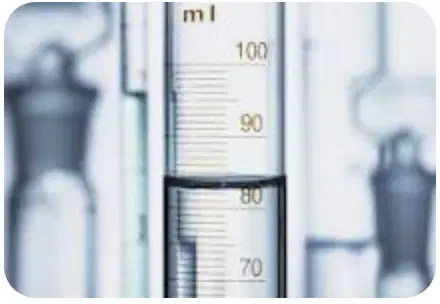
The following picture shows a graduated cylinder. What is the name of the line used to correctly read the graduated cylinder?
a)
A) Meniscus
b)
B) Reading line
c)
C) Ruler
d)
D) Water line
13.
What is the primary reason gases produced by heating water are different from those in the potassium iodide and hydrogen peroxide reaction?
a)
A) Different reaction temperatures
b)
B) Different types of molecules breaking up
c)
C) Different amounts of substances used
d)
D) Different starting materials
14.
A substance has a mass of 40.0 grams and a volume of 20.0 mL. What is its density? Please include the units in your answer. Density = Mass/Volume
4 lines
15.

Ice cubes (made of fresh water) float higher in salt water, than ice cubes (made of fresh water) in fresh water (non-salt), why is this?

a)

fresh liquid water and ice have the same density

b)

frozen fresh water is more dense than salt water

c)

salt water is more dense than frozen fresh water

16.

When we combine baking soda and vinegar, it fizzes and eventually turn into a liquid. What is actually happening?

a)

baking soda melted into its liquid form

b)

baking soda combined with the vinegar produced a new substance

c)

evaporated into the air

17.

What is matter? (Choose the BEST answer)

a)

anything that has mass and volume

b)

amount of space it takes up

c)

anything that has color

d)

amount of odor it has

18.

What is water in a gas form called?

a)

Water vapor

b)

Ice

c)

liquid water

d)

Kool-aid

19.
The substances listed on the right side of a chemical equation are the
a)
Yields
b)
Reactants
c)
Products
d)
Precipitates
20.
The substances listed on the left side of a chemical equation are the
a)
Products
b)
Coefficients
c)
Precipitates
d)
Reactants
21.
In chemical reactions, what does the principle of conservation of mass mean?
a)
Matter is not created or destroyed.
b)
The total mass of the reactants is greater than the total mass of the products.
c)
The total mass of the reactants is less than the total mass of the products.
d)
Matter is not changed.
22.
A molecule is smaller than an atom.
a)
True
b)
False
23.
How many Hydrogen (H) atoms are in NH3O5
a)
3
b)
4
c)
5
d)
1
24.
A molecule is________
a)
a glob of gelatinous goo
b)
smaller than an atom
c)
filled with raisons
d)
more than one atom bonded together
25.
Which is the Law of Conservation of Matter?
a)
matter cannot be created or destroyed, it only changes form
b)
matter can be created but it cannot be destroyed, it never changes form
c)
matter can be destroyed but it cannot be created, it usually just changes form
d)
matter is an unproven theory created by Hans Geiger
26.

Identify the Reactants in this equation.

a)

A

b)

B

27.

What is electrolysis?

a)

The process of extracting salt from water

b)

The process of combining hydrogen and oxygen to form water

c)

The process of converting electricity into water

d)

The process of splitting water into hydrogen and oxygen
