
 Worksheets
Unit 2 Test - Imperialism
Total questions: 29
Worksheet time: 15mins
Name
Class
Date
1.
1. Under imperialism, the stronger nation attempts to
a)
a. dominate a weaker country.
b)
b. sell its products to a weaker country.
c)
c. create an empire.
d)
d. all of the above.
2.
2. What connection was made between imperialism and the American frontier?
a)
a. Imperialism would help close the frontier.
b)
b. Closing the frontier would spur competition.
c)
c. Imperialism would offer Americans a new frontier.
d)
d. Imperialism would make the world more like the United States.
3.
3. Admiral Alfred T. Mahan argued that to protect its trade, the United States must build up its
a)
a. army.
b)
b. navy.
c)
c. labor unions
d)
d. pioneer spirit.
4.
4. To support their view, anti-imperialists argued that
a)
a. imperialism would reduce U.S. military forces.
b)
b. the United States should get more involved in foreign affairs.
c)
c. imperialism rejected the American ideal of “liberty for all.”
d)
d. imperialism would make the United States more admired in the world.
5.
5. Anti-imperialists also objected to the
a)
a. independence of the Philippines.
b)
b. the Teller Amendment
c)
c. costs of expansion.
d)
d. sale of American goods abroad
6.
6. American business leaders favored expansion in order to
a)
a. establish an empire throughout the world.
b)
b. solve the economic problem of overproduction.
c)
c. establish military equality with European nations.
d)
d. stop Russian expansion into Alaska.
7.
7. Some anti-imperialists feared the existence of
a)
a. foreign markets.
b)
b. different races in the United States.
c)
c. newly independent countries
d)
d. a new frontier.
8.
8. Expansionists, such as Theodore Roosevelt, argued that a quest for empire would
a)
a. turn into a military disaster.
b)
b. open Latin America to invasion
c)
c. restore the country’s pioneer spirit
d)
d. make the U.S. stronger than Britain
9.
9. The United States annexed Hawaii because
a)
a. Queen Liliuokalani executed several foreign merchants.
b)
b. the United States needed naval stations in the Pacific. and economic opportunity
c)
c. Hawaiians requested American protection.
d)
d. the Boxers started a rebellion.
10.
10. Which of the following demonstrated enforcement of the Monroe Doctrine?
a)
a. The United States convinced Japan to open trade relations.
b)
b. The United States allowed Hawaiians to import sugar duty free.
c)
c. The United States insisted that Great Britain submit a boundary dispute with Venezuela to arbitration.
d)
d. The United States competed against France and Britain for Asian markets.
11.
11. In the 1890s, William R. Hearst and Joseph Pulitzer used their newspapers to
a)
a. help start the Boxer Rebellion
b)
b. increase sympathy for Cuban rebels.
c)
c. repeal the Monroe Doctrine
d)
d. elect Theodore Roosevelt President.
12.
12. In the 1890s, William R. Hearst and Joseph Pulitzer used their newspapers to fan the flames of war with this article style
a)
Yellow Journalism
b)
Fake News
c)
Deep Fakes
d)
Red Journalism
13.
13. Which event eventually led to the Spanish-American War?
a)
a. Cubans rebelled against Spanish rule.
b)
b. The United States annexed Cuba.
c)
c. Spain destroyed American-owned sugar plantations in the Philippines.
d)
d. The Spanish navy sank two American ships in the Pacific.
14.
14. As a result of the peace treaty with Spain, the United States gained
a)
a. Honduras, Colombia, and Cuba.
b)
b. the Philippines, Guam, and Puerto Rico
c)
c. Mexico, Venezuela, and Chile.
d)
d. Samoa, the Philippines, and Hawaii
15.
15. Why was the Open Door Policy important to the United States?
a)
a. It gave the United States territory in China.
b)
b. It gave the United States access to millions of consumers in China.
c)
c. It increased Chinese investments in the United States.
d)
d. It kept European goods out of China.
16.
16. What was the central message of the Roosevelt Corollary?
a)
a. United States territories could not enter any foreign agreements.
b)
b. United States territories would remain unincorporated.
c)
c. The United States would use force to prevent intervention in neighboring countries.
d)
d. The United States would support revolutionary movements that promoted democratic principles.
17.
17. The building of the Panama Canal was important because it
a)
a. helped stabilize the economies of Latin American countries.
b)
b. improved relations between Colombia and the United States.
c)
c. facilitated movement between Atlantic and Pacific ports.
d)
d. promoted European investment in the United States.
18.
18. The United States acquired control of the Canal Zone by
a)
a. paying Panama $25 million.
b)
b. passing the Roosevelt Corollary
c)
c. signing a treaty with Spain.
d)
d. organizing a revolt in Panama
19.
19. Among Latin Americans, United States actions related to the Panama Canal created
a)
a. hope for a prosperous future
b)
b. Bad feelings in latin american countries toward the United States.
c)
c. calls for Roosevelt’s impeachment
d)
d. a long-lasting economic crisis
20.
20. President Taft was known for a foreign policy based on
a)
a. military intervention.
b)
b. economic investment.
c)
c. land concessions
d)
d. humanitarian projects.
21.
21. People in foreign lands turned against the United States when it
a)
a. closed its doors to immigrants
b)
b. refused to sell manufactured goods.
c)
c. supported unpopular governments
d)
d. insisted on “liberty for all.”
22.
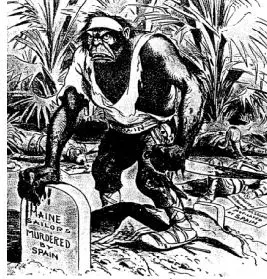
22. The above cartoon is an example of which popular media tactic?
a)
a. Anti-Imperialism Cartoons
b)
b. Ethnocentric mass media
c)
c. Yellow Journalism
d)
d. Jingoism
23.
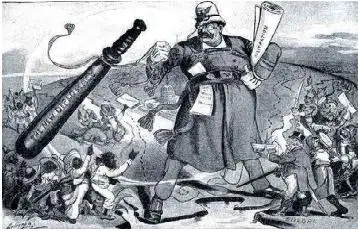
23. The above cartoon is most closely related to which of the following?
a)
a. The Monroe Doctrine
b)
b. Anti-Imperialist Arguments
c)
c. The Roosevelt Corallary
d)
d. Washington’s Farewell Address
24.
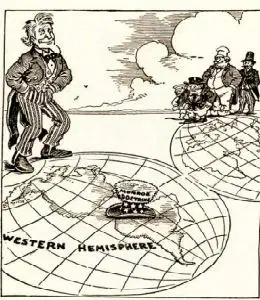
Which of the following most closely relates to the main claim of the cartoon above?
a)
a. The United States should imperialize the Western Hemisphere
b)
b. The United States should not imperialize the Western Hemisphere.
c)
c. The United States would oppose Europe’s efforts to imperialize the Western Hemisphere
d)
d. The United States welcomed European intervention in the Western Hemisphere.
25.

25. The above cartoon most closely relates to which of the following?
a)
a. The Monroe Doctrine
b)
b. The Roosevelt Corollary
c)
c. The Russo-Japanese War
d)
d. The Open Door Policy
26.
26. How could this quote by Teddy Roosevelt symbolize American Imperialism
"The strenuous life, the life of toil and effort, of labor and strife, is not the life of ease and of luxury; but it is the life of vigor and honor. It is the life of the man who does the work of the world, and bears the burden of the world."
4 lines
27.
27. How much was American imperialism driven by humanitarian goals versus economic interests?
4 lines
28.
28. Do you think Social Darwinism was a factor in American imperialism? Why/Why not?
4 lines
29.
How do you think American imperialism impacted the United States in the future.
Consider the economic, political, and social consequences of American expansionism.
4 lines
100 %

