

wayground logo

Free Printable Worksheets

Font size

S
M
L
XL
Worksheets

Quarter 1 Final Exam

Total questions: 25

Worksheet time: 1hrs 15mins
Name
Class
Date
1.
Locard’s Exchange principle supports all of the following claims, except:
a)
Fibers can be transferred from one person to another.
b)
Blood spatter is used to identify blood type.
c)
Cat hair can be transferred to your jacket.
d)
Leaves and soil can be carried from the yard into your home.
2.
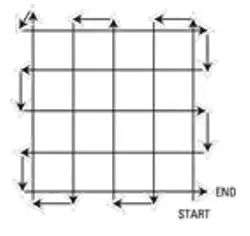
Which type of crime scene search pattern is shown in the image below?
a)
spiral
b)
grid
c)
quadrant
d)
line/strip
3.
Correct collection of evidence requires which of the following?
a)
documenting the location where the evidence was found
b)
correct packaging of the evidence
c)
maintaining proper Chain of Custody
d)
all of the above
4.
Which of the following best describes the difference between circumstantial evidence and direct evidence?
a)
Direct evidence can lead to the conviction of a suspect, while circumstantial evidence cannot.
b)
Direct evidence is not admissible in court; however, circumstantial evidence is admissible with the approval of a judge.
c)
Direct evidence is used to imply a fact, while circumstantial evidence includes first-hand observations.
d)
Direct evidence includes first-hand observations, while circumstantial evidence is used to imply a fact.
5.
The documented and unbroken transfer of evidence is known as ____.
a)
Locard’s Exchange Principle
b)
Chain of Custody
c)
Frye Standard
d)
Daubert Standard
6.
Which of the following evidence is considered to be direct evidence?
a)
a fingerprint left on a door knob
b)
a fiber from a suspect’s couch found on the victim’s shirt
c)
blood from a victim found under the fingernails of a suspect
d)
a confession in a police report
7.

The Bank of Eastman was robbed last Friday. The first responder secured the scene and immediately began looking and collecting evidence (without gloves). When the crime scene investigators arrived, the first responder and C.S.I members immediately opened the packs from the top, breaking the signed seal. Several pieces of evidence were analyzed such as a surveillance film from the bank, a ransom letter that requested $10,000.00, a set of car keys left by the robber, and a hair sample (with the root intact) found near the ransom letter. After analyzing the evidence, customers and bank personnel were interviewed by detectives. The bank robber was never found. Which of the following did the first responder do incorrectly during the investigation? (CHOOSE ALL THAT APPLY.)

a)
He secured the crime scene.
b)
He collected evidence before the C.S.I contaminated the scene.
c)
He collected evidence without gloves.
d)
He opened evidence packs from the top of the package, breaking the signed seal.
8.

The Bank of Eastman was robbed last Friday. The first responder secured the scene and immediately began looking and collecting evidence (without gloves). When the crime scene investigators arrived, the first responder and C.S.I members immediately opened the packs from the top, breaking the signed seal. Several pieces of evidence were analyzed such as a surveillance film from the bank, a ransom letter that requested $10,000.00, a set of car keys left by the robber, and a hair sample (with the root intact) found near the ransom letter. After analyzing the evidence, customers and bank personnel were interviewed by detectives. The bank robber was never found. How would the set of keys be useful?

a)
They may contain physical evidence, such as fingerprints.
b)
They may contain biological evidence, such as DNA.
c)
They may serve as class evidence to help detectives determine information about the suspect.
d)
All of the above.
9.

The Bank of Eastman was robbed last Friday. The first responder secured the scene and immediately began looking and collecting evidence (without gloves). When the crime scene investigators arrived, the first responder and C.S.I members immediately opened the packs from the top, breaking the signed seal. Several pieces of evidence were analyzed such as a surveillance film from the bank, a ransom letter that requested $10,000.00, a set of car keys left by the robber, and a hair sample (with the root intact) found near the ransom letter. After analyzing the evidence, customers and bank personnel were interviewed by detectives. The bank robber was never found. Which of the following pieces of evidence would most likely be considered individual evidence?
a)
the car keys
b)
the hair sample
c)
the ransom letter
d)
the eye witnesses
10.
According to the Steps of Crime Scene Investigation, which of the following steps should follow the first responders “securing the scene?”
a)
sketching the scene
b)
photographing the scene
c)
scanning the scene
d)
separating the witnesses
11.
When packaging evidence, which of the following is NOT a procedure that should be followed?
a)
The evidence should be approved by a judge.
b)
The evidence must be naturally dried if it’s wet.
c)
The evidence must be placed in a bindle if it’s small and fragile.
d)
The evidence packaging must include a signature from the person who recovered it.
12.
According to the Chain of Custody, which of the following must be done when working with evidence?
a)
Sealed evidence must be opened at a location other than the sealed/signed edge.
b)
Sealed evidence must remain in its container for 7 days.
c)
Sealed evidence must never be opened by more than one person.
d)
Sealed evidence must be carefully opened at the sealed/signed edge.
13.
Which of the following is completed after the crime scene is scanned and evidence is marked with evidence markers?
a)
Evidence is sorted.
b)
Evidence is destroyed.
c)
Evidence is analyzed.
d)
Evidence is photographed.
14.
Which of the following C.S.I. team member is responsible for declaring the cause of death when a homicide occurs?
a)
detective
b)
crime scene investigator
c)
medical examiner
d)
first responder
15.
What is the minimum number of photographs that an investigator will take of ONE piece of evidence at a crime scene?
a)
24
b)
12
c)
9
d)
3
16.
A forensic scientist may be asked to testify in court as an expert witness. He/she is there to provide ____.
a)
fact
b)
opinion
c)
judgment
d)
reflection
17.
The Innocence Project found that mostly faulty convictions were based on ______.
a)
out-of-date investigating equipment.
b)
untrained C.S.I.
c)
inaccurate eyewitness accounts.
d)
officers not following the 7 S’s of C.S.I.
18.
All of the following are ways to improve our observational skills except ____.
a)
Be sure to look at the entire area of a crime scene.
b)
Observe everything, no matter how big or small.
c)
When collecting evidence, record only those things that you are sure are important.
d)
Write down and photograph everything you find.
19.
True or false: Forensic investigators must rely on their ability to observe, interpret, and report observations clearly.
a)
True
b)
False
20.
True or false: First responding officers must identify the extent of a crime, secure the scene, and dictate/record who enters and leaves the scene.
a)
True
b)
False
21.
True or false: Eyewitness accounts are always accurate.
a)
True
b)
False
22.
True or false: The Jon Benet Ramsey case is an example of why there is a need for forensics steps and procedures when it comes to processing a crime scene.
a)
True
b)
False
23.
True or false: Techniques and procedures used in forensics has remained the same for the past century. Very few changes have been made to the way that investigators process the crime scene and analyze evidence.
a)
True
b)
False
24.

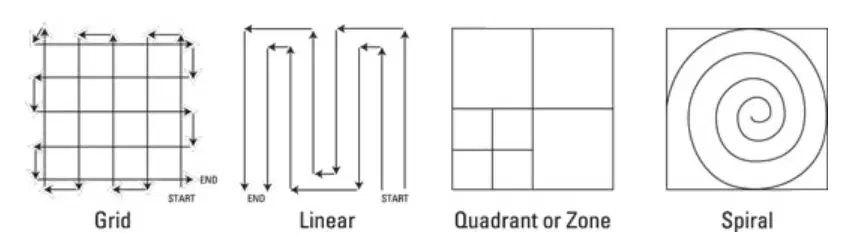
Which of the following search patterns would be most appropriate to use whenever a forensic science team is working indoors and trying to each search a different area?

a)

grid

b)

linear

c)

quadrant

d)

spiral

25.

Which of the following search patterns would be most appropriate to use whenever a forensic science team is working in a large open area such as the outdoors?

a)

grid

b)

linear

c)

quadrant

d)

spiral
