
 Worksheets
QUIZ 6- Electron Configurations and EMS
Total questions: 20
Worksheet time: 3600secs
Name
Class
Date
1.
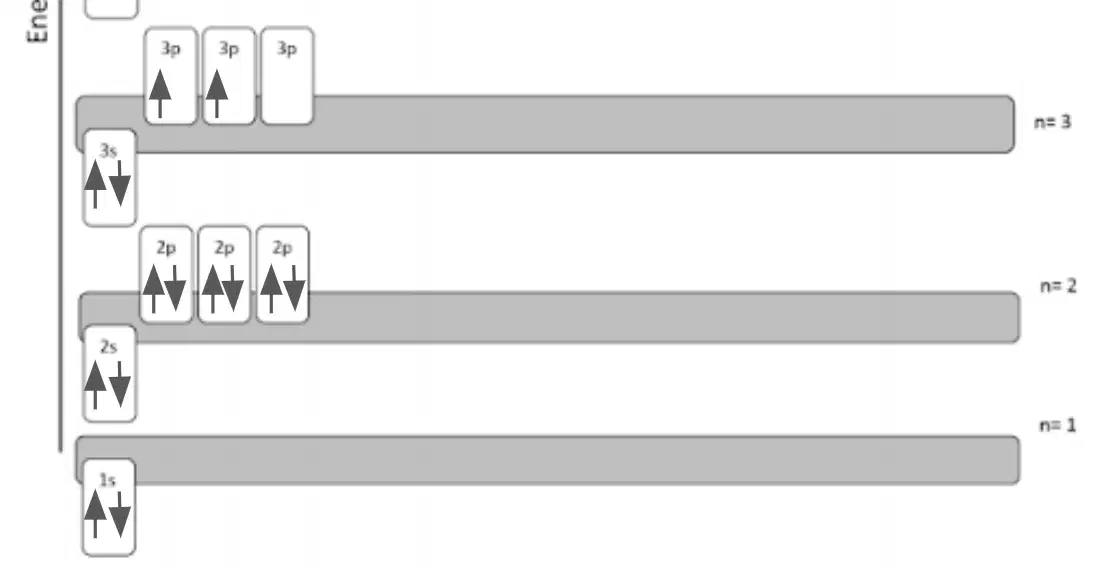
What element does this electron orbital diagram represent?
a)
Oxygen
b)
Silicon
c)
Phosphorus
d)
Selenium
2.

A student completed the electron orbital diagram for Carbon. What is wrong with their diagram?
a)
It does not have a complete lower level
b)
It does not have one electron in each orbital before they pair
c)
It does not have both electrons spinning down in each orbital
d)
It does not have the correct number of electrons
3.
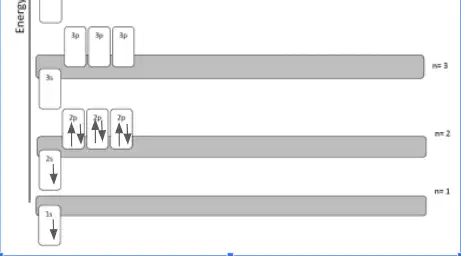
A student completed the electron orbital diagram for the element for Oxygen. What is wrong with their diagram?
a)
It does not have complete lower levels
b)
It does not have one electron in each orbital before they pair
c)
It does not have an electron spinning down in each orbital
d)
It does not have the correct number of electrons
4.

A student completed an electron orbital diagram for Nitrogen. What is wrong with their diagram?
a)
It does not have a complete lower level
b)
It does not have one electron in each orbital before they pair
c)
It does not have one electron spinning up and one spinning down in each orbital
d)
It does not have the correct number of electrons
5.

Which of the following is the correct electron configuration for the element Phosphorus?
a)
b)
c)
d)
6.
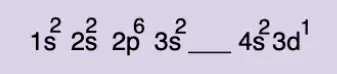
Using the periodic table strategy, find the missing orbital notation for the element Scandium 21
a)
b)
c)
d)
7.
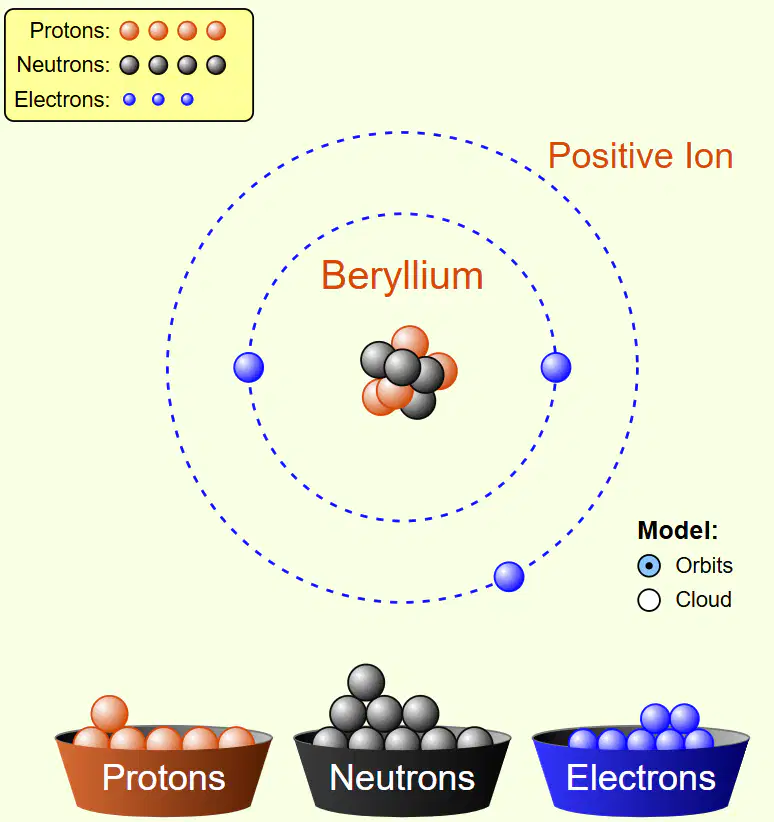
Why does this model show that this Beryllium atom is a positive ion?
a)
It has more electrons than protons
b)
It has more protons than electrons
c)
It has less neutrons than electrons
d)
It has less neutrons than electrons or protons
8.
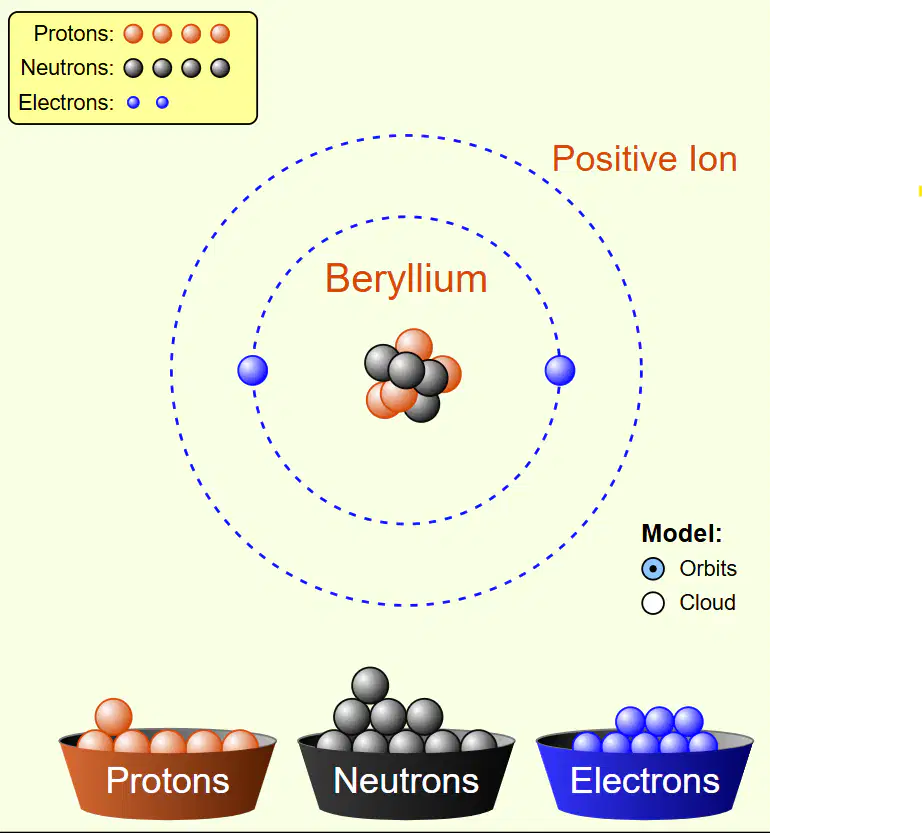
How would the electron configuration change for the Beryllium ion above?
a)
It would not change because it is the same element.
b)
It would have two extra electrons and look like Carbon.
c)
It would have two fewer electrons and look like Helium.
d)
It would have two extra protons and look like Carbon.
9.
Electron configurations can be abbreviated using the Noble gas configuration. Which is the correct Noble gas configuration for the element scandium?
a)
b)
c)
d)
10.

What is wrong with the following electron configuration for the element Titanium?
a)
It should be "3d" instead of "4d"
b)
There are too many electrons
c)
The last "2" should be a "6"
d)
The shapes' letters are out of order
11.

These symbols explain the relationship between frequency and wavelength. What do the arrows represent?
a)
Frequency and wavelength are directly proportional. Both increase together.
b)
Frequency and wavelength are inversely proportional. One increases the other decreases.
c)
Frequency and wavelength are always equal.
d)
Frequency and wavelength are not related.
12.

How are energy and frequency related in the energy level and wave diagram?
a)
Frequency and energy are directly proportional. Both increase together.
b)
Frequency and energy are inversely proportional. One increases the other decreases.
c)
Frequency and energy are always equal.
d)
Frequency and energy are not related.
13.
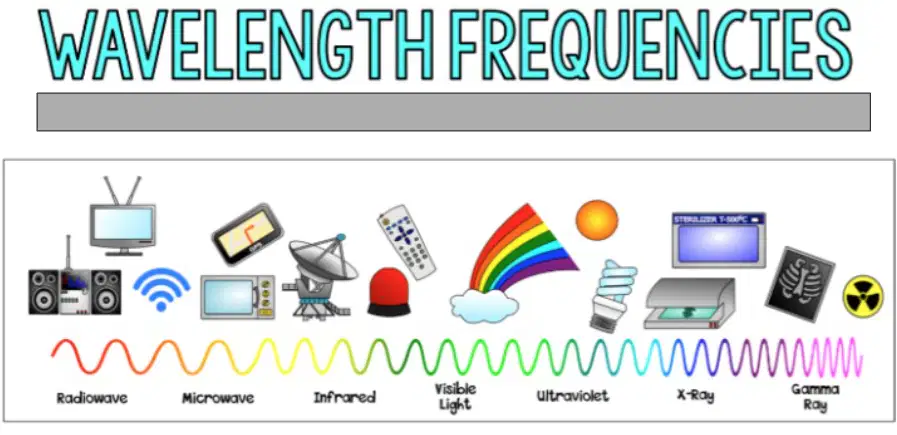
Scientists created the electromagnetic spectrum to categorize the different wavelengths and frequencies of all the electromagnetic waves. They do not show the energy levels. However, you can use the relationship between frequency and energy. Based on this diagram, which are the waves that have the highest energy?
a)
Radiowaves
b)
Infrared
c)
Ultraviolet
d)
Gamma Rays
14.

The electron is releasing energy, because...
a)
It is going to a higher energy level
b)
It is going to a lower energy level
c)
It remained in the same energy level
15.

In the flame lab, electrons emitted light when...
a)
they got excited and moved up levels
b)
they relaxed and released energy
c)
they remained in the same energy level
d)
they flew out of the atom
16.

When scientists observe light waves through a spectrometer, they create an emission spectra. Using the key for emission spectra, which of the following is matches the unique spectra for the element hydrogen.
a)
b)
c)
17.

Using the chart below: In the flame lab, which of the following correctly describes the wavelength and frequency of the green light emitted by the CuCl2?
a)
Wavelength: 625-740 nm Frequency: 400-484 THz
b)
Wavelength: 564- 590 nm Frequency: 508-526 THz
c)
Wavelength: 520-565 nm Frequency: 526-606 THz
d)
Wavelength: 380-435 nm Frequency: 700-789THz
e)
18.

Which orbital shows a violation of Hund's Rule?
a)
A
b)
B
c)
C
d)
D
19.

How many orbitals does Nickel have?
a)
3
b)
4
c)
5
d)
10
20.

Which electron transition leads to the highest energy released:
a)
n6 to n2
b)
n5 to n2
c)
n4 to n2
d)
n3 to n2
100 %

