
 Worksheets
IGCSE Ch.1,7
Total questions: 84
Worksheet time: 2hrs 50mins
What type of rock forms from the cooling and hardening of molten magma?
Metamorphic rocks
Igneous rocks
Crystalline rocks
Sedimentary rocks
Which type of rock is formed from the accumulation of dead plants and animals?
Volcanic rocks
Metamorphic rocks
Igneous rocks
Sedimentary rocks
What is the process called when minerals in an existing rock are changed by heat and pressure?
Erosion
Metamorphism
Sedimentation
Crystallization
Which mining method involves digging a large, deep, cone-shaped pit?
Strip mining
Drift mining
Open-pit mining
Shaft mining
What is a major environmental impact of surface mining?
Groundwater contamination
Deforestation
Underground instability
Mineral depletion
Which mining method is generally safer for workers?
Surface mining
Drift mining
Sub-surface mining
Shaft mining
What is the main advantage of subsurface mining?
Lower costs
Easier access to minerals
Less environmental damage
Faster extraction
What does the rock cycle represent?
The changes between rock types
The types of mining methods
The formation of minerals
The mining processes
Which method is used to restore ecosystems after mining?
Drift mining
Bioremediation
Open-pit mining
Shaft mining
What is the goal of sustainable development?
To increase economic growth at all costs
To eliminate all mining activities
To meet present needs without compromising future generations
To maximize resource extraction
What is one method of land restoration mentioned in the text?
Open-pit mining
Shaft mining
Topsoil replacement
Surface mining
What is a characteristic of minerals?
They are crystalline solids
They are only found in igneous rocks
They are always liquid
They cannot be recycled
What is the primary disadvantage of subsurface mining?
Lower safety risks
Faster extraction rates
High costs and complex infrastructure
Significant habitat destruction
Which of the following is NOT a type of metamorphic rock formation?
Cooling of magma
Heat and pressure
Chemical alteration
Recrystallization
What type of rock is formed through the cooling and solidification of lava on the Earth's surface?
Metamorphic rocks
Igneous rocks
Sedimentary rocks
Volcanic rocks
What is the term for the natural process of breaking down rocks into smaller pieces?
Weathering
Erosion
Metamorphism
Crystallization
Rocks are mostly made of
minerals
lava
fossils
dirt
Place the products of the rock cycle in their proper place.


This rock is formed in layers.
Sedimentary
Igneous
Metamorphic
This type of mining does less damage to the environment.
surface mining
subsurface mining.

When ore is extracted from near the surface by digging deep into the ground.
Strip Mining
Contour Mining
Mountaintop Removal
Open Pit Mining
What are the two ways we extract minerals?
Digging holes in our backyard
Using a metal detector
Playing in a sandbox
Surface & Subsurface mining
A mineral that contains a useful substance that can be mined for a profit is called a ______.
Gem
Ore
Rock


Most of the atmosphere is composed of the following gas
nitrogen
oxygen
carbon dioxide
argon
flatulence
Which layer of the atmosphere contains the ozone?
troposphere
stratosphere
mesosphere
thermosphere
Temperature increases with height in the ______ due to the ozone trapping heat.
troposphere
stratosphere
mesosphere
thermosphere
Temperature decreases with height in the ______ because there is nothing but thin air.
troposphere
stratosphere
mesosphere
thermosphere
What is the term for the day to day conditions of the atmosphere?
weather
climate
hurrican
global wind
What protects the earth from harmful UV rays from the sun?
clouds
ionosphere
nitrogen gases
the ozone

Why does the temperature increase in the stratosphere?
It's closer to the sun
The ozone layer absorbs UV rays
Heat rises
All of the above
Gases released from power plants mix with water vapor in the sky to make ________________.
smog
acid rain
global warming
particulate matter

Where is the "GOOD" ozone located?
troposphere
stratosphere
mesosphere
thermosphere
Which of the following is a solution to reduce air pollution?
use public transport more
dust storm
volcano eruption
methane from landfills
Source of carbon monoxide
Incomplete combustion of fossil fuels
Combustion of fossil fuels
Decomposition of plant and animal matters
Photochemical reaction of CO2

Which of the following are examples of VOC's ? (Select 3)
paint and paint thinners
gasoline
water vapor
formaldehyde
smog
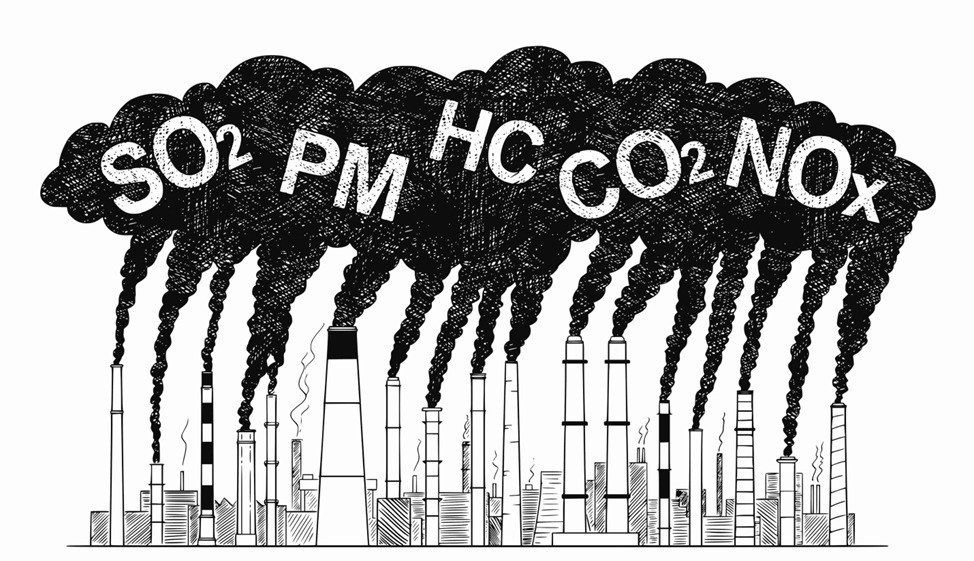
Which pollutants result from fossil fuel combustion (list all that apply)?
Sulfur Dioxides
Nitrogen Oxides
Carbon Oxides
Stratospheric Ozone
Particulate Matter
What are the 2 sizes of Particulate Matter that the EPA classifies? Which is more dangerous, and why?
(a)
Ozone is considered a pollutant in the stratosphere, but not the troposphere.
True
False
health effects: breathing problems, lung damage
environmental effects: ingredient in acid rain
Source: Chemical reaction of VOCs and NOx
Health effects: breathing problems, reduced lung capacity, asthma, eye irritation, reduced resistance to disease
Environmental effects: can damage plants
Source: are released from burning fuel (fossil fuels or biomass), solvents, paints glues and other commonly used products. They include benzene, methane, formaldehyde and others
Health effects: In addition to smog (ozone) effects, some are carcinogenic
Environmental effects: affects some plants directly in addition to smog effects
NO2 +VOCs +O2 +sunlight form
stratospheric ozone
tropospheric ozone
acid rain
industrial smog
What chemicals are most responsible for ozone depletion?
Carbon dioxide
Carbon monoxide
Chlorofluorocarbons
Chlorine gas
What is an effect of ozone depletion?
Global warming
Increased strength of Earth's gravity
Increased visible light that reaches Earth's surface
Increased UV light that reaches Earth's surface
What is the phenomenon that helps keep Earth warm?
Ozone depletion
Greenhouse effect
Bluehouse effect
Industrialization
Which chemical that replaced CFCs in refrigerants is now a concern as a major greenhouse gas?
CFCs
HFCs
DDT
CFCl2
Correctly label each layer of the atmosphere
Thermosphere
Troposphere
Mesosphere
Stratosphere
Exosphere
CFCs are made up of which three compounds
Calcium, fluorine,
carbon
Chlorine, Fluorine, Carbon
Carbon, Bromine, Calcium
Chromine, Fluoride, Carbon
What is the ozone layer?
A layer of harmful gases in the atmosphere
A layer of oxygen molecules in the stratosphere
A layer of smog in the troposphere
A layer of carbon dioxide in the mesosphere
What causes the formation of polar stratospheric clouds (PSCs)?
Presence of volcanic ash in the stratosphere
Presence of ice clouds in the polar regions
Emissions from industrial processes
Emissions from forest fires
What is full form of SDG
Sustainable division goals
Sustainable deprivation goal
Sustainable development goals
Sustainable democratic goals

How many Sustainable Development Goals are there?
16
17
18
19
Identify the logo of SDG.


What is the aim of sustainable development?
Maximizing profitability
Minimizing environmental degradation
Balancing economic, environmental, and social needs
Preventing overexploitation of resources
What is sustainable development?
Maximizing overexploitation of resources
Ignoring the quality of the environment for future generations
Meeting the needs of present generations without compromising the ability of future generations to meet their own needs
Maximizing environmental problems

