
 Worksheets
Quiz Momentum
Total questions: 9
Worksheet time: 5mins
Which of the following is true about momentum?
Momentum is directly proportional to velocity
Momentum is directly proportional to mass and velocity
Momentum is directly proportional to mass
Momentum is directly proportional to weight and acceleration
When considering a system, how do we know momentum is conserved?
The mass of the system remains constant during the interaction
The momentum of the system is greater before the interaction
The momentum of the system is less before the interaction
The mass of the system redistributes unequally during the interaction
What is the difference in momentum between a semi-truck and a bicycle both traveling at 5 m/s?
The bicycle has less momentum because it has a greater mass which increases momentum
The semi-truck has less momentum because it has a greater mass which decreases momentum
The semi-truck has greater momentum because it has a greater mass which increases momentum
The bicycle has greater momentum because it has a greater mass which increases momentum
What is the momentum of the car right before it collides with the wheel?
4500 kg m/s
1500 kg m/s
7500 kg m/s
6000 kg m/s

Which of the following statements about mass, velocity, and momentum of the balls in a Newton’s Cradle is correct?
The initial weight of the ball is transferred equally to the secondary ball so that initial and final conditions are the same
The initial momentum of the ball is transferred unequally to the secondary ball so that initial and final conditions are different
The initial mass of the ball is transferred equally to the secondary ball so that initial and final conditions are the same
The initial momentum of the ball is transferred equally to the secondary ball so that initial and final conditions are the same
How would you best define the initial conditions of the wheel?
The wheel has a constant mass of 22 kg with an initial velocity of 5 m/s
The wheel has a constant mass of 1500 kg with an initial velocity of 5 m/s
The wheel has a constant mass of 22 kg, with an Initial velocity of 0 m/s
The wheel has a constant mass of 1500 kg with an initial velocity of 4.5 m/s
How would you calculate the final momentum for the car AFTER it bumps the wheel?
p=(22)*(4.5)=99 kg*m/s
p=(1500)*(4.5)= 6,750 kg*m/s
p=(1500)*(5)=7,500 kg*m/s
p=(22)*(5)=110 kg*m/s
Which of the following is not considered in the mathematical calculations provided, but likely has an effect on the car and wheel system?
The effect of gravity on the wheel.
The effects of friction between the car and the ground, and between the wheel and the ground.
The fact that the wheel ends up having negative momentum and velocity.
The effect of air resistance on the wheel after it has stopped.
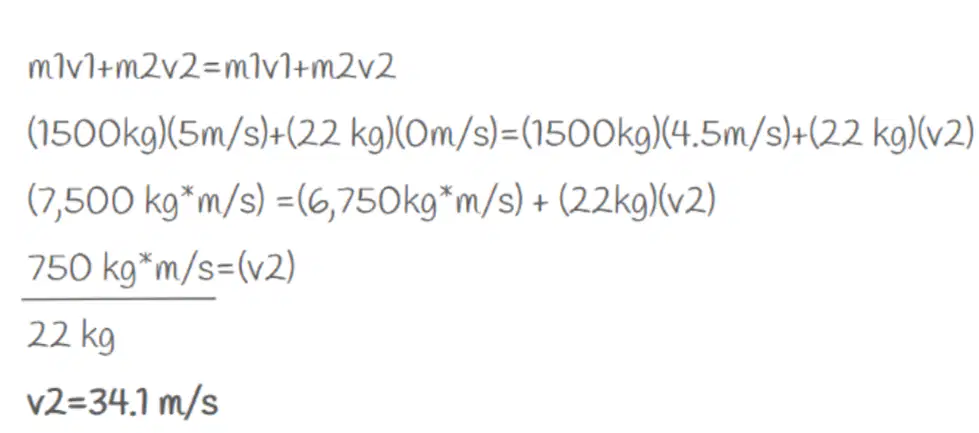
Evaluate the initial and final conditions within the calculation to determine if conservation of momentum is represented accurately.
Yes, the conservation of momentum is accurately represented.
No, the conservation of momentum is not accurately represented.
The calculation does not involve momentum.
The initial and final conditions are not provided.

