
Font size
 Worksheets
Chemistry OL Review
Total questions: 20
Worksheet time: 10mins
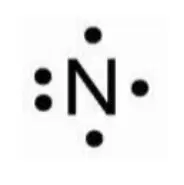
Atoms will undergo chemical bonding to become more stable. Based on the diagram below, nitrogen must pick up valence electrons in order to achieve chemical stability.
1
2
3
4
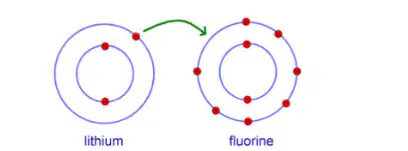
The image below represents a __________ bond.
Ionic
Covalent
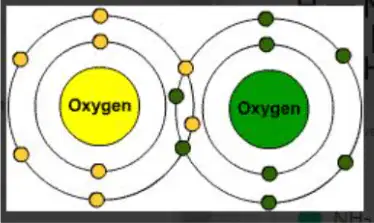
The image below represents a __________ bond.
Ionic
Covalent
Metallic
Hydrogen
Using the following properties, decide what type of chemical bond would be formed. - Low Boiling Point & Low Melting Point - Valence Electrons are shared - Poor Conductors - Bonds are weak - Occurs between 2 nonmetals
Ionic Bond
Covalent Bond
James Bond
Using the following properties, decide what type of chemical bond would be formed. - High Melting Point & High Boiling Point - Valence Electrons are transferred between atoms - Good Conductors (when dissolved in water) - Bonds are strong - Occurs between a metal and a nonmetal
Ionic Bond
Covalent Bond
Coach Bond
During the bonding process, an oxygen atom (8 protons and 8 electrons) gains two extra valence electrons. Which statement(s) below are true?
Oxygen would have a +2 charge (O2+)
Oxygen would have a -2 charge (O2-)
Oxygen would be classified as an anion
Oxygen would be classified as a cation
Which subatomic particle is directly involved in the bonding process?
Protons
Neutrons
Electrons
Predict the chemical formula for an ionic compound that is created between sodium & chlorine.
NaCl2
Na2Cl
NaCl
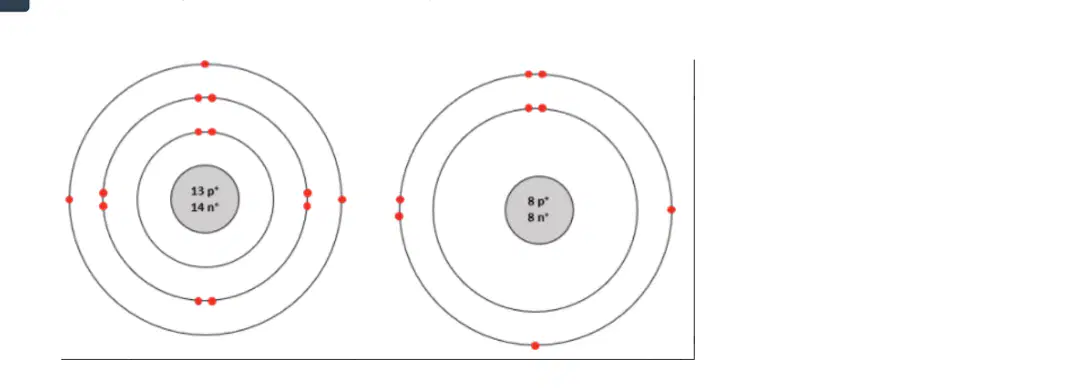
The two atoms pictured below are bonded together. This compound will require a ______ bond.
Ionic
Covalent
Metallic
Hydrogen
According to IUPAC standards, what is the name for the compound MgCl₂?
Magnesium dichloride
Monomagnesium dichloride
Manganese dichloride
Magnesium Chloride
According to IUPAC standards, what is the chemical formula for the compound tetraphosphorus decoxide?
P₅O₁₀
P₇O₁₀
P₄O₁₀
P₂O₁₀
According to IUPAC standards, what is the chemical formula for sodium nitride?
SN₃
Na₃N
S₃N
NaN₃
According to IUPAC standards, what is the correct name for a molecule of IF₇?
monoiodine heptafluoride
iodine fluoride
iron heptafluoride
iodine heptafluoride
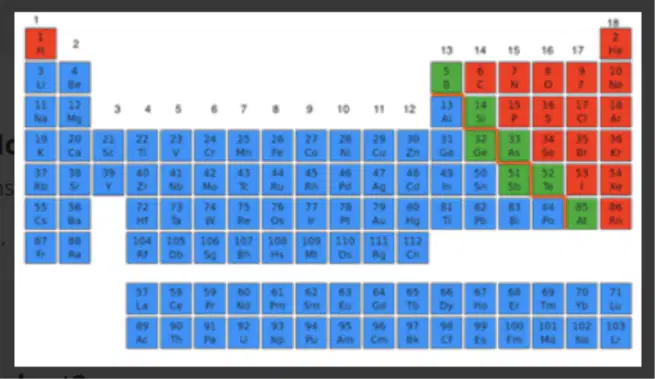
The elements shown in blue are classified as:
nonmetals
metals
metalloids
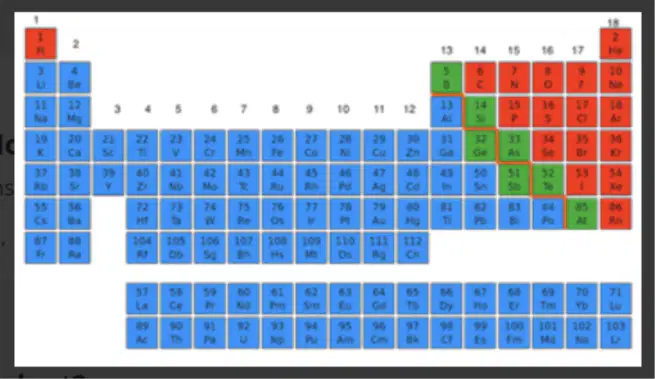
The elements shown in green are classified as:
nonmetals
metals
metalloids
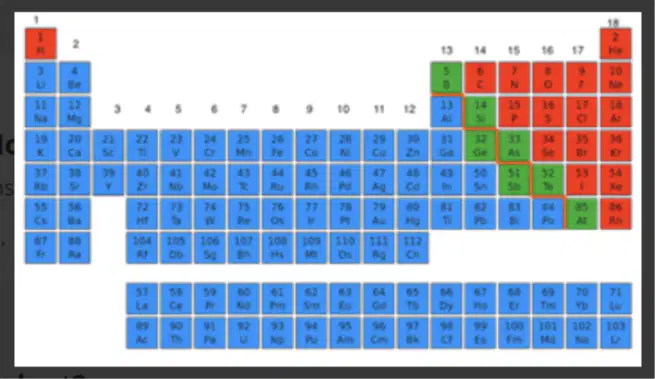
The elements shown in red are classified as:
nonmetals
metals
metalloids
Which formulas and their respective names do not match?
BaO & barium hydroxide
SF₆ & sulfur hexafluoride
N₂O₄ & dinitrogen pentoxide
HF & hydrogen monofluoride
The International Union of Pure and Applied Chemistry (IUPAC) has specific rules on how to name ionic and covalent compounds. Choose all of the answers where the chemical formulas match the chemical names.
calcium chloride & CCl₂
dihydrogen monoxide & H₂O
potassium nitride & K₂N
nitrogen trioxide & NO₃
A chlorine atom reacts with a sodium atom to form sodium chloride (NaCl). A chlorine atom can also react with another chlorine atom to form a chlorine molecule (Cl₂). Which statement best explains the behavior of chlorine in these two reactions?
The chlorine molecule (Cl₂) is created using covalent bonds, while NaCl is created using ionic bonds
The chlorine molecule (Cl₂) is created using ionic bonds, while NaCl is created using covalent bonds
Both substances are created using covalent bonds
Both substances are created using ionic bonds
Beryllium, atomic number 4, forms an ionic bond with an unknown element. What is the most likely choice for the other element in this compound?
fluorine (group 17)
selenium (group 16)
neon (group 18)
potassium (group 1)

