wayground logo

Free Printable Worksheets

NEW

Font size

S
M
L
XL
Worksheets

Continental drift

Total questions: 20

Worksheet time: 11mins

Name
Class
Date
1.
Who is the person credited with developing the theory of continental drift?
a)
Harry Hess
b)
Galileo
c)
Alfred Wegener
d)
Newton
2.
What two specific continents fit together most noticeably?
a)
Africa and North America
b)
South America and Europe
c)
South America and Africa
d)
Antartica and Africa
3.

Fossils on which continent show that it used to support forests with plant life and animal life?

a)

Antarctica

b)

India

c)

North America

d)

Africa

4.

Wegener thought that all the continents were once together in one large continent called _______.

a)

Laurasia

b)

Eurasia

c)

Pangaea

d)

Gondwana

5.
Was continental drift accepted in Wegener's lifetime? 
a)
Yes
b)
No
6.
Why did no one believe Wegener's theory?
a)
He could not explain HOW the continents moved.
b)
He was a meteorologist and not a geologist.
c)
His evidence was not supporting the hypothesis.
d)
He didn't use the right technology to gather data.
7.
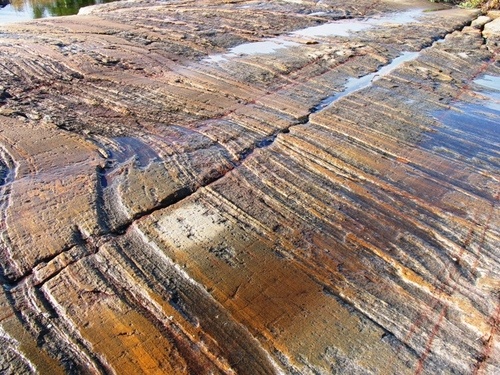
This is a picture of glacier scars found in Africa.  What are these evidence for?
a)
Africa has always been near the equator
b)
Africa was once in an area of the Earth that had a very cold climate
c)
The continents have not moved
d)
sea floor spreading
8.
What does the theory of continental drift state?
a)
The continents were once joined in a super-continent and have moved over time
b)
Continents are stationary and do not move
c)
The Earth is broken into lithospheric plates that move due to convection currents
d)
none of the above
9.
How long ago is Pangea believed to have existed?
a)
200-300 million years ago
b)
1000-2000 years ago
c)
10,000-20,000 years ago
d)
20-30 billion years ago
10.
The best evidence that the continents were once connected is that they have matching
a)
Weather, fossils, and Rock Types
b)
Rock types, fossils, coastlines
c)
Coastlines, weather, rock types
d)
Coastlines, weather, fossils
11.

Which of the following is the best evidence that Earth's continents were once in vastly different positions than they are today?

a)

Penguins only found in southern hemisphere

b)

Fossils of tropical plants found in Antarctica

c)

Volcanoes encircling Pacific Ocean

d)

Major rivers from deltas from continental erosion

12.
Which evidence was not used by Wegener to support his continental drift theory?
a)
South America & Africa coastlines
b)
Coal beds in Antarctica & Britain
c)
Plant & reptile fossils
d)
Earthquake patterns
13.
The following are animal fossil evidences of the Continental Drift theory except?
a)
Glossopteris
b)
Cynognathus
c)
Lystrosaurus
d)
Mesosaurus
14.

Mesosaurus fossils are found between where?

a)

Africa and India

b)

Africa and South America

c)

Antarctica and Australia

d)

India and Antarctica

15.

Glossopteris fossils are found between where?

a)

South America and Africa

b)

Antarctica and Australia

c)

Africa and India

d)

All of them

16.
What is a theory?
a)
An idea based on hypothesis and problems observed using five senses
b)
A belief, policy, or procedure that is not proposed or followed as the basis of action
c)
A supposition or a system of ideas intended to explain something, especially one based on general principles independent of the thing to be explained.
d)
A set of concepts that uses tests without evidences but uses the scientific method in order to prove a specific phenomena that happened on Earth or may happen to Earth
17.
What is the theory that states that parts of the Earth's crust slowly drift atop a liquid core.
a)
Theory of Evolution
b)
Heliocentric Theory
c)
Geocentric Theory
d)
Continental Drift Theory
18.
What do you call the northern part of Pangea after it moved million years ago?
a)
Russia
b)
Asia
c)
Eurasia
d)
Gondwanaland
19.

What is the force that moves the continents?

a)

Conduction

b)

Convection

c)

Radiation

d)

Conveyor belts

20.

What evidence did Wegener use to support his theory?

a)

Continents and fossils fitting together/matching-up like puzzle pieces

b)

glacier scars and other climate evidence from temperature

c)

mountain ranges and rocks line up across continents

d)

all of the above