
Font size
 Worksheets
Chem CH 4 - Arrangement of Electrons in Atoms
Total questions: 46
Worksheet time: 2hrs 37mins

In order to go from ground state to an excited state, an electron must
emit energy
absorb energy
wiggle
When an electron returns to ground state from an excited state, the atom will (a)

In which state does an electron have the least amount of energy?
Excited state
Ground state
Orbital
Bohr model


Flame tests can be used to identify an element. Each element emits characteristic waves of light when it is heated in a flame. What describes how the light is produced?
Protons in the ground state lose energy and give off light.
Protons in the ground state gain energy and are emitted from the nucleus, giving off light.
Electrons in the ground state lose energy and move to an excited state, giving off light.
Electrons in the ground state gain energy, move to an excited state, and give off light when they return to the ground state.
What is the typical units of measurement for the "E" in the following equation:
Ephoton= h x v
The number of waves that pass a given point every second
Frequency
Wavelength
Energy
Electromagnetic Spectrum
Broad range of radiation that carries energy as waves
Frequency
Wavelength
Energy
Electromagnetic Spectrum
Which two variables of the electromagnetic spectrum have a direct relationship?
Crests and trough
energy and frequency
wavelength and energy
frequency and wavelength
As wavelength increases: frequency,_____________ and energy ______________.
Increases; decrease
Increases; increases
Decreases; decreases
Decrease; increases
What is the speed of light?
3.0x10⁸ ms
3.0x10⁸ m/s
6.626x10⁻³⁴ Js
6.626x10⁻³⁴ J/s
The frequency of violet light is 7.5x10¹⁴ Hz. What is its wavelength?
4.0x10⁻⁷ m
4.0x10⁷ m
2.25x10²³m
2.25x10²³ Hz
Which principal energy level change by the electron of a
hydrogen atom will cause the greatest amount of energy to be absorbed?
n = 2 to n = 4
n = 2 to n = 5
n = 4 to n = 2
n = 5 to n = 2

The angular momentum quantum number (l), describe..
energy level of electron.
the orientation of the orbital in space.
the shape of orbital.
the behavior of electrons as spinning clockwise or anticlockwise in orbital.
Which of the following is NOT a possible pair of quantum numbers?
2p
2d
4p
4f

Identify the element (symbol only) with the electron configuration
1s2 2s2 2p6 3s2 3p6 4s2 3d10 4p6 5s2 4d10 5p6 6s2 4f9
Tb
V
As
Nd
The principle quantum number, n, represents the:
spin
subshell
Energy level
orbital

This orbital shape corresponds to a
s orbital
d orbital
p orbital
f orbital
There may be a maximum of ____ p orbitals at a given energy level.
2
6
3
8

This is a ____ orbital
s
d
p
d
Orbital sublevels, or L, represents:
orbital color
orbital shape
electron spin
energy level
What does the 1 in "1s" stand for?
energy level
s orbitals
p orbitals
the number of electrons
n=5 l=2
3s
4sp
5d
5p
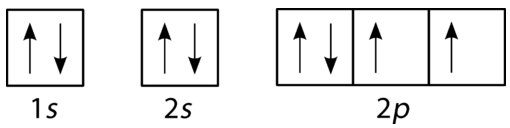


What element's orbital notation is pictured here?
Ar
Br
Cu
Cl

1s22s22p63s23p64s23d10


Atoms tend to lose or gain electrons to be ____________ a noble gas, their 'octet' of 8 valence electrons is very stable.
exclusive with
identical to
isoelectric to
the same charge as
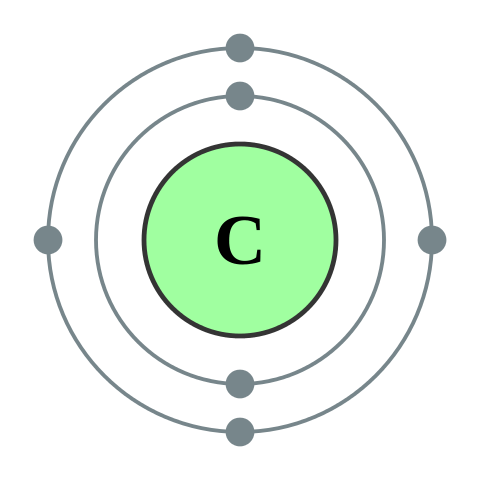
How many valence electrons does carbon have?
4
5
6
7
Valence electrons are the
electrons in the highest energy level with electrons in it
total electrons in an atom

