
 Worksheets
Alg 2 MCM Properties and Operations
Total questions: 189
Worksheet time: 18hrs 8mins

1.1
Which answer matches the question?
That we are not our own but belong, body and soul, both in life and death, to God and to our Savior Jesus Christ.
God is the creator and sustainer of everyone and everything. He is eternal, infinite, and unchangeable in his power and perfection, goodness and glory, wisdom, justice, and truth. Nothing happens except through him and by his will.
That we are not our own but belong, body and soul, both in life and death, to God.
God created us male and female in his own image to know him, love him, live with him, and glorify him. And it is right that we who were created by God should live to his glory.
That we are not our own but our souls, both in life and death, to God and to our Savior Jesus Christ.

2.1
Which answer matches the question?
That we are not our own but belong, body and soul, both in life and death, to God and to our Savior Jesus Christ.
God is the creator and sustainer of everyone and everything. He is eternal, infinite, and unchangeable in his power and perfection, goodness and glory, wisdom, justice, and truth. Nothing happens except through him and by his will.
That we are not our own but belong, body and soul, both in life and death, to God.
God created us male and female in his own image to know him, love him, live with him, and glorify him. And it is right that we who were created by God should live to his glory.
That we are not our own but our souls, both in life and death, to God and to our Savior Jesus Christ.
3.1
Which answer matches the question?
That we are not our own but belong, body and soul, both in life and death, to God and to our Savior Jesus Christ.
God is the creator and sustainer of everyone and everything. He is eternal, infinite, and unchangeable in his power and perfection, goodness and glory, wisdom, justice, and truth. Nothing happens except through him and by his will.
There are three persons in the one true and living God: the Father, the Son, and the Holy Spirit. They are the same in substance, equal in power and glory.
God created us male and female in his own image to know him, love him, live with him, and glorify him. And it is right that we who were created by God should live to his glory.
That we are not our own but our souls, both in life and death, to God and to our Savior Jesus Christ.
4.1
Which answer matches the question?
That we are not our own but belong, body and soul, both in life and death, to God and to our Savior Jesus Christ.
God is the creator and sustainer of everyone and everything. He is eternal, infinite, and unchangeable in his power and perfection, goodness and glory, wisdom, justice, and truth. Nothing happens except through him and by his will.
There are three persons in the one true and living God: the Father, the Son, and the Holy Spirit. They are the same in substance, equal in power and glory.
God created us male and female in his own image to know him, love him, live with him, and glorify him. And it is right that we who were created by God should live to his glory.
That we are not our own but our souls, both in life and death, to God and to our Savior Jesus Christ.
5.1
Which answer matches the question?
That we are not our own but belong, body and soul, both in life and death, to God and to our Savior Jesus Christ.
God is the creator and sustainer of everyone and everything. He is eternal, infinite, and unchangeable in his power and perfection, goodness and glory, wisdom, justice, and truth. Nothing happens except through him and by his will.
There are three persons in the one true and living God: the Father, the Son, and the Holy Spirit. They are the same in substance, equal in power and glory.
God created us male and female in his own image to know him, love him, live with him, and glorify him. And it is right that we who were created by God should live to his glory.
God created all things by his powerful Word, and all his creation was very good; everything flourished under his loving rule.
1.2
Which question matches the answer?
"That we are not our own but belong, body and soul, both in life and death, to God and to our Savior Jesus Christ."
What is our only hope in life and death?
What is God?
How many persons are there in God?
How and why did God create us?
What is our only certainty in life and death?
2.2
Which question matches the answer?
"God is the creator and sustainer of everyone and everything. He is eternal, infinite, and unchangeable in his power and perfection, goodness and glory, wisdom, justice, and truth. Nothing happens except through him and by his will."
What is our only hope in life and death?
What is God?
How many persons are there in God?
How and why did God create us?
What is our only certainty in life and death?
3.2
Which question matches the answer?
There are three persons in the one true and living God: the Father, the Son, and the Holy Spirit. They are the same in substance, equal in power and glory."
What is our only hope in life and death?
What are the three persons in God?
How many persons are there in God?
How and why did God create us?
What is our only certainty in life and death?
4.2
Which question matches the answer?
God created us male and female in his own image to know him, love him, live with him, and glorify him. And it is right that we who were created by God should live to his glory.
What is our only hope in life and death?
What are the three persons in God?
How many persons are there in God?
How and why did God create us?
What is our only certainty in life and death?
5.2
Which question matches the answer?
God created all things by his powerful Word, and all his creation was very good; everything flourished under his loving rule.
What else did God create?
What are the three persons in God?
How many persons are there in God?
How and why did God create us?
What is our only certainty in life and death?

1.3
What scripture is this catechism based on?
Romans 14:7–8
John 14:7–8
Matthew 14:7–8
Mark 14:7–8
Luke 14:7–8

2.3
What scripture is this catechism based on?
Psalm 86:8-10,15
Romans 14:7–8
2 Corinthians 13:14
Genesis 1:27
Genesis 1:31

3.3
What scripture is this catechism based on?
Psalm 86:8-10,15
2 Corinthians 13:14
Romans 14:7–8
Genesis 1:27
Genesis 1:31
4.3
What scripture is this catechism based on?
Psalm 86:8-10,15
2 Corinthians 13:14
Romans 14:7–8
Genesis 1:27
Genesis 1:31
5.3
What scripture is this catechism based on?
Psalm 86:8-10,15
2 Corinthians 13:14
Romans 14:7–8
Genesis 1:27
Genesis 1:31

1.2.2
A
B
C
1.2.2a
How many distinct elements are in the word "Shampoo"
(a)
1.2.2a
How many distinct elements are in the show title "Jujutsu Kaisen"
(a)

1.2.3
A
B
C

1.2.4
A
B
C

1.2.5
A
B
C

1.2.6
A
B
C

1.2.7
A
B
C

1.2.8
A
B

1.2.9
A
B

1.2.10
A
B

1.2.11
A
B
C

1.2.12
A
B

1.2.13
A
B
C

1.3.1
A
B
C
D
E

1.3.2a
Match #1 to the correct option on the right.
A
B
C
D
E
1.3.2b
Match #2 to the correct option on the right.
A
B
C
D
E
1.3.2c
Match #3 to the correct option on the right.
A
B
C
D
E
1.3.2d
Match #4 to the correct option on the right.
A
B
C
D
E
1.3.2e
Match #5 to the correct option on the right.
A
B
C
D
E

1.3.3a
Match #1 to the correct option on the right.
A
B
C
D
E
1.3.3b
Match #2 to the correct option on the right.
A
B
C
D
E
1.3.3c
Match #3 to the correct option on the right.
A
B
C
D
E
1.3.3d
Match #4 to the correct option on the right.
A
B
C
D
E
1.3.3e
Match #5 to the correct option on the right.
Standby for additional enrichment (time permitting)
A
B
C
D
E
List all the elements in A= {letters in the word "BOOK"}.
A= {B,O,K}
A= {B,O,O,K}
A= {B,K}

Complete the statement correctly: Cow____ the set of all farm animals.
ϵ
⊂
⊆
⊂
Which of these sets is equal to {L,O,V,E}?
{O,V,E}
{S,E,V,O,L}
{O,E,L,V}
{L,E,V}
Describe this set in words: {2,3,5,7,11,13,17,19}
Set of prime numbers from 2 to 19
Set of prime numbers less than 19
Set of odd numbers less than 20
Set of whole numbers less than 20
Which of the following statements is TRUE?
2 ϵ {1,3,5,7}
{5} ϵ {5,10,15,20,}
6 ϵ {x/x is an odd number}
3 ϵ {x/x is a prime number}
Consider M={vowels in the word "MATHEMATICS"}. Find n(M).
4
3
7
10
Write {even whole numbers between 3 to 15} using the roster method.
{3,5,7,9,11,13,15}
{5,7,9,11,13}
{4,6,8,10,12,14}
{2,4,6,8,10,12,14,16}
If A={6,8,10,12} then 5 ∈ A
True
False
Elements of set do not repeat itself.
True
False
If P = {a, e, i, o, u} then choose which are correct .
a ∈ P
b ∈ P
i ∈ P
g ∉ P

List the elements of A
{2,3}
{2,3,5,9}
{1,2,3,4,5}
{5,9}

List the elements of A Ո B
{5,9}
{2,3,7,6,8}
{2,3,5,9,7,6,8}
{1,4}

For the given sets A and B, which statement is true?
A ⊂ B
B ⊂ A
A = B
A' = B

List the elements of B
{4,5,6,7,8,9,10,11}
{4,6,7,8}
{9,5,10,11}
{4,5,6,7,8,9,10}
Which of the following is set Q ?
Which of the following is the symbol for null set?
∅
⊂
∈
⊂
Which of the following means proper subset?
⊂
⊆
∈
=
Which of the following is the symbol for element of?
∅
⊂
∈
⊂
< says:
greater than
less than
greater than or equal to
less than or equal to
What does this symbol ( ∪ ) represent in set theory?
Union
Intersection
Disjointed
Subset
What type of set is denoted as either { } or ∅?
Superset
Empty (or Null) Set
Disjointed Set
Subset
Equivalent sets have
the same number of elements
the exact same elements
the opposite elements
nothing
Equal sets have
the same number of elements
the exact same elements
the opposite elements
nothing
What is intersection of A and B?
A ∪ B
∈
∉
A ∩ B
What is Union of A and B?
A ∩ B
A′
A ∪ B
A ⊂ B
Find the sum (2x2 + 5x - 7) + ( 3 - 4x2 + 6x)
2x2 + 3x +1
-2x2 - 11x -4
2x2+ 5x -7
-2x2 + 11x -4
Find the sum (4x3 - 5x2 + 3x) + (-2x3 - x2 + 6x)
2x3 - 6x2 - 9x
2x3 + 6x2 + 9x
-2x3 - 6x2 + 9x
2x3 - 6x2 + 9x
Find the sum (3x - 4) + (12x + 10)
x - 12
15x + 6
36x + 40
17x + 9,000
Find the sum (9x + 17) + (19x - 27)
28x + 44
28x - 10
-28x + 10
-171x - 459
Find the sum (2x + 5y) + (3x - 2y)
3x + 5y
5x + 3y
5x + 7y
7xy + 1xy
3x3 – 6x
x2(2x+3)


3y218y6 +9y4 −12y2
6y2 +3y2 −4y2
15y4 +6y2 − 9
6y4 +3y2−4
6y3 −3y2 +4y
Simplify (-8v4 + 4v3 + 3v) + (- 8v4 + 4v - 7)
-17v4 + 4v3 + 2v - 7
-16v4 + 4v3 + 10v - 7
-16v4 + 4v3 + 7v - 7
-16v4 + 4v3 + 2v - 7
(3- 2x + 2x2) - (4x -5 +3x2)
(x5 + x3) - (6x - x3 + 6x5)
7x - 125 - 6x4 + 14x2
Divide
4x2y510x8y5
6x6y
25x6
25x6y
6x6
Example: (d2)5
Example: c6 ⋅ c4
Example: h8 / h3
The associative property means...
You can group the numbers however you want.
You can change a multiplication sign to a division sign.
You can leave one of the numbers off.
You can't solve the problem.
5(3+6) = (5*3) + (5*6)
Each object in a set is called
Element
roster
intersection
union
What is an element?
A member of a set
Group of objects
The intersection of two sets
Subset
List all the letters in the name " jennylyn"
{j,e,n,n,y,l,y,n}
{j,e,n,y,l,y,n}
{j,e,n,y,l}
{j.e.n}
What is a Set?
It has a limited number of elements.
Two sets which have the same members.
It is a collection of well-defined objects or elements.
It has no element present in it.
1.2.5*
Use the list method to write perfect cubes between 1 and 125 separated by commas and without spaces, brackets, or parenthesis.
(a)
Which of the following statements is TRUE?
2 ϵ {1,3,5,7}
{5} ϵ {5,10,15,20,}
6 ϵ {x/x is an odd number}
3 ϵ {x/x is a prime number}
Write {even whole numbers between 3 to 15} using the roster method, separated by commas, and without parenthesis, brackets, or spaces.
(a)

1.4.3
A
B
C
D

1.4.4
Kindly include the empty set as a subset
A
B
C

1.4.6
A
B
C

1.4.7
A
B
C

1.4.8
A
B
C

1.4.9
A
B
C

1.4.10
A
B
C

1.4.11
A
B
C
D
E

1.4.13
A
B
C

1.4.15
A
B
C

1.4.16
A
B
C
D

1.4.5
Kindly type your answer without spaces, brackets, or parenthesis and include a comma to separate values. If the set is empty, type "empty set".
(a)

1.4.17
A
B
C

1.5.E1
Kindly identify the property shown
Commutative
Associative
Identity
Additive
Reflexive

1.5.E2
Kindly identify the property shown
Commutative
Associative
Identity
Additive
Reflexive

1.5.E3
Kindly identify the property shown
Commutative
Associative
Identity
Additive
Reflexive
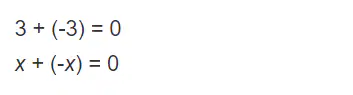
1.5.E4
Kindly identify the property shown
Commutative
Associative
Identity
Additive
Reflexive
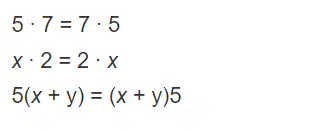
1.5.E5
Kindly identify the property shown
Commutative
Associative
Identity
Additive
Reflexive

1.5.E6
Kindly identify the property shown
Commutative
Associative
Identity
Additive
Reflexive

1.5.E7
Kindly identify the property shown
Commutative
Associative
Identity
Additive
Reflexive

1.5.E8
Kindly identify the property shown
Commutative
Associative
Identity
Multiplicative Inverse
Reflexive

1.5.E9
Kindly identify the property shown
Commutative
Associative
Identity
Multiplicative Inverse
Distributive
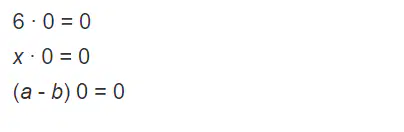
1.5.E10
Kindly identify the property shown
Commutative
Zero
Identity
Multiplicative Inverse
Distributive
-2 x (3 + 8 ÷ 4)2
-8 + (15-3) ÷ 4
[25-(13+4)+4] ÷ 3

Addition ALWAYS comes before subtraction.
2 + (4 x 5 - 2) + 8 = 28
5 - 62 ÷ 4 - 3
(2 + 7 - 1) ÷ 22
Which operation would you do first in the following equation?
10 - 4 ÷ 1 x 5
Subtraction
Division
Multiplication
Addition
Addition ALWAYS comes before subtraction.
Are these two expressions equal?
(6 - 4) -1 and 6 - (4 - 1)
Yes, they both equal 1
Yes, they both equal 3
No, they are not equal
Which operation would you do first?
( 12 + 10) ÷ 10 x 14 - 6
Division
Multiplication
Addition
Subtraction
(13 - 1) + 4
5 - 3 + 2
= 5 - 5
= 0
64
Apply the order of operations and choose the correct answer:
9
21
32
1
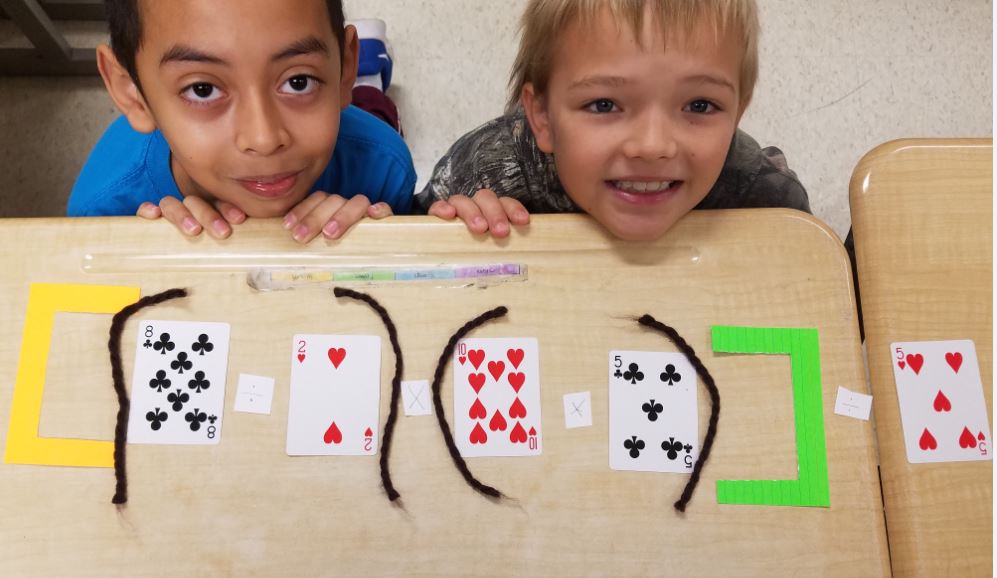
50 − 16 ÷ 2 ∗ (12 + 4)
multiplication
subtraction
division
multiplication
division
subtraction
division
multiplication
subtraction
subtraction
multiplication
division
(2 + 7 - 1) ÷ 22
62 −92÷4
What is the order of operations for solving this problem?
Subtract, Divide, Exponent
Exponent, Subtract, Divide
Exponent, Divide, Subtract
Solve: 10×8+52÷4
93
150
25
125
Which operation would you do first in the following equation?
10 - 4 ÷ 1 x 5
Subtraction
Division
Multiplication
Addition
Pick the correct order for Order of Operations
Parentheses, Multiplication, Division, Addition, Exponents, Subtraction
Exponents, Multiplication, Division, Addition, Parentheses, Subtraction
Parentheses, Exponents, Multiplication, Division, Addition, Subtraction
-2 x (3 + 8 ÷ 4)2
[25-(13+4)+4] ÷ 3
Which operation should you perform first in the expression
exponent
division
addition
subtraction
Who is correct?
Sallie
16÷2×8=64
Brian
16÷2×8=1
Sallie
Brian
I'm not sure
Both
When multiplying and dividing (for example, 4 x 5 / 2), how do you know which step to do first?
Always multiply
Always divide
Whichever comes first reading left to right
Whatever I feel like doing first
(2 + 7 - 1) ÷ 22
3 + 4 x 6 - 4
5 - 3 + 2
5 - 5
0
if a = 10 and b = 6
when b = 3
Evaluate -2x + -3y if x = 10 and y = -6
18
-38
12
-2
If p = -6, what does -10(p + 4) equal?
2
20
-2
-20
t2 - t + 1 when t = 5

