
 Worksheets
FINAL EXAM - 207 World History A
Total questions: 35
Worksheet time: 18mins
Name
Class
Date
1.

Which of the following began this chain of events?
a)
The opening of trade routes during the Crusades
b)
A population decline caused by the Black Death
c)
The discovery of new foods in the New World
d)
A religious conflict caused by the Protestant Reformation
2.
How did the Bubonic Plague affect medieval Europe?
a)
It prompted advances in medicine that extended the average life span
b)
It caused economic and social instability by drastically reducing the workforce
c)
It caused persecution of religious and ethnic minorities to decrease
d)
It allowed church officials to expand their authority
3.
One factor contributing to the decline of the Roman Empire was...
a)
the conversion of the population to a monotheistic religion
b)
social unrest created by an emerging middle class
c)
political decisions that contributed to internal conflicts
d)
the development of a political bureaucracy
4.
The Berlin Conference affected European imperialism in Africa by-
a)
establishing partnerships with local kingdoms to promote trade
b)
defending the rights of African citizens to participate in colonial governments
c)
supporting the establishment of colonial spheres of influence
d)
developing guidelines to regulate joint-stock trading companies
5.
What was a defining characteristic of feudalism in medieval Europe?
a)
Universities granted degrees to qualified students
b)
Lords granted land to knights (vassals) in return for military services
c)
Guilds supervised the work done by craftsmen
d)
Troubadours performed concerts in town halls in return for food and lodging
6.
Which grievance was shared by both French and American revolutionaries?
a)
The inequality of women
b)
Widespread starvation because of food shortages
c)
Frequent public executions of citizens
d)
Unfair taxation practices
7.

This map shows a pattern of commerce that expanded the slave trade AND --
a)
depleted supplies of natural resources in South America
b)
weakened western Europe's dominance over its colonies
c)
encouraged manufacturing industries in West Africa
d)
increased agricultural production in North America
8.

Which of the following best completes the diagram?
a)
The creation of the Safavid Empire in Persia
b)
The expansion of the Mongol Empire into Russia
c)
The formation of the Mughal Empire in India
d)
The expansion of the Ottoman Empire into eastern Europe
9.

The main reason for the loss of lives described in the passage below is that American Indians--
a)
were shipped to Europe as slaves
b)
experienced a series of famines
c)
exhausted their supplies of natural resources
d)
were not immune to European diseases
10.
In the early middle ages, the Roman Catholic Church contributed to cultural unity in Western Europe by--
a)
challenging the legitimacy of the Carolingian Empire
b)
using missionaries to convert Germanic tribes
c)
maintaining trade routes commonly used by Italian merchants
d)
sending armies to recapture cities under Byzantine rule
11.
Martin Luther's posting of the 95-Theses in 1517 led to--
a)
a decline in the expansion of overseas colonies
b)
the beginning of the Crusades in the Middle East
c)
a decline in the authority of the Roman Catholic Church
d)
the emergence of absolute monarchies
12.

Which of the following had the greatest influence on the political ideas in the passage below?
a)
Justinian Code
b)
Writings of John Locke
c)
Philosophy of Machiavelli
d)
Theories of Jean-Jacques Rousseau
13.
Which statement best describes the importance of the invention of the telescope?
a)
Similar technology helped cartographers create accurate maps
b)
It led to the invention of eyeglasses
c)
Similar technology allowed scientists to understand the human circulatory system
d)
It allowed observation that supported the heliocentric theory
14.
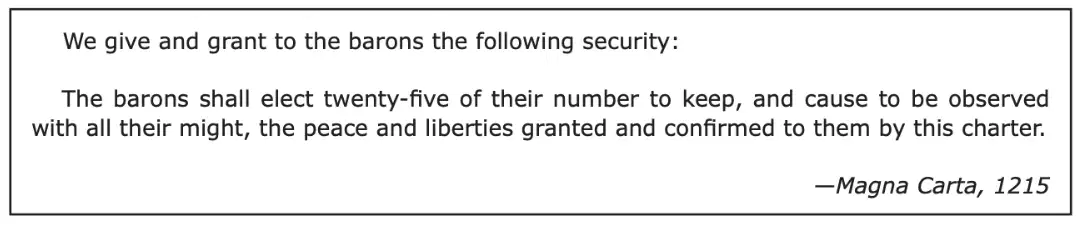
Which principle of government is discussed in the passage below?
a)
Federalism
b)
Separation of Church and State
c)
Popular Sovereignty
d)
Representative Government
15.
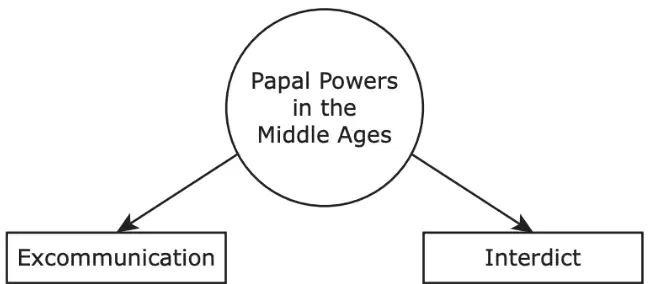
Which of the following best explains how the powers shown/listed in the diagram supported the authority of the Roman Catholic Church in western Europe?
a)
The powers were exercised against kings and nobles who failed to follow to church customs and mandates
b)
The powers were used to force local populations to pay taxes supporting parishes and monasteries
c)
The powers allowed nobility to appoint bishops and abbots
d)
The powers allowed dioceses to collect funds that paid for the construction of cathedrals and schools
16.
Which factor contributed to Europe's Commercial Revolution in the 16th century?
a)
The application of mercantilist principles to regulate trade with colonies
b)
The nationalization of agriculture through the seizure of aristocratic lands
c)
The formation of financial institutions controlled by the church
d)
The translation from feudal production to modern industrial techniques
17.
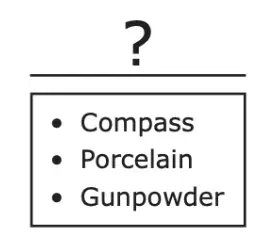
Who invented the following items?
a)
Muslims
b)
Chinese
c)
Greeks
d)
Americans
18.

People in England came to believe that the Magna Carta promised a trial by jury for anyone charged with a crime.
Which phrase suggests this idea of "trial by jury"?
a)
No one will refuse or delay right or justice
b)
No freeman shall be taken or imprisoned
c)
Without credible witness
d)
Lawful judgment of his peers
19.
What was Justinian's code?
a)
An improved library system
b)
A new form of writing
c)
A school of philosophy
d)
An organized set of laws
20.
What motivated Japan to try to prevent contact with foreigners?
a)
A concern about Catholic missionaries attracting converts
b)
Fear of diseases brought from Europe and Africa
c)
Pride in the purity of Japanese culture
d)
The desire to keep the process of silk manufacturing a secret
21.
Russia considered itself to be the "Third Rome" because it...
a)
was the same size as the Roman Empire before it split into the East and West
b)
was governed by a senate and emperor like ancient Rome
c)
Russia saw itself as heir to the Roman and Byzantine Empires
d)
was the third empire in history to rule the Italian Peninsula
22.
How did the Crusades lead to globalization in later centuries?
a)
They increased hostility between Muslims and Christians, promoting war
b)
They introduced Europeans to luxury goods from Asia, encouraging trade
c)
They strengthened the knights and noblemen of Europe, weakening royal power
d)
They demonstrated the economic value of slavery, motivating expeditions to Africa
23.
The magnetic compass and the astrolabe encouraged the development of...
a)
Renaissance ideals
b)
Exploration by ship
c)
Colonial bureaucracies
d)
Weapons using gunpowder
24.
Westernization was the process by which...
a)
European ideas and values spread around the world
b)
Colonial powers extended their influence into the interior
c)
Asian products and inventions were introduced into Europe
d)
Democratically elected governments replaced absolute rulers
25.
Who were the shoguns?
a)
Regional landowners in the Japanese feudal system
b)
Japanese sea captains who traveled to faraway places
c)
Strong military rulers of centralized Japanese state
d)
Bankers and traders in the new Japanese commercial class
26.
Humanism was a belief in the value of...
a)
Personal faith
b)
The individual
c)
Missionary work
d)
Absolute monarchy
27.
Which of these events began with the teachings of Martin Luther?
a)
The Renaissance
b)
The Reformation
c)
The Counter-Reformation
d)
The Commercial Revolution
28.
Which of the following was TRUE of the Manorial System?
a)
The lord provided housing and protection to the serfs
b)
Free peasants did not receive protection from the lord
c)
Serfs had to purchase most items from outside the manor
d)
The male peasants were the only ones who owed the lord duties
29.
Which of the following was a problem that troubled the Roman Catholic Church during the middle ages?
a)
Many priests refused to marry and have families even though the Church encouraged it
b)
Many bishops cared more about their spiritual duties than their duties as feudal lords
c)
Many bishops participated in the practice of selling indulgences
d)
Many people refused to pay tithes to the church
30.
How did patrons of the arts participate in the Renaissance?
a)
by creating their own art
b)
by establishing law schools
c)
by funding humanist universities
d)
by funding writers and artists
31.
Which of the following was NOT an effect of the Bubonic Plague?
a)
There was a decrease in trade
b)
That was a decrease in the prestige of the Church
c)
There was an increase in population
d)
There was an increase in the number of serfs leaving the manors
32.
Why was Johann Gutenberg's printing press significant?
a)
It allowed monarchs to communicate laws to their subjects
b)
It made the bible more expensive and led to a revival of religious devotion
c)
It enabled religious writers to reinterpret medieval works
d)
It made books less expensive and encouraged the spread of ideas
33.
How did humanists break with medieval thinkers over the acceptance of tradition and beliefs?
a)
Humanists questioned everything in order to form their own opinions
b)
Humanists looked for answers by interpreting religious texts
c)
Humanists relied on political leaders to provide guidance on questions of faith
d)
Humanists incorporated ideas from different countries to find answers
34.
Which of the following characterized humanism?
a)
a philosophy based on a strict following of christian beliefs and teachings
b)
an economic system stressing investment in technology and markets
c)
a movement focused on human potential and a study of the classics
d)
a political system emphasizing democratic ideals and policies
35.
How did the rise of a middle class in the Italian city-states affect the Renaissance?
a)
it provided money to sponsor military campaigns
b)
it created wealth to influence local elections
c)
it provided money to sponsor artists and writers
d)
it created wealth to establish new colonies
100 %

