
 Worksheets
Israel Unit Test Review
Total questions: 45
Worksheet time: 23mins
What made the Israelites different from other cultures of their time?
They worshiped only one god.
They lived in small towns instead of cities.
They relied more on fishing than farming.
They lived far from a major river.
According to the Hebrew Bible, Abraham led his family from Mesopotamia to Canaan because they were forced to leave by the Assyrians.
True
False
Moses is considered an important figure because he led the Israelites out of Egypt.
True
False
Canaan was uninhabited when the Israelites arrived.
True
False
The Kingdoms of Israel and Judah both practiced the religion of the Israelites.
True
False
What is a tabernacle?
A chest where the Hebrew Bible was stored.
A temple where the Canaanites worshiped.
A tent where Israelites went to pray.
A building where the Israelites stored grain.
Who was the first king of the Israelites?
David
Saul
Moses
Solomon
According to the Hebrew Bible, which of the following did David NOT accomplish as king?
He united the Israelites.
He defeated the Philistines.
He wrote the proverbs in the Hebrew Bible.
He overthrew King Saul in battle.
The Assyrian army started the Babylonian Exile after conquering Jerusalem.
True
False
What role did prophets play in the daily life of Judeans?
They taught people how to read the Hebrew Bible.
They advised government officials.
They explained when people were not following the word of God.
They shared words of God during hard times.
What is the Sabbath?
A book found in the Hebrew Bible.
A weekly day of worship and rest observed by Jewish people.
A Jewish holiday celebrated during the winter.
A collection of poems written by a prophet.
Where did the Jews build the Second Temple?
Bethlehem
Babylon
Samaria
Jerusalem
Which of the following is NOT found in the Hebrew Bible?
The Torah
The New Testament
The Prophets
The Writings
What does it mean to keep kosher?
To follow Jewish dietary rules.
To attend synagogue every Saturday.
To believe in a single God.
To read the Hebrew Bible only.
What was one result of the Diaspora?
The destruction of the Second Temple.
The downfall of the Chaldean Empire.
The rise of a Jewish kingdom in the Mediterranean.
The spread of Jewish beliefs and culture.
Who were the Maccabees?
A group of rabbis that studied the Torah.
A Jewish rebel army that opposed the Greeks.
A community of prophets that spread Judaism.
A group of Jews that moved to Babylon.
As a result of the Jewish-Roman wars,
The Jewish people could no longer visit Jerusalem.
The Romans could no longer worship more than one God.
The Romans were forced to withdraw from Judea.
The Jewish people were forced to return to Egypt.
Who helped keep the teachings of Judaism alive after the Second Temple was destroyed?
Herod and the Essenes
The Pharisees
The Sadducees
Yohanan ben Zaccai
The Philistines, an eastern Mediterranean group, migrated from near present-day:
Syria
Greece
Damascus
Rome
Which Jewish holiday is celebrated with a Seder?
Hanukkah
Rosh Hashanah
Passover
Yom Kippur
Judaism played a part in the development of Christianity and Islam.
True
False
The ancestors of the ancient Israelites were Abraham and his family.
True
False
David and his army defeated the Greeks.
True
False
Cyrus II, the Persian king, let Jews return to Judah and govern themselves.
True
False
The Essenes were priests who broke away from the Temple of Jerusalem and lived in Qumran near the Dead Sea.
True
False

According to the excerpt from Exodus, who called to Moses out of the burning bush?
Jethro
Pharaoh
Madian
God

In the excerpt from Exodus, the statement "...the bush burned with fire, and the bush was not consumed" means?
The bush burned out.
The bush was not eaten.
The bush did not burn.
The bush was up in the sky.

The Talmud is a collection of discussions and teachings from authoritative rabbis. What can you conclude is the purpose of this excerpted quotation?
To encourage the Jewish people to take back their lands and temples.
To praise God for everything that he has given the Jewish people.
To ask God to write more books for the Talmud and the Torah.
To encourage all generations to learn and be devoted to Jewish teachings and law.
Whom did early Israelites ask to choose a king for them?
Saul
Daniel
Samuel
David
Which Jewish beliefs are shared by Christians and Muslims? Select all that apply.
Monotheism
The Ten Commandments
Abraham & His Descendants
Biblical Dietary Laws

According to the above chart, which two prophets' teachings are similar? Explain your answer.
Isaiah & Amos
Micah & Elijah
Hosea & Jeremiah
Ezekiel & Micah

According to the chart, which prophet taught that people should help others and pursue justice?
Micah
Isaiah
Hosea
Amos
"But let justice roll on like a river, righteousness [honor] like a never failing stream." -Amos 5:24 What does this quotation mean?
That rivers are fun to kayak down.
That people should let things go and not hold onto hate.
That people should work for a united society where everyone is treated fairly.
That justice is achieved by testing if people can swim.
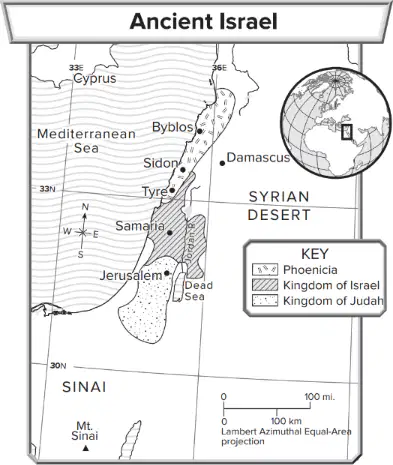
According to the map, which kingdom is bordered to the east by the Dead Sea?
Israel
Jordan
Judah
Sinai
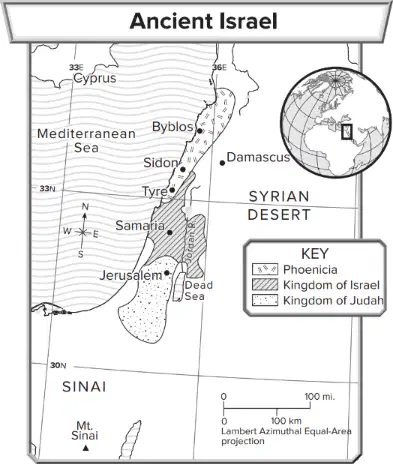
After looking at the map, name three Phoenician cities located along the Mediterranean Sea.
Tyre
Byblos
Jerusalem
Sidon
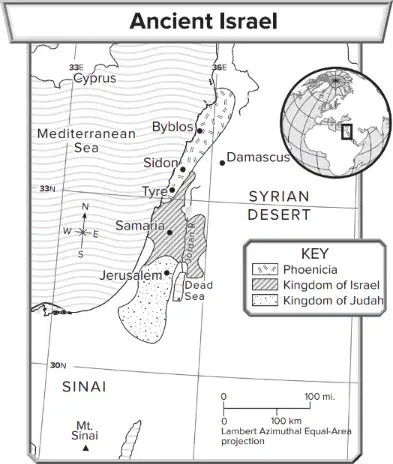
According to the map, in which kingdom is the city of Samaria located?
Judah
Sinai
Israel
Phoenicia
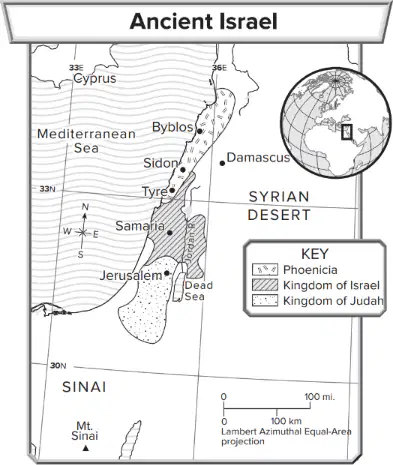
According to the map, which desert borders the Phoenician empire and the kingdoms of Israel and Judah?
Sandy Desert
Syrian Desert
Sinai Desert
Sahara Desert
"But let justice roll on like a river, righteousness [honor] like a never-failing stream." -Amos 5:24 To what does Amos compare righteousness?
A never-failing stream
A river
Justice
A dried up stream
Period of time when the Judeans were sent
to Babylon by Nebuchadnezzar.
Babylonian Exile
Babylonian Diaspora
Babylonian Trial
Babylonian Journey
Name given to Judaea by the Romans; refers
to the Philistines.
Israel
Philistine
Palestine
Pheonicia
What is the significance of the Western Wall in Judaism?
It is the burial site of Moses.
It is the last remaining wall of the Second Temple in Jerusalem.
It is where the Ten Commandments were given.
It is the location of the first synagogue.
Which Jewish festival commemorates the rededication of the Second Temple in Jerusalem?
Purim
Hanukkah
Passover
Yom Kippur
Who is considered the father of the Jewish people?
Isaac
Jacob
Abraham
Joseph
What was the primary language spoken by the ancient Israelites?
Aramaic
Hebrew
Greek
Latin
What is the significance of the Torah in Judaism?
It is a historical account of the Jewish people.
It is a collection of Jewish prayers.
It is a book of prophecies.
It is the first five books of the Hebrew Bible.

