
 Worksheets
Unit 4 Part 2 Review
Total questions: 12
Worksheet time: 6mins
Name
Class
Date
1.
Two ways to propose an amendment: 2/3 vote in both chambers
or
2/3 of __________________ __________________ can call for a national convention
a)
House of Representatives
b)
state legislatures
c)
Constitutional Convention
d)
The President
2.
To ratify an amendment:
What fraction of the state legislatures or the states at the convention must pass?
a)
2/3
b)
3/5
c)
3/4
d)
1/2
3.
A Bill is passed by both the House and the Senate. The Bill is then submitted to the Pres. Which is NOT an option for the President?
a)
Let the Bill die in committee
b)
Sign the Bill and it becomes law
c)
Veto the Bill and inform Congress of the reasons for the veto
d)
Not sign the Bill and after 10 days if Congress is not in session the Bill dies
4.
If the president vetoes a bill, what must Congress do to make that bill a law?
a)
ask the Supreme Court to review the bill
b)
impeach the president
c)
override the president’s veto with a 2/3 vote in both houses
d)
refuse to confirm the presidents appointments
5.
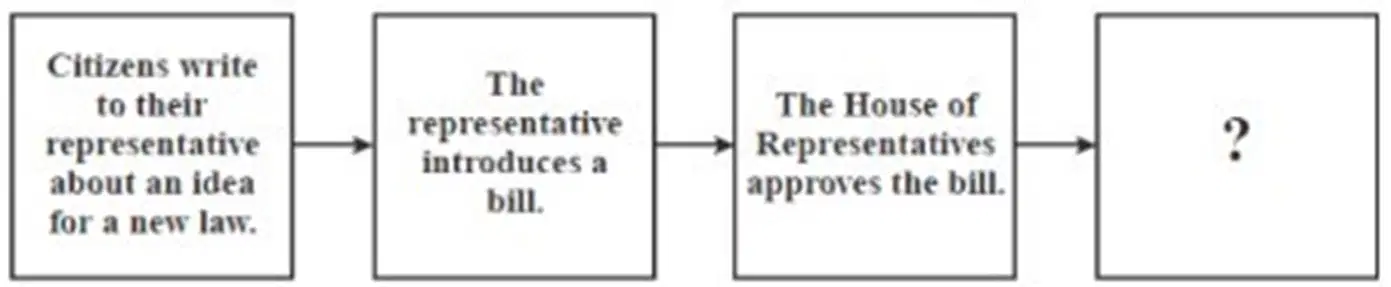
What is the next step in the lawmaking process?
a)
The President signs the bill into law.
b)
The bill goes to the Senate for action.
c)
The people vote on the bill in an election.
d)
The bill goes to the Supreme Court for a hearing.
6.
If a bill passes in the House, where does it go next?
a)
The President
b)
The Senate
c)
The Supreme Court
d)
The Vice President
7.
Which of the following best describes the U.S. Constitution's amendment process?
a)
Step 1: The amendment is proposed by a 2/3 vote in both chambers of Congress. Step 2: 3/4 of the State legislatures ratify the amendment.
b)
Step 1: The amendment is proposed by the President. Step 2: The Supreme Court approves it
c)
Step 1: The amendment is proposed a vote in the House of Rep. Step 2: The Senate ratifies the amendment.
d)
Step 1: The amendment is proposed by 5/9 of the Supreme Court Justices. Step 2: The President signs the amendment.
8.
Which phrase describes the main reason the framers of the U.S Constitution made the amendment process difficult?
a)
to ensure that endless amendments would be avoided
b)
to ensure that amendments would be approved by all states
c)
to ensure the process would not be dominated by a single political party
d)
to ensure the process would not be dominated by a single political issue
9.
Which two sets of freedoms and rights are mentioned in the Bill of Rights?
a)
freedom of speech and the right to bear arms
b)
freedom of religion and the right to education
c)
freedom of the press and the right to not pay taxes
d)
freedom of assembly and the right to seize property
10.
Who can introduce a bill in Congress?
a)
The President
b)
Suprene Court justices
c)
Members of Congress
d)
State governors
11.
What is the purpose of a committee in the legislative process?
a)
To veto bills
b)
To campaign for bills
c)
To review and make changes to bills
d)
To sign bills onto law
12.
What happens if a bill is approved by a committee?
a)
It is sent to the President
b)
It is debated on the floor of the House or Senate
c)
It is automatically passed as a law
d)
It is discarded
100 %

