
NEW
Font size
 Worksheets
QUIZ | TruthTables, Equivalent Statements, and Tautologies
Total questions: 6
Worksheet time: 3mins
2 TRUTHS AND 1 LIE | DETERMINE THE LIE
a.) Truth tables help us determine the truth value of compound statements based on the truth values of their components.
b.) Truth tables can only be used with statements involving three or fewer variables; more complex statements require other methods.
c.) Each possible combination of truth values for the variables in a compound statement is listed as a separate row in a truth table.
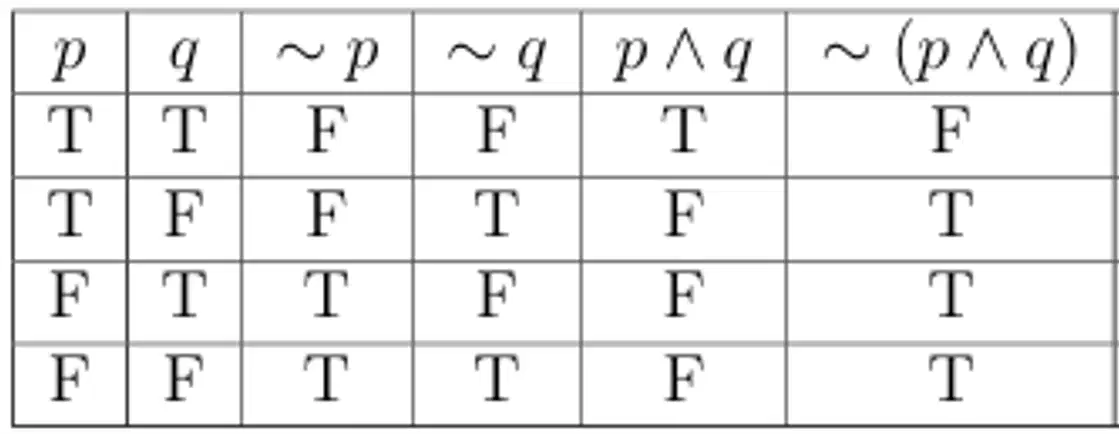
2 TRUTHS AND 1 LIE | DETERMINE THE LIE
a.) The Column labeled p^q (representing the logical AND of p and q) is true only when both p and q are true.
b.) The column labeled ~(p^q) represents the negation of p^q and is true in all cases except when both p and q are true.
c.) The column labeled ~p is true whenever p is true, as it represents the logical complement of p.
2 TRUTHS AND 1 LIE | DETERMINE THE LIE
a.) Tautologies are always true, regardless of the truth values of their components.
b.) A contradiction is a statement that is sometimes false.
c.) The conjunction of a tautological statement and a contradiction results in a contradiction.
2 TRUTHS AND 1 LIE | DETERMINE THE LIE
a.) If a statement is a tautology, its truth value is true for all possible truth assignments.
b.) The conjunction of any given statement and a tautological statement is always false.
c.) A contradiction cannot be true under any circumstance.
2 TRUTHS AND 1 LIE | DETERMINE THE LIE
a.) If two statements have the same truth value for all possible truth assignments to their variables, they are logically equivalent.
b.) De Morgan's law allows us to rewrite negations of conjunctions and disjunctions as equivalent statements involving the opposite logical operation.
c.) Logically equivalent statements always look the same when written out in words.
2 TRUTHS AND 1 LIE | DETERMINE THE LIE
a.) The inverse of a statement is always logically equivalent to the original statement.
b.) The converse of a statement is not necessarily equivalent to the original statement.
c.) The contrapositive of a statement is logically equivalent to the original statement.

