wayground logo

Free Printable Worksheets

Font size

S
M
L
XL
Worksheets

polynomials

Total questions: 185

Worksheet time: 12hrs 9mins

Name
Class
Date
1.
What is the degree classification of this polynomial?
x²+4x-8
a)
binomial
b)
trinomial
c)
quadratic
d)
cubic
2.
What is the term classification of the following polynomial?
x³-7x²+3
a)
monomial
b)
binomial
c)
trinomial
d)
polynomial
3.
Which is an example of a linear polynomial?
a)
x²-5
b)
6x+4
c)
5x⁵
d)
2x³-9x²
4.
Which is an example of a cubic binomial?
a)
x³+5
b)
x²+3
c)
x²+5x-6
d)
5x³
5.
What is the leading coefficient of the following polynomial?
5x²-3x+6
a)
2
b)
-3
c)
5
d)
6
6.
Which of these has a negative leading coefficient?
a)
x²+9x-4
b)
6x-9
c)
-8x+8
d)
9x
7.
What is the classification of the following polynomial?
x²-8x+10
a)
quadratic binomial
b)
cubic trinomial
c)
linear binomial
d)
quadratic trinomial
8.
Add the following polynomials:
(x³-2x²+3)+(2x³+3x²-1)
a)
3x³-2x²+3x+2
b)
3x³+x²+2
c)
3x³-5x²-2
d)
3x³-x²+1
9.
Add the following polynomials
(x³-6x²+3)+(3x³+4x-1)
a)
4x³-2x²+2
b)
4x³-6x²+4x+2
c)
-2x³+2x+2
d)
4x³-2x²-2
10.
Subtract the following polynomials:
(3x²-3x+2)-(x²-2x+1)
a)
2x²+x+1
b)
2x²-5x+3
c)
2x²-x+1
d)
4x²-5x+3
11.
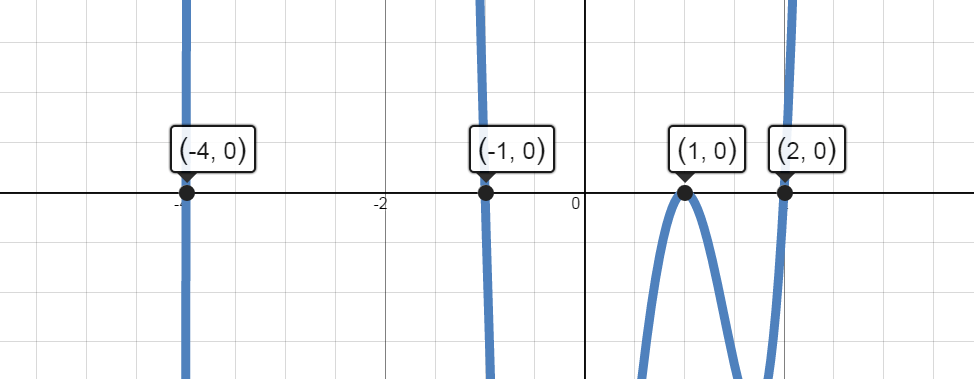
What are the zeros of the graph?
a)
-4, -1, 2, 1 multiplicity 2
b)
-4, -1, 1, 2
c)
4, 1, -2, -1 multiplicity 2
d)
4, 1, -1, -2
12.
Based on the end behavior which option best describes the leading term?
a)
negative coefficient, even degree
b)
negative coefficient, odd degree
c)
negative degree, odd coefficient
d)
negative degree, even coefficient
13.
Assuming the scale is 1, where is f(x) > 0?
a)
[-4, -1] U [2, +oo)
b)
(-4, -1) U (2, +oo)
c)
(-oo, -4] U [-1, 2]
d)
(-oo, -4) U (-1, 2)
14.
f(x)=(x+4)(x-3)(x-2)
List the zeros for this function.
a)
x= -4, x=3, x= -2
b)
x= -4, x=3, x=2
c)
x= -4, x=3, x=2
d)
x=4, x= -3, x= -2
15.
How many zeros does the polynomial function
 P(x) = 3x4+4x-8 have?
a)
1
b)
2
c)
3
d)
4
16.
Identify the zeros:
a)
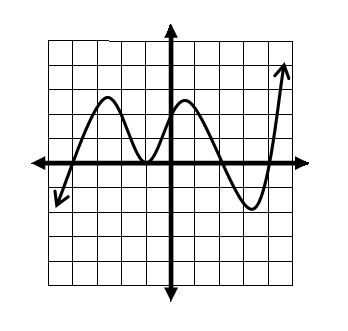
x=-2, x=-1, x=0
b)
x=-2, x=0
c)
x=-1, x=0, x=2
d)
x=-2, x=0, x=1
17.
a)
The function has an Even degree
b)
The function has a Negative coefficient
c)
The function has an Odd degree
d)
The function has 3 real zeros
18.
a)
Positive Odd
b)
Positive Even
c)
Negative Odd
d)
Negative Even
19.
a)
A
b)
B
c)
C
d)
D
20.
Determine the y-intercept 
f(x) = x3 - 5x2 - 25x + 125
a)
(0,0)
b)
(0,25)
c)
(0,125)
d)
(0,5)
21.
Which of the following could be the equation of this graph in factored form? (Careful-pay attention to multiplicity.)
a)
f(x) = (x-4)(x-1)2(x+2)(x+4)
b)
f(x) = (x-4)(x+1)2(x+2)(x+4)
c)
f(x) = (x-4)(x-1)2(x-2)(x+4)
d)
f(x) = (x+4)(x+1)2(x-2)(x-4)
22.
a)
2
b)
1
c)
4
d)
cannot be determined
23.
a)
a
b)
b
c)
c
d)
d
24.
Which of the following could be the equation of the graph in factored form?
a)
y=-(x+1)(x-2)(x-4)
b)
y=(x+1)2(x-2)
(x-4)3
c)
y = x(x+1)(x-2)
(x-4)
d)
y=(x+1)3(x-3)
(x-1)2
25.
a)
A
b)
B
c)
C
d)
D
26.
What is the end-behavior of the function 
y = -x3 + 6x2 + 7x
a)
as x-> -∞  f(x) -> ∞
 as x-> ∞  f(x) -> -∞
b)
as x-> -∞ f(x) -> ∞
 as x-> ∞  f(x) -> ∞
c)
as x->-∞ f(x) -> -∞
 as x-> ∞   f(x) -> ∞
d)
as x-> -∞ f(x) -> -∞
 as x-> ∞ f(x) -> -∞
27.
Select polynomial whose zeros and degree are given.
Zeros: – 5(multiplicity of 3), 9(multiplicity of 2), – 2, 4
Degree: 7
a)
(x + 5)3(x - 9)2
(x + 2)(x - 4)
b)
(x + 5)3(x - 9)2
(x + 2)7(x - 4)7
c)
(x + 5)3(x - 9)2(x + 2)
d)
(x + 5)(x - 9)(x + 2)
(x - 4)
28.
Which of the following MUST be true about 
the graph shown.
a)
It has a degree of
exactly 3
b)
It has a degree of
AT LEAST 3
c)
It has a degree of
AT LEAST 5
d)
It has a degree
of exactly 5
29.
Which of the following allows you to describe the end behavior of a polynomial?
a)
the degree and the constant
b)
the leading coefficient and the constant
c)
degree and the variable
d)
the degree and the leading coefficent
30.
a)
y=-(x+1)(x-2)(x-4)
b)
y=(x+1)2(x-3)(x-1)3
c)
y = 3x3 – 2x + 1
d)
y=(x+1)3(x-3)(x-1)2
31.
What are the zeros (x-intercepts)?
a)
x = 2,-2
b)
x = 2,-2,0
c)
x = 2,0
d)
x = -4,-2,2,0
32.

Is this polynomial ODD or EVEN?

f(x) = -7x3 + 11x5 - 4x6 + 113x

a)

ODD

b)

EVEN

33.
Over the interval (−1, 2), the graph of the polynomial shown could be described as
a)
decreasing
b)
increasing
c)
quadratic
d)
complex
34.

f(x)=(x+4)(x-3)(x-2)

List the zeros for this function.

a)

x= -4, x=3, x= -2

b)

x= -4, x=3, x=2

c)

x= -4, x=-3, x=2

d)

x=4, x= -3, x= -2

35.
Identify the zeros:
a)
x=-2, x=-1, x=0
b)
x=-2, x=0
c)
x=-1, x=0, x=2
d)
x=-2, x=0, x=1
36.
a)
The function has an Even degree
b)
The function has a Negative coefficient
c)
The function has an Odd degree
d)
The function has 3 real zeros
37.
a)
Positive Odd
b)
Positive Even
c)
Negative Odd
d)
Negative Even
38.
a)
y=-(x+1)(x-2)(x-4)
b)
y=(x+1)2(x-3)(x-1)3
c)
y = 3x3 – 2x + 1
d)
y=(x+1)3(x-3)(x-1)2
39.
Which of the following could be the equation of this graph in factored form? (Careful-pay attention to multiplicity.)
a)
f(x) = (x-4)(x-1)2(x+2)(x+4)
b)
f(x) = (x-4)(x+1)2(x+2)(x+4)
c)
f(x) = (x-4)(x-1)2(x-2)(x+4)
d)
f(x) = (x+4)(x+1)2(x-2)(x-4)
40.
What does multiplicity of a zero mean?
a)
Look at the number of terms
b)
How many times the zero repeats
c)
Find the sum of all the coefficients
d)
Ratio your x and y
41.
Which of the following could be the equation of the graph in factored form?
a)
y=-(x+1)(x-2)(x-4)
b)
y=(x+1)2(x-2)
(x-4)3
c)
y = x(x+1)(x-2)
(x-4)
d)
y=(x+1)3(x-3)
(x-1)2
42.
What is the end-behavior of the function 
y = -x3 + 6x2 + 7x
a)
as x-> -∞  f(x) -> ∞
 as x-> ∞  f(x) -> -∞
b)
as x-> -∞ f(x) -> ∞
 as x-> ∞  f(x) -> ∞
c)
as x->-∞ f(x) -> -∞
 as x-> ∞   f(x) -> ∞
d)
as x-> -∞ f(x) -> -∞
 as x-> ∞ f(x) -> -∞
43.
What is the end-behavior of the function 
y = x6 - 7x5 + 7x - 9
a)
as x-> -∞  f(x) -> ∞
 as x-> ∞  f(x) -> -∞
b)
as x-> -∞ f(x) -> ∞
 as x-> ∞  f(x) -> ∞
c)
as x->-∞ f(x) -> -∞
 as x-> ∞   f(x) -> ∞
d)
as x-> -∞ f(x) -> -∞
 as x-> ∞ f(x) -> -∞
44.
Which of the following could be the factored form for the equation representing the graph shown?
a)
(x+3)(x-2)(x-5)
b)
(x-5)2(x-2)(x+3)
c)
(x-3)(x+2)(x+5)2
d)
none of these
45.
Classify
a)
Monomial
b)
Binomial
c)
Trinomial
d)
Polynomial
46.
Classify by the DEGREE:
3x - 2
a)
1
b)
2
c)
3
d)
4
47.
Polynomial or not?
5x4 - 7x
a)
polynomial
b)
not a polynomial
48.
Polynomial or not?
a)
polynomial
b)
not a polynomial
49.
Rewrite the polynomial in standard form: -5 + 4m
a)
-5 + 4m
b)
4m - 5
c)
-4m + 5
d)
4m2 - 5
50.
What is the degree classification of this polynomial?
x²+4x-8
a)
binomial
b)
trinomial
c)
quadratic
d)
cubic
51.
Which is an example of a cubic binomial?
a)
x³+5
b)
x²+3
c)
x²+5x-6
d)
5x³
52.
What is the leading coefficient of the following polynomial?
5x²-3x+6
a)
2
b)
-3
c)
5
d)
6
53.
Which is an example of a linear polynomial?
a)
x²-5
b)
6x+4
c)
5x⁵
d)
2x³-9x²
54.
Classify the polynomial by its degree.
x2 + 2x3 - 4
a)
A
binomial
b)
B
trinomial
c)
C
quadratic
d)
D
cubic
55.
Classify the polynomial by its number of terms.
 4x² - 2
a)
A
monomial
b)
B
binomial
c)
C
trinomial
d)
D
polynomial
56.
What is the degree of the polynomial?
x3y- 7x2y + 3
a)
A
1
b)
B
3
c)
C
5
d)
D
7
57.
Which is an example of a cubic monomial?
a)
A
x³ + 5
b)
B
x² + 3
c)
C
x² + 5x - 6
d)
D
5x³
58.
How many terms are in the following polynomial?
3xy - 2y + 8x - 7z -16
a)
A
1
b)
B
2
c)
C
4
d)
D
5
59.
Add:
(3x² - 3x + 2) + (x² - 2x + 1)
a)
A
4x³-2x²+2
b)
B
4x² - 5x + 3
c)
C
-2x³+2x+2
d)
D
4x³-2x²-2
60.
a)
y =  _(x + 2)(x - 1)2
b)
y = -(x - 2)(x + 1)2
c)
y = (x - 2)(x + 1)2
d)
y = -x3
61.
a)
y = x(x - 3)(x - 2)
b)
y = x(x - 3)(x+2)
c)
y = x(x + 3)(x - 2)
d)
y = -x(x + 3)(x - 2)
62.

Which of the following correctly identifies the End Behavior?

a)
b)
c)
d)
63.

Which of the following correctly identifies the End Behavior?

a)
b)
c)
d)
64.
Is the leading coefficient positive or negative
a)
positive
b)
negative
65.

f(x) = (x+2)(x-3)2(x-4)

Which choice best describes the zeros?

a)

-2, 3 (multiplicity 2), 4

b)

-2 (multiplicity 2), 3, 4

c)

2, -3 (multiplicity 2), -4

d)

2 (multiplicity 2), -3, -4

66.

If a zero of a polynomial function has multiplicity 2 (is a double), that means:

a)

There is a zero at 2

b)

The graph will "bounce" off the x-axis at that zero

c)

The graph will "cross" the x-axis at that zero

d)

Double zeros don't exist

67.

What is the minimum of this graph?

a)

2

b)

4

c)

- \infty

d)

-1

68.

Which root has a multiplicity of 2?

a)

-1

b)

2

c)

4

d)

-4

69.
What is the equation in factored form of this graph?
a)
f(x) = (x-4)(x-1)2(x+2)(x+4)
b)
f(x) = (x-4)(x+1)2(x+2)(x+4)
c)
f(x) = (x-4)(x-1)2(x-2)(x+4)
d)
f(x) = (x+4)(x+1)2(x-2)(x-4)
70.

What is the increasing interval for the function below?

a)

(,)\left(-\infty,\infty\right)

b)

(,2]\left(-\infty,2\right]

c)

(,6]\left(-\infty,6\right]

d)

(6,6)\left(-6,6\right)

71.

What is/are the decreasing interval(s) for the function shown?

a)

(2, 4) and (8, )\left(2,\ 4\right)\ and\ \left(8,\ \infty\right)

b)

(, 1) and (8, )\left(-\infty,\ 1\right)\ and\ \left(8,\ \infty\right)

c)

(,1), (3, 1) and (8, )\left(-\infty,1\right),\ \left(-3,\ 1\right)\ and\ \left(8,\ \infty\right)

d)

(, 1), (2, 4) and (8, )\left(-\infty,\ 1\right),\ \left(2,\ 4\right)\ and\ \left(8,\ \infty\right)

72.

What is/are the increasing interval(s) for the function shown?

a)

(3, 1)\left(-3,\ 1\right)

b)

(4, 8)\left(4,\ 8\right)

c)

(,1) and (3, 1)\left(-\infty,1\right)\ and\ \left(-3,\ 1\right)

73.

What is the increasing interval on the function shown?

a)

(, 1)\left(-\infty,\ 1\right)

b)

(, 2)\left(-\infty,\ 2\right)

c)

(2, )\left(2,\ \infty\right)

d)

(1, )\left(1,\ \infty\right)

74.

What is the increasing interval(s) on the function shown?

a)

(, 15) and (9, 15)\left(-\infty,\ -15\right)\ and\ \left(9,\ -15\right)

b)

(2, 9) and (2, )\left(-2,\ 9\right)\ and\ \left(2,\ \infty\right)

c)

(, 2) and (0, 2)\left(-\infty,\ -2\right)\ and\ \left(0,\ 2\right)

d)

(2, 0) and (2, )\left(-2,\ 0\right)\ and\ \left(2,\ \infty\right)

75.
Find the zeros.
a)
0 and 4
b)
0 and -4
c)
0
d)
-4
76.

What is the end behavior of this graph?

a)

x → ⁻∞, y→ ⁻∞ and

x→ ∞, y→ ⁻∞

b)

x → ⁻∞, y→ ∞ and

x→ ∞, y→ ∞

c)

x → ⁻∞, y→ ⁻∞ and

x→ ∞, y→ ∞

d)

x → ⁻∞, y→ ∞ and

x→ ∞, y→ ⁻∞

77.

What is the end behavior for the graph?

a)

x → ⁻∞, y→ ⁻∞ and

x→ ∞, y→ ⁻∞

b)

x → ⁻∞, y→ ∞ and

x→ ∞, y→ ∞

c)

x → ⁻∞, y→ ⁻∞ and

x→ ∞, y→ ∞

d)

x → ⁻∞, y→ ∞ and

x→ ∞, y→ ⁻∞

78.

How many complex roots (real or imaginary) of x2 + 2x + 1?

a)

1

b)

2

c)

3

d)

4

79.

How many complex roots (real or imaginary) of x2 + 3x3 - x4?

a)

2

b)

3

c)

4

d)

5

80.
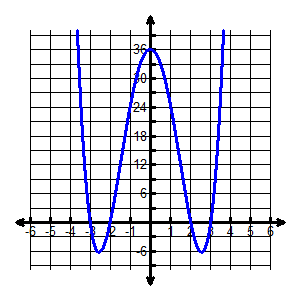
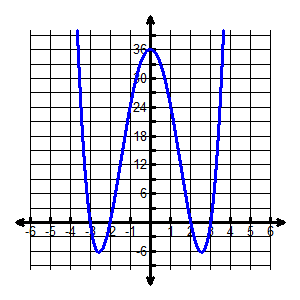
What is the relative max?
a)
(0, 36)
b)
(-2.55, -6.55), (2.55, -6.55)
c)
(-∞, ∞)
d)
None
81.
What is the relative min?
a)
(0, 36)
b)
(-2.55, -6.55), (2.55, -6.55)
c)
(-∞, ∞)
d)
None
82.
What is the end behavior as x → -∞ f(x)→ ?
a)
-∞
b)
83.
Is the leading coefficient positive or negative?
a)
+
b)
-
84.
What is the min degree?
a)
2
b)
4
c)
5
d)
3
85.
Describe the end behavior of the graph.
a)
x →∞, y→∞ and x→∞, y→⁻∞
b)
x →∞, y→∞ and x→⁻∞, y→∞
c)
x →∞, y→∞ and x→⁻∞, y→0
d)
x →∞,y→0 and x→∞, y→⁻∞
86.
Determine the end behavior of the graph of 
f(x) = -7x3 + 2x - 1
a)
As x →∞, f(x) →∞.
As x→-∞, f(x) →-∞.
b)
As x →∞, f(x) →∞.
As x→-∞, f(x) →∞.
c)
As x →∞, f(x) →-∞.
As x→-∞, f(x) →∞.
d)
As x →∞, f(x) →-∞.
As x→-∞, f(x) →-∞.
87.

Even or Odd degree?

a)

even

b)

odd

88.

Even or odd degree?

a)

even

b)

odd

89.
f(x)=(x+4)(x-3)(x-2)
List the zeros for this function.
a)
x= -4, x=3, x= -2
b)
x= -4, x=3, x=2
c)
x= -4, x=3, x=2
d)
x=4, x= -3, x= -2
90.
What is the degree of the function graphed here?
a)
2
b)
3
c)
4
d)
5
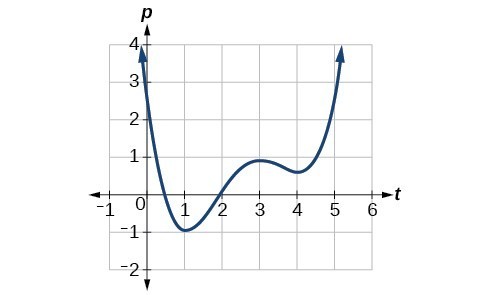
91.

Choose all intervals where the graph is DECREASING (Choose all that apply)

a)

(-∞ , 1)

b)

(1 , 3)

c)

(3 , ∞)

92.

Choose all intervals where the graph is Increasing (Choose all that apply)

a)

(-∞ , 1)

b)

(1 , 3)

c)

(3 , ∞)

93.
Where is the function decreasing?
a)
(-∞, -1)
b)
(-1, ∞)
c)
(-∞, 3)
d)
(-∞, ∞)
94.

Where is the function Increasing?

a)
(-∞, -1)
b)
(-1, ∞)
c)
(-∞, 3)
d)
(-∞, ∞)
95.

When is this function increasing?

a)

(-3, 3)

b)

(-2.5, 2.5)

c)

[-3, 3]

d)

(3, ∞)

96.

When is this function decreasing?

a)

(-3, 3)

b)

(-2.5, 2.5)

c)

[-3, 3]

d)

(3, ∞)

e)

(,3)(3,)\left(-\infty,-3\right)\cup\left(3,\infty\right)

97.

What is the decreasing interval on the function shown?

a)

(, 3)\left(-\infty,\ -3\right)

b)

(, 4)\left(-\infty,\ -4\right)

c)

(4, )\left(-4,\ \infty\right)

d)

(3, )\left(-3,\ \infty\right)

98.
What is the range of the graph?
a)
[1, ∞)
b)
(1, ∞)
c)
(-∞, ∞)
d)
none of these
99.

What is the domain of the graph?

a)
[1, ∞)
b)
(1, ∞)
c)
(-∞, ∞)
d)
none of these
100.
What is the range of the graph?
a)
(-∞,∞)
b)
[0,∞)
c)
(0,5)
d)
[-1,∞)
101.

Over what interval is this function constant?

a)

-5 < x < -2

b)

-3 < x < 4

c)

4 < x < 8

d)

-5

102.
When is this function increasing?
a)
-2.5 < x < 2.5
b)
0 < x < 5
c)
0 < x < 55
d)
-5 < x < 0
103.
What is the increasing interval for this function?
a)
(-6, -2)
b)
(-∞, ∞)
c)
(-2, 6)
d)
(-1, 3)
104.
Which statement is true about this graph?
a)
This function is always constant
b)
This function is always increasing
c)
This function is never increasing
d)
This function is both increasing and decreasing
105.

Where is the function increasing?

a)

[4, ∞)

b)

[−4, ∞)

c)

[6, ∞)

d)

4 < x < 6

106.

For what intervals of x is f(x) decreasing?

a)

(-∞,-1)

b)

(-1,∞)

c)

(6,∞)

d)

(-∞,6)

107.

What is the range of the function?

a)

all real numbers

b)

(-3, 1)

c)

(, 4)\left(-\infty,\ 4\right)

d)

(4, )\left(4,\ \infty\right)

108.

What is the domainof the function?

a)

all real numbers

b)

(-3, 1)

c)

(, 4)\left(-\infty,\ 4\right)

d)

(4, )\left(4,\ \infty\right)

109.

Where is the function decreasing?

a)
( −∞, −2.55) U (0, 2.55)
b)
(∞, −6.25) U (36, −6.25)
c)
(−∞, ∞)
d)
(−∞, 0)
110.

Where is the function increasing?

a)
( −∞, −2.55) U (0, 2.55)
b)

(2.55, 0)(2.55, )\left(-2.55,\ 0\right)\cup\left(2.55,\ \infty\right)

c)
(−∞, ∞)
d)
(−∞, 0)
111.

How many x-intercepts does the polynomial have?

a)

1

b)

5

c)

6

d)

7

112.

What is the first step in solving using synthetic division

a)

Factor the Polynomial

b)

Divide by 7

c)

Solve for n in the denominator

d)

Solve for n in the numerator

113.

What number do we place in the equation when a term is missing for long division

a)

1

b)

2

c)

0

d)

5

114.

What is the remainder for the question

(a)  

115.

x2+13x+40÷x+8x^2+13x+40\div x+8

a)

5

b)

-5

c)

x+5

d)

x-5

116.

x2625÷x+25x^2-625\div x+25

a)

x-25

b)

x+25

c)

x-15

d)

x+15

117.

What is step 2 in this long division problem? x2+18x+80÷x4x^2+18x+80\div x-4

a)

Multiply by 22

b)

Multiply by x

c)

Add 18x and -4x

d)

Subtract 18x and -4x

118.

x2196÷x14x^2-196\div x-14

Which method would be the fastest way to solve this problem?

a)

Synthetic Division

b)

Factoring

c)

Long Division

d)

Leave it alone

119.

m2+14m+45÷m6m^2+14m+45\div m-6

Using synthetic division what is the constant term?

a)

20

b)

8

c)

14

d)

9

120.

a2+15a+44÷a+?a^2+15a+44\div a+?

Which 1 is a possible factor?

a)

11

b)

5

c)

9

d)

8

121.

How do you know you have a remainder in long division

a)

The first letter is x

b)

The last number left is not 0

c)

The answer is negative

d)

I have no clue. (help)

122.

6x2+19x+3x+3\frac{6x^2+19x+3}{x+3}  

(a)  

123.

15x2+19x+65x+3\frac{15x^2+19x+6}{5x+3}  

(a)  

124.

5x29x2x2\frac{5x^2-9x-2}{x-2}  

(a)  

125.

81x954x6+27x39x\frac{81x^9-54x^6+27x^3}{9x}  

a)

9x96x6+3x39x^9-6x^6+3x^3  

b)

9x86x5+3x29x^8-6x^5+3x^2  

c)

9x106x7+3x49x^{10}-6x^7+3x^4  

d)

81x86x5+3x281x^8-6x^5+3x^2  

126.

36x21216x+11\frac{36x^2-121}{6x+11}  

(a)  

127.

4x217x+18x2\frac{4x^2-17x+18}{x-2}  

(a)  

128.

14x2+17x2214x11\frac{14x^2+17x-22}{14x-11}  

(a)  

129.

75x8+50x4+30x3+5x25x2\frac{75x^8+50x^4+30x^3+5x^2}{5x^2}  

a)

15x8+10x4+6x3+x215x^8+10x^4+6x^3+x^2  

b)

15x6+10x2+6x15x^6+10x^2+6x  

c)

15x10+10x6+6x5+x415x^{10}+10x^6+6x^5+x^4  

d)

15x6+10x2+6x+115x^6+10x^2+6x+1  

130.

x216x4\frac{x^2-16}{x-4}  

(a)  

131.

x2+2x48x6\frac{x^2+2x-48}{x-6}  

(a)  

132.

x2+14x+13x+1\frac{x^2+14x+13}{x+1}  

(a)  

133.

16x8+24x640x44x3\frac{16x^8+24x^6-40x^4}{4x^3}  

a)

4x5+6x310x4x^5+6x^3-10x  

b)

4x8+6x610x44x^8+6x^6-10x^4  

c)

12x5+20x344x12x^5+20x^3-44x  

d)

4x11+6x910x74x^{11}+6x^9-10x^7  

134.

x2+10x+25x+5\frac{x^2+10x+25}{x+5}  

(a)  

135.

4x24x+12x1\frac{4x^2-4x+1}{2x-1}  

(a)  

136.
Is this division problem worked correctly?
a)
This is correct!
b)
This is incorrect!
137.
Which term is missing in this problem?
2x3 + 5x2 + 9 ÷
x + 3
a)
x4
b)
x3
c)
x2
d)
x
138.
If you were dividing x6 + 4x3 + 2, how many 0's would you need when setting up the top row of your synthetic division?
a)
0
b)
2
c)
4
d)
6
139.
Which would be better to use here?
a)
Long division
b)
Synthetic division
140.
What should be the order of the polynomial coefficients if
(3x - 4x3 + 6x4 + 1) / (x + 3)
a)
3   0   -4   6   1
b)
6   -4   3   1   0
c)
6   -4   0   3   1
d)
-6   4   0   -3   -1
141.
For synthetic division, what would be the number in the left hand box?
a)
0
b)
1
c)
2
d)
3
142.
If you were dividing x6 + 4x3 + 2, how many 0's would you need when setting up the top row of your synthetic division?
a)
0
b)
2
c)
4
d)
6
143.
            Is (x-2) a factor of             f(x)= x3-8x2+14x-4?
a)
Yes, (x-2) is a factor. There is a remainder.
b)
No, (x-2) is  not a factor. The remainder is zero.
c)
Yes, (x-2) is a factor. The remainder is zero.
d)
No, (x-2) is  not a factor. There is a remainder. 
144.
Divide using synthetic division 
(2x³ + 4x² - 5) by (x + 3).
a)
2x² + 2x - 4  R(-12)
b)
2x² - 2x + 6  R(-23)
c)
2x² - 2x + 8  R(-20)
d)
2x² - 4x + 1  R0
145.
2x3 - 5x2 + 3x + 7 ÷ x - 2
a)
2x3 - x2 + x + 9
b)
2x2 - x + 1
c)
2x2 - x + 1 + 9/x-2
d)
2x2 - 9x - 15 - 23/x-2
146.
3x3 + 5x - 1 ÷ x + 1
a)
3x3 - 3x2 + 8x - 9
b)
3x2 - 3x + 8 - 9/x+1
c)
3x2 + 3x + 8 + 7/x+1
d)
3x3 + 3x2 + 8x + 7
147.
Find the Quotient
(2x3 - 5x2 - 3x + 7) / (x - 2)
a)
2x2- 9x +15
b)
2x2 - x - 5
c)
2x2 - 9x - 21
d)
2x2 + x + 5
148.
Find the remainder
(2x3 - 5x - 7) / (x + 2)
a)
-9
b)
11
c)
-13
d)
-1
149.

Divide:


(4x2 - 24x + 35) / (2x - 5)

a)

2x - 7

b)

2x - 12

c)

2x + 12

d)

2x + 7

150.
Which term is missing in this problem?
2x3 + 5x2 + 9 ÷
x + 3
a)
x4
b)
x3
c)
x2
d)
x
151.
Which would be better to use here?
a)
Long division
b)
Synthetic division
152.
For synthetic division, what would be the number in the left hand box?
a)
0
b)
1
c)
2
d)
3
153.

Divide using synthetic division

(2x³ + 4x² - 5) by (x + 3).

a)

2x² + 2x - 4 - 12/(x + 3)

b)

2x² - 2x + 6 - 23/(x + 3)

c)

2x² - 2x + 8 - 20/(x + 3)

d)

2x² - 4x + 1

154.

2x3 - 5x2 + 3x + 7 ÷ x - 2

a)

2x3 - x2 + x + 9

b)

2x2 - x + 1

c)

2x2 - x + 1 + 9/(x - 2)

d)

2x2 - 9x - 15 - 23/(x - 2)

155.

Divide (4x³ - 2x² - 3) by (2x² - 1).

a)

2x - 1 + (2x - 4)/(2x2 - 1)

b)

2x + 3 + (x - 3)/(2x2 - 1)

c)

2x - 1

d)

2x + 3 + (3x-5)/(2x2 - 1)

156.

(6b2 - 5b - 52) ÷ (3b - 10)

a)

2b - 5 +2/(3b - 10)

b)

2b + 5 - 2/(3b - 10)

c)

18b -15 + 3/(3b - 10)

d)

-2b +15 +2/(3b - 10)

157.
a)

2x - 5

b)

x - 4 + 3/(4x - 5)

c)

2x + 4 + 3/(4x - 5)

d)

2x + 4

158.

Divide (x3 + 3x2 - 4x - 12) by (x2 + x - 6)

a)

x - 2

b)

x5 + 6

c)

x + 2

d)

x2 + 2

159.

Find the quotient when (21x2 - 52x + 32) is divided by (7x - 8).

a)

3x + 4

b)

3x + 3

c)

3x - 4

d)

3x + 2

160.

The area of a rectangular pool table is: x2 + 14x +40.

The length is x + 4. What is the width?

a)

x + 8

b)

x + 14

c)

x + 10

d)

x +4

161.

Decide if (x - 3) is a factor of 3x3 + 10x2 - x - 12.

a)

Yes, it is a factor

b)

No, it is not a factor

162.

(2x3 + 13x2 + 31x + 35)/(2x + 7)

a)

x2 - 3x + 5

b)

x2 + 3x + 5

c)

x2 - 3x - 5

d)

x2 + 3x - 5

163.

(4x4 - 3x3 - 4x2 - x + 3)/(4x - 3)

a)

x3 + x2 + x - 1

b)

x3 - x - 1

c)

x3 - 2x - 1

d)

x3 - x2 + x - 3

164.
Divide:
(9x2 + 6x)  ÷ 3x
a)
3x + 2
b)
3x2 + 2x
c)
5x2
d)
3x + 6
165.
a)
5p- 16p
b)
5p + 4
c)
5p - 4
d)
5p + 4p
166.
a)
4y6
b)
4y22
c)
30y6
d)
30y22
167.
Divide the polynomial by the monomial.
a)
15x9 - 8x3
b)
3x6 - 8x3
c)
-5x12
d)
3x6 - 40x3
168.
Divide the polynomial by the monomial.
a)
2x8-8x2-28x
b)
2x8-2x2-7x
c)
8x7-8x-28x
d)
2x-2x -7
169.

Simplify   45x159x10\frac{45x^{15}}{9x^{10}}  

a)

5x1.55x^{1.5}  

b)

36x536x^5  

c)

5x55x^5  

d)

36x1.536x^{1.5}  

170.

18y6 +9y4 12y23y2\frac{18y^{6\ }+9y^{4\ }-12y^2}{3y^2}  

a)

6y2 +3y2 4y26y^2\ +3y^2\ -4y^2  

b)

15y4 +6y2  915y^{4\ }+6y^2\ -\ 9  

c)

6y4 +3y246y^{4\ }+3y^2-4  

d)

6y3 3y2 +4y6y^{3\ }-3y^2\ +4y  

171.
a)
1/m2
b)
m2
c)
m8
d)
1/m8
172.

12a4 + 6a36a3\frac{-12a^{4\ }+\ 6a^3}{6a^3}  

a)

2a2a  

b)

2a+1-2a+1  

c)

2a +12a\ +1  

d)

2a + 1a-2a\ +\ 1a  

173.
Simplify.
a)
y15
b)
y5
c)
y2
d)
2y5
174.

Simplify. Assume no denominator is equal to 0.

24mn912mn11\frac{24mn^{-9}}{12mn^{-11}}  

**Remember:  Divide/reduce coefficients, subtract exponents, and then move negative exponents to the opposite spot.**

a)

12m2n20\frac{12m^2}{n^{20}}  

b)

2n22n^2  

c)

2mn22mn^2  

175.


Simplify. Assume no denominator is equal to 0.

9f1g8h36g2h9\frac{-9f^{-1}g^8h^{-3}}{6g^2h^9}  


a)

3g62fh12\frac{-3g^6}{2fh^{12}}  

b)

3fg10h6-3fg^{10}h^6  

c)

54fg16h27\frac{-54fg^{16}}{h^{27}}  

176.

Simplify. Assume no denominator is equal to 0.

x3y2xy6\frac{x^3y^2}{xy^{-6}}  

**Remember:  When dividing monomials, subtract exponents of like variables.**

a)

x2y8x^2y^8  

b)

x3y3\frac{x^3}{y^3}  

c)

x3y12\frac{x^3}{y^{12}}  

177.

Simplify   24y84y2\frac{-24y^8}{4y^2}  

a)

6y66y^6  

b)

6x6-6x^6  

c)

6y4-6y^4  

d)

6y6-6y^6  

178.

What would be the coefficients we use to solve:

(5x7+3x69x4+4x3+2x37)x+1\frac{\left(5x^7+3x^6-9x^4+4x^3+2x-37\right)}{x+1}  

a)

5,  3,9,  4,  2,375,\ \ 3,-9,\ \ 4,\ \ 2,-37  

b)

5,  3,  0,9,  4,  0,  2,375,\ \ 3,\ \ 0,-9,\ \ 4,\ \ 0,\ \ 2,-37  

c)

5,  3,  0,9,  4,  2,375,\ \ 3,\ \ 0,-9,\ \ 4,\ \ 2,-37  

d)

5,  3,  0,9,  4,  25,\ \ 3,\ \ 0,-9,\ \ 4,\ \ 2  

179.
What should be the order of the polynomial coefficients if
(3x - 4x3 + 6x4 + 1) / (x + 3)
a)
3   0   -4   6   1
b)
6   -4   3   1   0
c)
6   -4   0   3   1
d)
-6   4   0   -3   -1
180.

What is the proper way to write the answer for the following problem?

a)

2x3-x2-25x+12

b)

2x4-x3-25x2-12x+0

c)

2x3-x2-25x-12

d)

2x4-x3-25x2-12x-0

181.

What is the next step in synthetic division?

a)

Multiply the 9 and 6

b)

Add the 6 and -58

c)

Bring down the -58

d)

Divide the -58 by 6

182.

What is the next step in synthetic division?

a)

Add the -48 to the 54

b)

Multiply the 54 and 6

c)

Divide the 54 by 6

d)

Bring down the -58

183.

It's time to write the answer. What goes in the yellow area?

a)

n9n-9

b)

9

c)

-9

d)

6n248n586n^2-48n-58

184.

Find the quotient:

(2x3 - 5x - 7) ÷ (x - 2)

a)

2x3 - 4x2 + 3x - 13

b)

2x3 + 4x2 +3x - 1

c)

2x2 - 4x + 3 - 13/x-2

d)

2x2 + 4x + 3 - 1/x-2

185.

Find the quotient:

(2x3 + 5x2 + 9) ÷ (x + 3)

a)

2x2 - x + 3

b)

2x3 - x2 + 3x

c)

2x2 + 11x + 33 + 108/x+3

d)

2x2 - 5x + 12