
 Worksheets
Pre-Board-I-PHYSICS
Total questions: 182
Worksheet time: 2hrs 31mins
Clockwise moment produced by a force about a fulcrum is considered to be:
Positive
Negative
Zero
None of these
When the speed of a moving object is doubled, then its kinetic energy:
Remains the same
decreases
is doubled
becomes four times
The energy conversion in a washing machine is from __________:
Magnetic to electrical
electrical to mechanical
electrical to magnetic
magnetic to electrical
Which of the following radiations suffer maximum deflection in a magnetic field?
Alpha radiations
Beta radiations
Gamma radiations
X-radiations
Speed of blue light in water is:
More than green light
more than orange light
more than violet light
more than red light
A concave lens produces only ____________ image.
Real, enlarged
virtual, enlarged
virtual, diminished
real, diminished
When a body vibrates under a periodic force, the vibrations of the body are always:
Natural vibrations
damped vibrations
forced vibrations
resonant vibrations
Two notes are produced from two different musical instruments, such that they have the same loudness and same pitch. The produced notes differ in their:
Waveform
Frequency
Wavelength
Speed
When a current I flows through a wire of resistance R for time t, then the electrical energy produced is given by:
I2Rt
IR2t
IRt
IRt2
Choose the correct relation for e.m.f. (ε) and terminal voltage V:
ε= V (always)
V > ε [always]
V < ε [when the cell is in use]
None of These
When a ray of light travels normal (perpendicular) to the given surface, then the angle of refraction is:
180o
90o
0o
45o
Small air bubbles rising up a fish tank appear silvery when viewed from some particular angle is due to the:
reflection
refraction
dispersion
total internal reflection
Which class of lever always has a mechanical advantage (MA) greater than 1?
Class I
Class II
Class III
Class IV
In a block and tackle system, how does increasing the weight of the movable block affect the efficiency of the pulley system?
Increases the efficiency
Decreases the efficiency
Does not affect the efficiency
Doubles the efficiency
If the mass and velocity of a body are both doubled, how does its kinetic energy change compared to its initial kinetic energy?
It is doubled.
It becomes four times.
It becomes eight times.
It remains the same.
What is the unit of power commonly used in mechanical engineering?
Watt
Horsepower
Erg per second
Joule
What is the SI unit of electrical power?
Watt
Kilowatt
Joule
Horsepower
Two copper wires can have different _________ but will always have the same _________.
resistances; resistivities
resistivities; resistances
lengths; diameters
temperatures; lengths
A JCB lifts a load of 2000 kg at a velocity of 1.5 m/s. What is the power spent by the JCB (g = 10 m/s2)?
3000 W
30000 W
1333.33 W
13333.33 W
Power can be defined as:
Product of force and displacement
Product of force and velocity
Product of mass and velocity
Product of mass and acceleration
How is the radioactivity of a radioisotope affected if it undergoes a chemical change?
It increases.
It decreases.
It is not affected.
It becomes zero.
Why is the radioactivity of a radioisotope unaffected by a chemical change?
Chemical changes involve electrons in the outermost shells, while radioactivity involves the nucleus.
Chemical changes involve the nucleus, while radioactivity involves the electrons in the outermost shells
Radioactivity is a physical process.
Radioactivity depends on external factors like temperature.
Is it possible for a concave lens to form an image of size two times that of the object?
Yes
No
Only if the object is at infinity
Only if the object is at the focus
What happens to the focal length of a concave lens if a part of it is covered with opaque paper?
The focal length increases.
The focal length decreases.
The focal length remains unchanged.
The focal length becomes zero.
Substances A and B have the same thermal capacity. Mass of A is greater than mass of B. Which has a higher specific heat capacity?
Substance A
Substance B
Both have the same specific heat capacity.
Cannot be determined.
If A and B have the same thermal capacity, and A is heavier than B, which will show a greater temperature rise for the same heat input?
Substance A
Substance B
Both will show the same temperature rise.
Cannot be determined.
Wire A is twice as long as wire B, but they have the same thickness and are made of the same material. How does the resistance of A compare to B?
Resistance of A is twice that of B.
Resistance of A is half that of B.
Resistance of A is four times that of B.
Resistance of A is the same as that of B.
Two copper wires, A and B, have the same thickness, but A is twice as long as B. How do their resistivities compare?
Resistivity of A is twice that of B.
Resistivity of A is half that of B.
Resistivity of A is the same as that of B.
Resistivity of A is four times that of B.
Which type of waves are commonly used for sound ranging?
Infrared waves
Microwaves
Ultrasonic waves
Radio waves
Why are ultrasonic waves preferred for sound ranging?
They travel faster than other waves.
They can be directed in a beam.
They are easily absorbed by the medium.
They are visible to the human eye.
Why are ultrasonic waves inaudible to humans?
They travel too fast.
Their frequency is below the human hearing range.
Their frequency is above the human hearing range.
Their amplitude is too high.
For a body thrown vertically upwards, how does the graph of potential energy vs. height appear?
A straight line with a positive slope.
A straight line with a negative slope.
A parabola opening upwards.
A parabola opening downwards.
Bodies A and B have the same kinetic energy. Mass of A is four times the mass of B. How do their velocities compare?
Velocity of A is twice that of B.
Velocity of A is half that of B.
Velocity of A is four times that of B.
Velocity of A is one-fourth that of B.
When a body is thrown vertically upward, its potential energy is maximum at:
The starting point
The highest point
Mid-point
When it returns to the ground
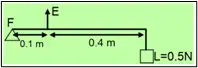
What type of lever is shown in the diagram?
Class I Lever
Class II Lever
Class III Lever
Class IV Lever
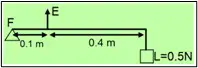
In the given lever, where is the fulcrum located?
On the left end (at point F)
In the middle
On the right end
0.4m from the left end.
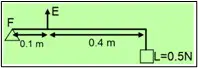
In the given lever, where is the effort applied?
On the left end
In the middle
0.1 m from the left end
On the right end
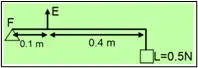
The lever shown demonstrates which principle?
Principle of Conservation of Energy
Principle of Moments
Principle of Inertia
Principle of Superposition
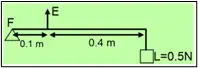
What is the effort arm length in the given lever?
0.1 m
0.4 m
0.5 m
0.3 m
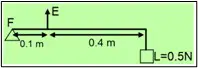
What is the load arm length in the given lever?
0.1 m
0.4 m
0.5 m
0.3 m

Calculate the mechanical advantage (MA) of the lever.
0.2
5
0.25
4
What does a mechanical advantage of less than 1 indicate about a lever?
The lever increases force.
The lever increases speed and distance.
The lever changes the direction of the force only.
The lever decreases both force and speed.
In a lever, if the effort arm is greater than the load arm, then:
MA>1
MA=1
MA=0
None of These
In a lever, if the effort arm is smaller than the load arm, then:
MA<1
MA=1
MA=0
None of These

In the given lever, to lift the load, the effort required will be:
Greater than 0.5 N
Lesser than 0.5 N
Equal to 0.5 N
0 N
The principle of moments states that for a lever in equilibrium:
Anticlockwise moment = Clockwise moment
Anticlockwise moment > Clockwise moment
Anticlockwise moment < Clockwise moment
Effort = Load
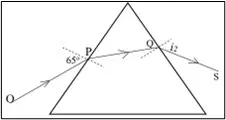
What is the angle of incidence (i1) at the first surface of the prism (where ray OP enters)?
65°
25°
90°
43°
Given that the prism is equilateral, what is the angle of the prism (A)?
45°
60°
90°
30°
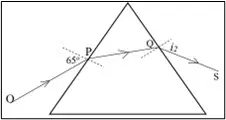
The angle of deviation (δ) is given as 43°. What does the angle of deviation represent?
The angle between the incident ray and the first refracted ray.
The angle between the incident ray and the emergent ray.
The angle between the refracted ray and the normal.
The angle between the emergent ray and the normal.

Using the formula δ = i1 + i2 - A, where δ=43o is the angle of deviation, i1 is the angle of incidence at the first surface, i2 is the angle of emergence, and A is the angle of the prism, calculate the value of i2.
65°
38°
43°
60°
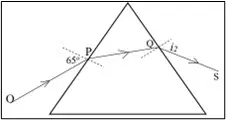
What is the name given to the ray QS in the diagram?
Incident ray
Refracted ray
Emergent ray
Normal ray
When a ray passes from air to glass, it bends:
Towards the normal
Away from the normal
Remains undeviated
Depends on the angle of prism
When a ray passes from glass to air, it bends:
Towards the normal
Away from the normal
Remains undeviated
Depends on the angle of prism

If the angle of prism is increased, keeping other factors constant, the angle of deviation will:
Increase
Decrease
Remain same
Becomes 0
What type of image is formed by a convex lens when the image distance (v) is positive?
Real and inverted
Real and erect
Virtual and inverted
Virtual and erect
To obtain a real image on the screen using a convex lens, where should the object be placed relative to the focal length (f)?
Between the lens and f
At f
Beyond f
At infinity
Using the lens formula (1/f = 1/v - 1/u), and the given values (f = 10 cm, v = 60 cm), what is the calculated value of the object distance (u)?
-12 cm
12 cm
-8.57 cm
8.57 cm
What does the negative sign in the calculated object distance (u) indicate (if applicable)?
The object is placed on the same side of the lens as the image.
The object is placed on the opposite side of the lens from the image.
The image is virtual.
The image is inverted.
In this problem, to form a real image on the screen 60 cm away from the lens, the object should be placed at what distance from the lens?
10 cm
-12 cm
60 cm
-60 cm
If the object is placed between f and 2f, then the real image formed will be:
Diminished
Magnified
Same size
At infinity
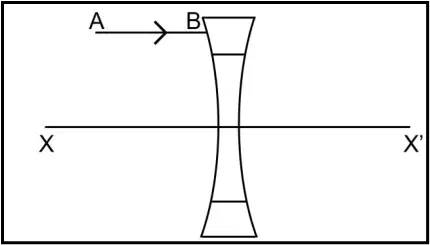
What type of lens is formed by the combination of a glass slab and two prisms as shown in the diagram?
Convex Lens
Concave Lens
Plano-convex Lens
Plano-concave Lens
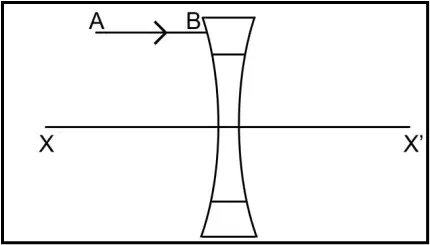
What is the line XX' called in the context of the lens?
Focal axis
Principal axis
Optical axis
Center line
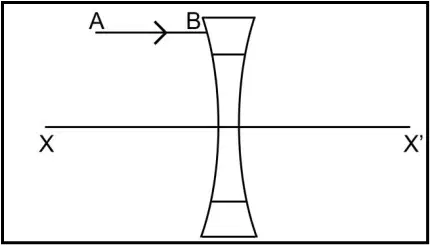
How will the incident ray AB travel after passing through the concave lens?
It will converge towards the principal axis.
It will diverge away from the principal axis.
It will pass through the lens undeviated.
It will reflect back along the same path.

When a ray parallel to the principal axis passes through a concave lens, it appears to diverge from which point?
The center of curvature
The principal focus
The optical center
The pole of the lens
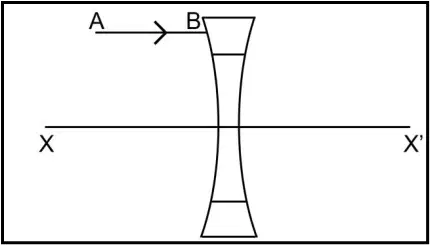
If the emergent ray appears to come from a point on the principal axis (XX'), what is that point labeled as F called?
Center of Curvature
Principal Focus
Optical Center
Pole

For a concave lens, is the principal focus (F) real or virtual?
Real
Virtual
Both real and virtual depending on the object's position
Neither real nor virtual
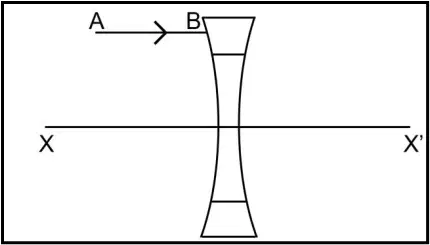
After passing through a concave lens, where will a ray parallel to the principal axis appear to diverge from?
2F
F
Between F and 2F
Infinity
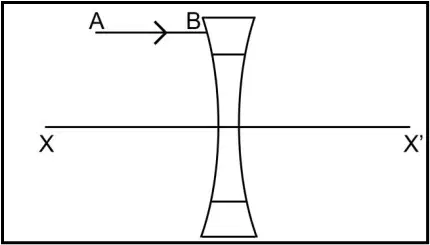
The point F for the given lens will lie on:
Left side of the lens
Right side of the lens
At the optical center
At infinity
An object is placed beyond 2f (twice the focal length) in front of a convex lens. What will be the nature of the image formed?
Real, inverted, and diminished
Real, inverted, and magnified
Virtual, erect, and magnified
Virtual, erect, and diminished
If an object is placed between f and 2f of a convex lens, the image formed will be:
Real, inverted and diminished
Real, inverted and magnified
Virtual, erect and magnified
Virtual, erect and diminished
Using the lens formula (1/f = 1/v - 1/u) and the given values (u = -24 cm, f = 8 cm), what is the calculated value of the image distance (v)?
+6 cm
-6 cm
+12 cm
-12 cm
What does the positive sign in the calculated image distance (v) indicate?
The image is formed on the same side of the lens as the object.
The image is formed on the opposite side of the lens from the object.
The image is virtual.
The image is erect.
When white light passes through a prism, which color shows the maximum angle of deviation?
Red
Violet
Green
Yellow
When white light passes through a prism, which color shows the minimum angle of deviation?
Red
Violet
Green
Yellow
The deviation produced by the prism is maximum for:
Red
Violet
Green
Yellow
The deviation produced by the prism is minimum for:
Red
Violet
Green
Yellow
If a green-colored ray is passed through a glass prism, what will be the color of the emergent ray?
Red
Violet
Green
White
When a monochromatic (single color) light passes through a prism it undergoes:
Dispersion
Deviation
Both dispersion and deviation
Neither dispersion nor deviation
When a polychromatic (many colors) light passes through a prism it undergoes:
Only dispersion
Only deviation
Both dispersion and deviation
Neither dispersion nor deviation
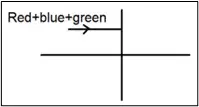
When a mixture of red, blue, and green light (white light) passes through a convex lens, what happens to the constituent colors after refraction?
They converge at a single point on the principal axis.
They converge at slightly different points on the principal axis.
They emerge parallel to each other without converging.
They diverge away from the principal axis.
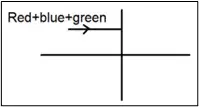
Why do the different colors of light converge at different points after passing through the convex lens?
Different colors have different speeds in the lens material.
Different colors have different intensities.
Different colors have different amplitudes.
Different colors have the same focal length.
Which of the following color will converge farthest from the lens?
Red
Blue
Green
All will converge at the same point
Which of the following color will converge nearest to the lens?
Red
Blue
Green
All will converge at the same point
Which type of invisible radiation can be obtained using a quartz prism?
Infrared radiation
Ultraviolet radiation
Microwaves
Radio waves
Why quartz prism is used to obtain the invisible radiations?
It absorbs the invisible radiations
It does not absorb the invisible radiations
It disperses the invisible radiations
It reflects the invisible radiations
What is one common use of ultraviolet (UV) radiation?
Remote controls
Sterilizing medical equipment
Cooking food
Radio communication
Which of the following radiations has a wavelength longer than that of ultraviolet radiation?
X-rays
Gamma rays
Infrared radiation
Cosmic rays
Arrange the given radiations in increasing order of their wavelength: Infrared, Ultraviolet, X-rays
X-rays, Ultraviolet, Infrared
Ultraviolet, X-rays, Infrared
Infrared, Ultraviolet, X-rays
X-rays, Infrared, Ultraviolet
Which of the following radiations can be detected by thermopile?
Ultraviolet
X-rays
Gamma rays
Infrared
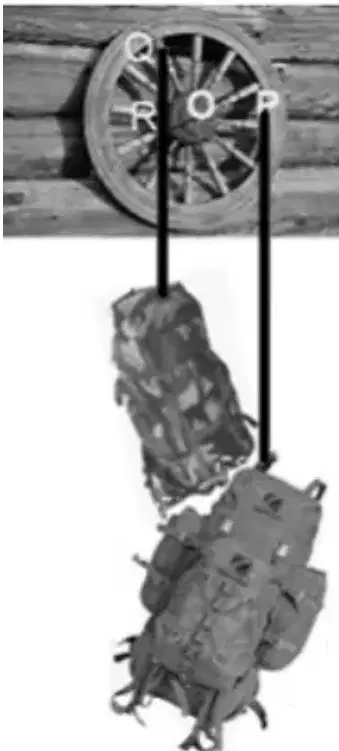
Sumit and Sachin suspend their bags from ropes attached to a wheel that can rotate around point O. The wheel is in equilibrium. The distance from point O to where Sachin's bag is suspended (OP) is greater than the distance from point O to where Sumit's bag is suspended (OQ). Which of the following statements is most likely true?
Sumit's bag is heavier.
Sachin's bag is heavier.
Both bags have the same weight.
The weights cannot be compared without more information.
The principle of moments is used to analyze systems in rotational equilibrium. Which of the following best describes the principle of moments?
For equilibrium, the sum of forces must be zero.
For equilibrium, the sum of clockwise moments must equal the sum of anticlockwise moments about the same point.
For equilibrium, the mass on one side must equal the mass on the other side.
For equilibrium, the distances from the pivot point must be equal.
A wheel and axle system is in equilibrium. A weight of 18 kgf is suspended at a distance 'y' from the center of rotation (O). Another weight 'W' is suspended at a distance 'x' from the center of rotation (O) on the other side. Which equation correctly relates these quantities based on the principle of moments?
18y = Wx
18x = Wy
18 + y = W + x
18/y = W/x
In a wheel and axle system, if the distance from the center of rotation to the point where a force is applied is reduced, what must happen to the force to maintain equilibrium, assuming the opposing moment remains constant?
The force must increase.
The force must decrease.
The force must remain the same.
The force becomes zero.
Two individuals are balancing a wheel and axle system. One person applies a force at a distance of 0.5 m from the center. To achieve equilibrium, the other person applies a force of 36 N at a distance of 0.25 m from the center on the opposite side. What is the magnitude of the force applied by the first person?
9 N
18 N
36 N
72 N
Moment of a force is defined as:
Product of force and perpendicular distance from the point of rotation
Sum of force and distance from the point of rotation
Force divided by the distance from the point of rotation
Difference between the force and distance from the point of rotation
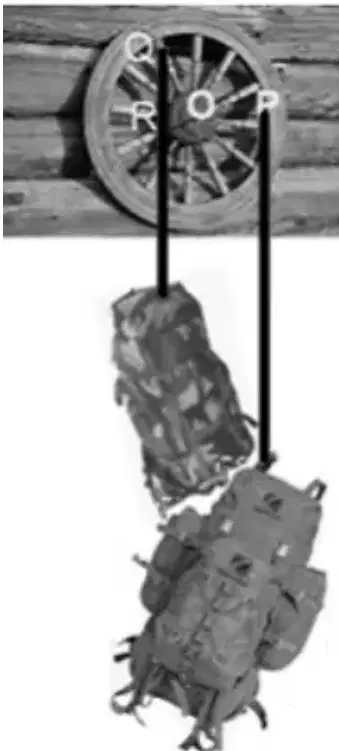
Sumit and Sachin suspend their bags from ropes attached to a wheel that can rotate around point O. The distance from point O to where Sachin's bag is suspended (OP) is greater than the distance from point O to where Sumit's bag is suspended (OQ). The wheel on which Sumit and Sachin suspended their bags is in equilibrium. This means:
The weight of Sumit's bag is equal to the weight of Sachin's bag.
The moment produced by Sumit's bag is equal and opposite to the moment produced by Sachin's bag.
The distance OP is equal to the distance OQ.
The ropes are of equal length.
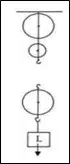
What is the maximum possible Velocity Ratio (V.R.) of the block and tackle system shown in the diagram?
1
2
3
4
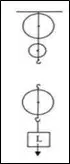
To achieve the maximum V.R. in this system, how many strands of rope should support the load (L)?
1
2
3
4
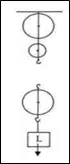
To achieve the maximum V.R. and have the effort applied in a convenient downward direction, where should the free end of the rope be attached after passing around all the pulleys?
To the upper block.
To the lower block.
To the load itself.
To a fixed point independent of the pulley system.
If the free end of the rope is pulled downwards, what is the direction of the tension force in the rope segments supporting the load?
Downwards
Upwards
Sideways
Cannot be determined
What is the relationship between the Velocity Ratio (V.R.) and the number of pulleys in an ideal block and tackle system where the number of rope segments supporting the load equals the number of pulleys?
V.R. = Number of pulleys + 1
V.R. = Number of pulleys - 1
V.R. = Number of pulleys
V.R. = 2 x (Number of pulleys)
The efficiency of a block and tackle system is given as 80%. What is the definition of efficiency in this context?
(Load / Effort) x 100%
(Effort / Load) x 100%
(Mechanical Advantage / Velocity Ratio) x 100%
(Velocity Ratio / Mechanical Advantage) x 100%

If the block and tackle system has an efficiency of 80% and the maximum possible V.R., what is its Mechanical Advantage (M.A.)?
2.4
3
3.75
0.8
Which of the following factors does *not* affect the efficiency of a block and tackle system in real-world applications?
Friction between the pulleys and the rope
The weight of the lower (movable) block.
The material of the rope
The color of the pulleys
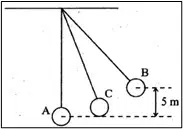
What is the potential energy of the pendulum bob at position B, if the mass of bob is 200g? (Assume g = 10 m/s2)
1 J
10 J
100 J
1000 J
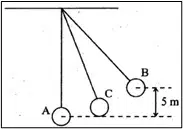
At which point in the pendulum's swing is the potential energy at its maximum?
At the mean position (A)
At the extreme position (B)
At the midpoint between A and B
The potential energy remains constant.
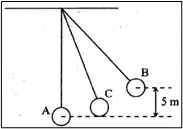
If air resistance is negligible, what is the total mechanical energy of the pendulum at point C (an intermediate point between A and B) compared to its potential energy at point B?
Less than the potential energy at B
Equal to the potential energy at B
Greater than the potential energy at B
Cannot be determined without knowing the height of C.

What is the kinetic energy of the pendulum bob at the mean position A when it is released from the extreme position B, assuming no energy loss?
0 J
Equal to the potential energy at B.
Greater than the potential energy at B.
Cannot be determined.

What is the speed of the bob at position A when released from B? (Assume g = 10 m/s2 and no energy loss)
5 m/s
10 m/s
50 m/s
100 m/s
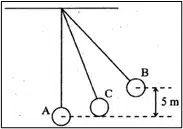
As the pendulum bob swings from its extreme position (B) to its mean position (A), what energy transformation occurs?
Kinetic energy is converted to potential energy.
Potential energy is converted to kinetic energy.
Kinetic energy is converted to heat energy.
Potential energy is converted to heat energy.
Which of the following best defines mechanical energy?
The energy possessed by a body due to its position or configuration.
The energy possessed by a body due to its motion.
The sum of the potential and kinetic energies of a body.
The energy possessed by a body due to its temperature.

At which position in its swing does the pendulum bob have maximum kinetic energy?
At the extreme positions
At the mean position
Mid-point between mean and extreme positions
Kinetic energy is constant throughout the swing
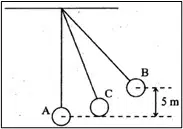
If the mass of the pendulum bob is doubled, how will its maximum speed at the mean position be affected (assuming the same initial displacement)?
It will be doubled
It will be halved
It will remain the same
It will become four times
A person fires a gun and hears the echo from a cliff after 3 seconds. The speed of sound is 336 m/s. What is the distance between the person and the cliff?
112 m
504 m
1008 m
336 m
An echo is a sound wave that has been:
Refracted
Reflected
Absorbed
Diffracted
After moving away from the cliff, the person fires the gun again and hears the echo 1.5 seconds later than the first echo (i.e., after 4.5 seconds). What is the new distance between the person and the cliff?
252 m
756 m
1512 m
112 m
A person fires a gun and hears the echo from a cliff after 3 seconds. The speed of sound is 336 m/s. After moving closer to the cliff, the person fires the gun again and hears the echo 1.5 seconds earlier than the first echo (i.e., after 4.5 seconds). How much closer did the person move to the cliff in the second scenario?
756 m
504 m
252 m
112 m
An alpha particle is equivalent to the nucleus of which element?
Hydrogen
Helium
Lithium
Beryllium
A beta particle is essentially a high-speed:
Proton
Neutron
Electron
Positron
A radioactive nucleus X emits an alpha particle. How does the atomic number of the resulting nucleus compare to X?
It is the same.
It is decreased by 2.
It is decreased by 4.
It is increased by 2.
A radioactive nucleus X emits an alpha particle followed by two beta particles. How does the atomic number of the final nucleus Y compare to the original nucleus X?
It is increased by 2.
It is decreased by 2.
It is the same.
It is decreased by 4.
A radioactive nucleus X emits an alpha particle followed by two beta particles. How does the mass number of the final nucleus Y compare to the original nucleus X?
It is increased by 2.
It is decreased by 2.
It is the same.
It is decreased by 4.
Element X and element Y have the same mass number but different atomic numbers after the radioactive decay. What is the general name for such elements?
Isotopes
Isobars
Isotones
Isomers
If the atomic number of the final nucleus Y is 80, and it was formed after one alpha and two beta decays from nucleus X, what is the atomic number of X?
78
80
82
84
A boy tunes a radio to 93.5 MHz. What scientific phenomenon is involved in tuning a radio?
Reflection
Refraction
Resonance
Interference
What is the definition of resonance in the context of radio tuning?
The bouncing of radio waves off a surface.
The bending of radio waves around an obstacle.
The tendency of a system to oscillate with greater amplitude at specific frequencies.
The superposition of two or more waves.
When a radio is tuned, which sound characteristic is primarily affected?
Loudness
Pitch
Quality
Amplitude
What is the SI unit equivalent of 93.5 MHz?
93.5 Hz
93.5 kHz
9.35 x 10⁷ Hz
9.35 x 10⁻⁷ Hz
What is the definition of frequency?
The distance between two consecutive crests of a wave.
The number of oscillations or cycles per unit time.
The maximum displacement of a wave from its equilibrium position.
The speed at which a wave travels.
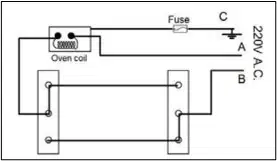
In the given circuit, which wire, A or B, should be the live wire?
A
B
Either A or B can be the live wire.
Neither A nor B should be the live wire.
Why is it important to connect the fuse to the live wire in an electrical circuit?
To ensure the fuse is the first component in the circuit.
To ensure that a blown fuse disconnects the appliance from the live potential, making it safer.
To reduce the overall resistance of the circuit.
To increase the voltage supplied to the appliance.

In the event of an overload in the given circuit, will the fuse serve its purpose of breaking the circuit?
Yes, the fuse will blow and break the circuit.
No, the fuse is not connected correctly and will not protect the circuit.
The fuse will only blow if both switches are closed.
The fuse will only blow if both switches are open.
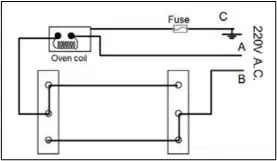
The connection of the switches in the given diagram suggests that they are:
Single-pole single-throw switches
Single-pole double-throw (two-way) switches
Double-pole single-throw switches
Double-pole double-throw switches
A bulb is rated 600W, 220V. What does the power rating (600W) indicate?
The total energy the bulb can consume.
A 600W, 220V bulb is designed to consume 600 Joules of electrical energy per second when connected to a 220V power source, producing a certain amount of light and heat
The resistance of the bulb.
The current flowing through the bulb.
What does the voltage rating (220V) of the bulb indicate?
The maximum voltage that can be safely applied across the bulb.
The voltage required for the bulb to operate at its rated power.
The voltage at which the bulb will blow.
The minimum voltage required for the bulb to light up.
If the bulb is connected to a voltage source lower than 220V, what will happen to its brightness (assuming it still lights up)?
The bulb will be brighter.
The bulb will be dimmer.
The brightness will remain the same.
The bulb will be dimmer only if the current is also reduced.
The resistance of the filament of the 600W, 220V bulb can be calculated using which of the following formulas?
R = V/I
R = V2/P
R = P/I2
All of the above
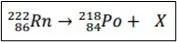
In the given nuclear reaction, what does the symbol "Rn" represent?
Radium
Radon
Rhenium
Ruthenium
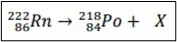
In the given nuclear reaction, what does the symbol "Po" represent?
Polonium
Potassium
Phosphorus
Palladium
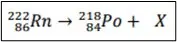
What type of radioactive decay is represented in the given nuclear reaction?
Alpha decay
Beta decay
Gamma decay
Nuclear fission
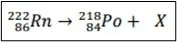
What is the mass number of the particle represented by "X" in the nuclear reaction?
0
1
2
4
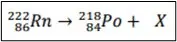
What is the atomic number of the particle represented by "X" in the nuclear reaction?
0
1
2
4
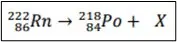
What is the particle represented by "X" in the nuclear reaction?
An electron
A proton
A neutron
An alpha particle

How will the radiation "X" be affected when it passes through an electric field?
It will be deflected towards the positive plate.
It will be deflected towards the negative plate.
It will pass through the field undeflected.
It will be completely absorbed by the field.
An alpha particle has:
Low penetrating power and high ionizing power
Low penetrating power and low ionizing power
High penetrating power and high ionizing power
High penetrating power and low ionizing power
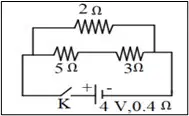
What is the equivalent resistance of the series combination of the 5Ω and 3Ω resistors?
2 Ω
8 Ω
15 Ω
2.5 Ω
When resistors are connected in parallel, how does the equivalent resistance compare to the individual resistances?
It is always greater than the largest individual resistance.
It is always equal to the sum of the individual resistances.
It is always smaller than the smallest individual resistance.
It is the average of the individual resistances.
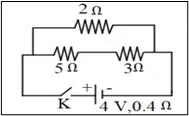
What is the equivalent resistance of the parallel combination of the 2Ω resistor and the 8Ω series combination (calculated in question 1)?
10 Ω
1.6 Ω
6 Ω
0.625 Ω
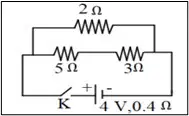
What is the total resistance of the entire circuit when the key K is closed (including the internal resistance of the battery)?
1.6 Ω
2 Ω
8.4 Ω
10.4 Ω
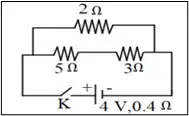
When the key K is closed, what is the total current flowing through the circuit from the battery?
0.4 A
2 A
2.5 A
10 A
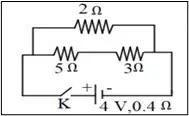
When the key K is closed, the voltage drop across the parallel combination of resistors is:
4 V
3.2 V
0.8 V
0 V
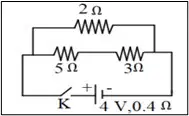
What is the current flowing through the 3Ω resistor when the key K is closed?
0.4 A
0.5 A
1.0 A
2.67 A
Which of the following formulas is used to calculate the equivalent resistance (R) of two resistors R1 and R2 connected in parallel?
R = R1 + R2
R = (R1 x R2) / (R1 + R2)
R = (R1 + R2) / (R1 x R2)
R = 1 / (R1 + R2)
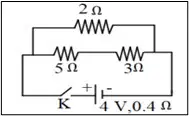
If the 5 ohm resistor is removed from the circuit, then the current flowing through the 3 ohm resistor will:
Increase
Decrease
Remain the same
Become zero
What is the formula for calculating the heat (Q) gained or lost by a substance when its temperature changes?
Q = mL
Q = mcΔT
Q = CΔT
Q = L/m
What does 'c' represent in the formula Q = mcΔT?
Specific latent heat
Specific heat capacity
Heat capacity
Thermal conductivity
What is the specific heat capacity of water, as given in the problem?
4.2 Jg-1°C-1
336 Jg-1
2.1 kg
50 °C
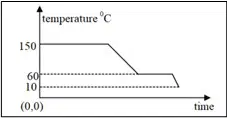
What is the change in temperature (ΔT) of the liquid as it cools down?
75 °C
25 °C
90 °C
100 °C
How much heat is lost by 2.1 kg of water when it cools from 75°C to 25°C?
4.2 x 10⁵ J
4.41 x 10⁵ J
105 J
157.5 J
What is the formula for calculating the heat (Q) required to melt a substance of mass 'm'?
Q = mcΔT
Q = mL
Q = CΔT
Q = L/m
What does 'L' represent in the formula Q = mL?
Specific heat capacity
Specific latent heat
Heat capacity
Thermal conductivity
What is the specific latent heat of ice?
4.2 Jg-1°C-1
336 Jg-1
2.1 kg
50 °C
After the ice melts, what will be the initial temperature of the melted ice (water)?
0°C
25°C
75°C
100°C
The mechanical advantage of a combination of single fixed pulley and a single movable pulley in an actual situation is:
1
2
less than 1
more than 1 but less than 2
What equation correctly represents the heat lost by the water being equal to the heat gained by the ice (and subsequently the melted ice)?
(mass of water) x (specific heat of water) x (temperature change of water) = (mass of ice) x (specific latent heat of ice)
(mass of water) x (specific heat of water) x (temperature change of water) = (mass of ice) x (specific latent heat of ice) + (mass of ice) x (specific heat of water) x (temperature change of melted ice)
(mass of water) x (specific latent heat of ice) = (mass of ice) x (specific heat of water) x (temperature change of water)
(mass of water) x (specific heat of water) = (mass of ice) x (specific latent heat of ice)
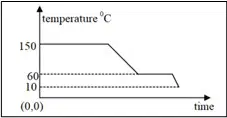
At what temperature does the substance represented in the cooling curve condense?
150°C
60°C
10°C
0°C
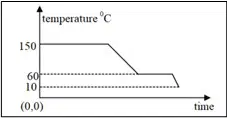
During condensation, what happens to the temperature of the substance?
It increases.
It decreases.
It remains constant.
It fluctuates.

What does the horizontal portion of the cooling curve at 60°C represent?
The substance is cooling down as a liquid.
The substance is undergoing a phase change from gas to liquid.
The substance is undergoing a phase change from liquid to solid.
The substance is heating up as a gas.
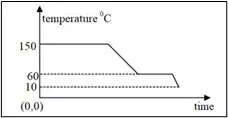
In what temperature range is the substance in a liquid state?
Above 150°C
Between 60°C and 10°C
Below 10°C
Between 150°C and 60°C
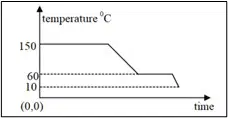
What is happening to the substance between 150°C and 60°C on the cooling curve?
It is changing from a gas to a liquid.
It is changing from a liquid to a solid.
It is cooling down as a gas.
It is cooling down as a liquid.
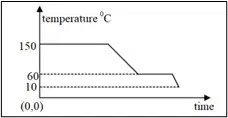
What is the melting point of the substance, according to the cooling curve?
150°C
60°C
10°C
0°C
Why is ice at 0°C more effective at cooling a drink than ice-cold water at 0°C?
Ice has a lower specific heat capacity than water.
Ice absorbs heat to melt (latent heat of fusion) in addition to absorbing heat to raise its temperature.
Ice has a higher density than water.
Ice is colder than ice-cold water.
What is the specific latent heat?
The amount of heat required to change the temperature of 1 kg of a substance by 1°C.
The amount of heat required to change the state of 1 kg of a substance without a change in temperature.
The amount of heat required to raise the temperature of a substance from its freezing point to its boiling point.
The amount of heat required to cool a substance from its boiling point to its freezing point.
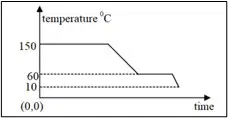
What does the horizontal portion of the cooling curve at 150°C represent?
The substance is cooling down as a liquid.
The substance is undergoing a phase change from gas to liquid.
The substance is undergoing a phase change from liquid to solid.
The substance is heating up as a gas.

When the magnet is entering the coil with its south pole facing downwards, what polarity is induced at the top end of the coil (near A)?
North
South
No polarity
Alternating North and South

When the magnet is leaving the coil with its south pole facing downwards, what polarity is induced at the top end of the coil (near A)?
North
South
No polarity
Alternating North and South

When the magnet is entering the coil, the current flows from A to B. When the magnet is leaving the coil, in which direction does the current flow?
From A to B
From B to A
No current flows
The current direction fluctuates rapidly.
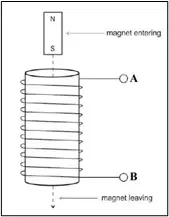
Which of the following laws can be used to determine the direction of the induced current in the coil?
Ohm's Law
Lenz's Law
Newton's Law of Cooling
Boyle's Law
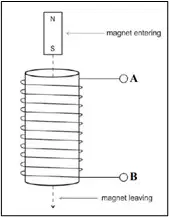
What is the underlying principle behind the generation of induced current in the coil in this scenario?
Electrostatic induction
Electromagnetic induction
Thermal expansion
Chemical reaction

Lenz's Law is a consequence of the law of conservation of which of the following?
Charge
Momentum
Energy
Mass
Which of the following actions would increase the magnitude of the induced current in the coil?
Using a weaker magnet
Moving the magnet slower
Increasing the number of turns in the coil
Using a coil made of a material with higher resistance.
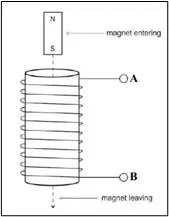
If the coil is replaced by a wooden ring of same dimensions, then on releasing the magnet along its axis:
Induced emf will be greater than that produced in the coil
Induced emf will be lesser than that produced in the coil
No induced emf will be produced
Induced emf will be same as that produced in the coil

