
 Worksheets
Rigid Body Equilibrium
Total questions: 20
Worksheet time: 11mins
What is degree of freedom refers to?
The numbers of independent forces or vectors required to specify the state of an object
The numbers of independent parameters or values required to specify the state of an object
The numbers of independent moment or values required to specify the state of an object
The numbers of independent line or vectors required to specify the state of an object
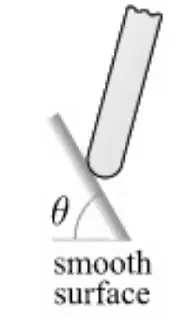
Draw free body diagram


Step 3 of determining free body diagram
Select and isolate an object
Select a reference frame
Identify all loads
Label the diagram
Draw free body diagram/ reaction
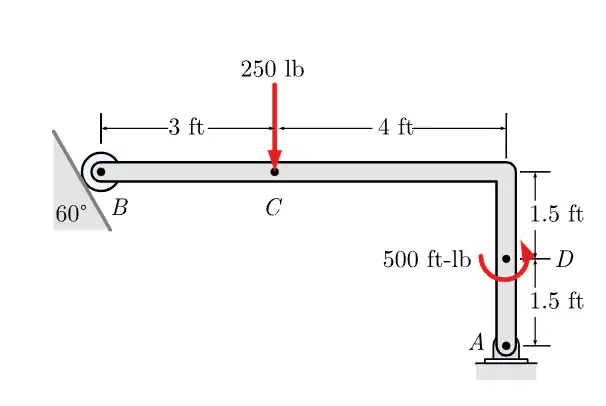
Two -dimensional rigid body have ......... degrees of freedom
one
three
two
four
Below are the example of rigid body except:
Beam
Slab
Cement
Column

If a system is in static equilibrium, it must have the following 2 conditions:
∑τ=0
Constant acceleration
∑F=0
Positive forces only

Giving the following image, there are _____ forces acting on the sytem.
3 forces (weight 1, weight 2, and distance 2)
2 forces(weight 1 and weight 2)
1 force (weight 1)
1 force ( weight 2)

The moment of a 50 N force 20 cm away from the pivot point will be...
500 N
20 Nm
10 Nm
15 Nm
What is the primary purpose of a free body diagram?
To determine the speed of an object
To calculate the mass of an object
To visualize forces acting on an object
To measure the temperature of an object
How many reaction forces are typically present in a two-dimensional static equilibrium?
Four
Two
One
Three
Which of the following is not a characteristic of a rigid body?
It can rotate about an axis
It does not deform under load
It can change shape
It maintains a constant distance between its particles
What is the total moment produced by a 30 N force applied 15 cm from the pivot?
2.25 Nm
3 Nm
0.45 Nm
4.5 Nm
In a static equilibrium, the sum of all forces acting on the body must be _____.
greater than zero
less than zero
equal to zero
not defined
Which of the following statements is true regarding the center of mass of a rigid body?
It can be outside the body
It is the point where all forces act
It is always located at the geometric center
It cannot change position
Which of the following is a condition for static equilibrium?
The sum of moments about any point is zero
The object must be in motion
The sum of forces must be greater than zero
The object must be a rigid body
What is the effect of increasing the distance from the pivot point on the moment produced by a force?
It decreases the moment
It has no effect on the moment
It increases the moment
It reverses the direction of the moment
What is the condition for a body to be in dynamic equilibrium?
The sum of forces is zero
The sum of forces is greater than zero
The object is at rest
The object is moving with constant velocity
Which of the following best describes a free body diagram?
A diagram showing all forces acting on a body
A diagram showing the motion of a body
A diagram showing the energy transformations in a system
A diagram showing the shape of a body
In a two-dimensional static equilibrium, how many equations are needed to solve for the unknown forces?
Two
Four
One
Three

