
 Worksheets
Thermal Energy Review
Total questions: 16
Worksheet time: 16mins
In some places, hot water from underground can shoot up into the air through a hole in the ground. When this happens, the ground surrounding the water increases in temperature. What happens to the molecules in the ground when the temperature of the ground increases?
More heat molecules combine with the molecules in the ground.
The energy of the molecules in the ground decreases.
The energy of the molecules in the ground increases.
The cold energy of the molecules in the ground decreases.

A space shuttle is covered with two layers of carbon. The two layers are the same size and have the same number of molecules. When the space shuttle is sitting on the ground, the layers do not touch. When the space shuttle takes off, the layers move so that they are touching. Use the information in the diagram to answer the question. How does the temperature of the outer layer compare with the temperature of the inner layer before the layers touch? What will happen after the layers have been touching for a while?
Before the layers touch, the outer layer is hotter than the inner layer. Once the layers are touching, the outer layer will transfer kinetic energy to the molecules in the cooler inner layer until both layers reach the same temperature, which will be in between their starting temperatures.
Before the layers touch, the outer layer is hotter than the inner layer. Once the layers are touching, the cooler inner layer will gain kinetic energy until the molecules of both layers have an energy of 90, because hotter things increase the temperature of cooler things.
Before the layers touch, the outer layer is cooler than the inner layer. Once the layers are touching, the inner layer will transfer kinetic energy to the molecules in the cooler outer layer until both layers reach the same temperature, which will be in between their starting temperatures.
Before the layers touch, the layers are different temperatures. Once the layers are touching, kinetic energy and cold energy will transfer between the molecules in the two layers until both layers reach the same temperature, which will be in between their starting temperatures.
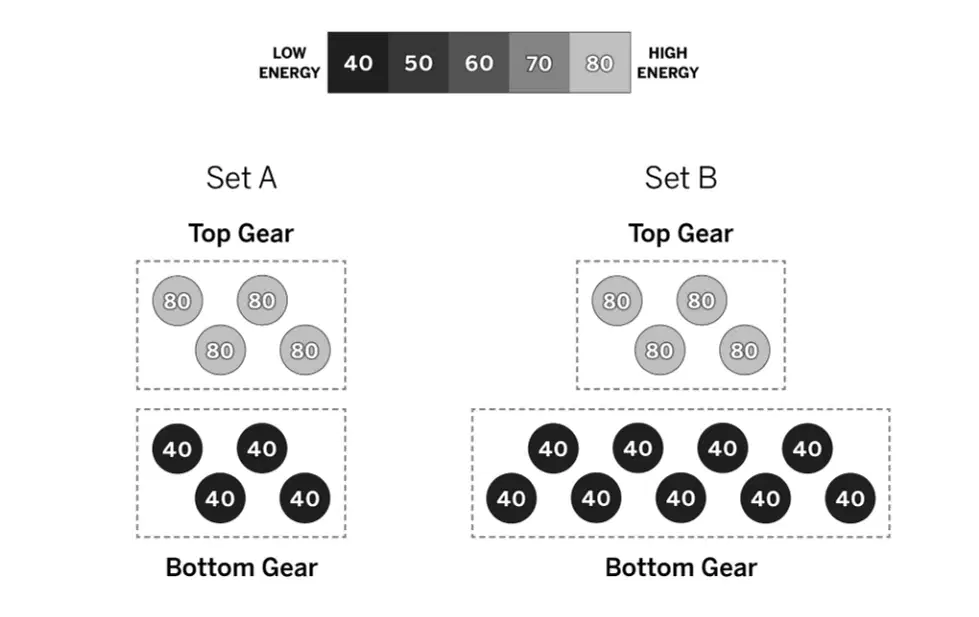
Louis has two sets of two gears (Set A and Set B) that he is using to build two different machines. He has all the gears laying out separately, as shown in the diagram above. Then he puts the gears into the machines so that the gears in Set A are touching each other and the gears in Set B are touching each other. Use the information in the diagram to answer the question. After the gears have been touching for a while, which of the two bottom gears will be cooler, and why?
The smaller bottom gear will be cooler than the larger bottom gear, because less energy has to transfer for the molecules to reach the same temperature as the molecules of the top gear.
The larger bottom gear will be cooler than the smaller bottom gear, because the energy that transferred to it was spread out over more molecules.
The larger bottom gear will be cooler than the smaller bottom gear. It started with more total energy, so less energy had to transfer for both gears in Set B to reach the same total energy.
Both gears will be the same temperature, because both of the top gears had the same amount of energy to transfer and the molecules in the bottom gears start with the same energy.
Lin cooked a pot of soup, then put half the soup in the freezer for a while. Now the soup in the pot is hot, and the soup in the freezer is cold. What is the difference between the molecules of the soup in the pot and the molecules of the soup in the freezer?
The molecules of the soup in the pot are moving and the molecules of the soup in the freezer are not moving.
The molecules of the soup in the pot are moving faster than the molecules of the soup in the freezer.
There is no difference because all of the soup is made of the same type of molecules.
The molecules of the soup in the freezer are smaller than the molecules of the soup in the pot.
Engineers design computers to cool down quickly so they do not break. What happens to the molecules in a computer when the temperature of the computer decreases?
The energy of the molecules in the computer decreases.
The energy of the molecules in the computer increases.
The cold energy of the molecules in the computer increases.
The computer loses heat molecules.

A plumber is going to put two pipes in a wall, one in front and one in back. The pipes will be touching once they are installed. Both pipes are the same size and have the same number of molecules. Use the information in the diagram to answer the question. How does the temperature of the front pipe compare with the temperature of the back pipe before the pipes touch? What will happen after the pipes have been touching for a while?
Before the pipes touch, the front pipe is cooler than the back pipe. Once the pipes are touching, the back pipe will transfer kinetic energy to the molecules in the cooler front pipe until both pipes reach the same temperature, which will be in between their starting temperatures.
Before the pipes touch, the two pipes are different temperatures. Once the pipes are touching, the kinetic energy and cold energy will transfer between the molecules in the two pipes until both pipes reach the same temperature, which will be in between their starting temperatures.
Before the pipes touch, the front pipe is hotter than the back pipe. Once the pipes are touching, the cooler back pipe will gain kinetic energy until the molecules in both pipes have an energy of 100, because hotter things increase the temperature of cooler things.
Before the pipes touch, the front pipe is hotter than the back pipe. Once the pipes are touching, the front pipe will transfer kinetic energy to the molecules in the cooler back pipe until both pipes reach the same temperature, which will be in between their starting temperatures.

A chef takes four pans from different parts of her kitchen and puts them in two stacks. Use the information in the diagram to answer the question. After the pans have been touching for a while, which of the two bottom pans will be cooler, and why?
The smaller bottom pan will be cooler than the larger bottom pan, because less energy has to transfer for the molecules to reach the same temperature as the molecules of the top pan.
The larger bottom pan will be cooler than the smaller bottom pan. It started with more total energy, so less energy had to transfer for both pans to reach the same total energy.
The larger bottom pan will be cooler than the smaller bottom pan, because the energy that transferred to it will have spread out over more molecules.
Both pans will be the same temperature because both of the top pans had the same amount of energy to transfer and the molecules in the bottom pans start with the same energy.
Joseph puts a piece of toast on a plate. The toast is hot from the toaster. When he puts the toast on the plate, the energy of the plate increases. What must be true of the energy of the toast?
Its energy stays the same while the energy of the plate increases.
Its energy decreases while the energy of the plate increases.
Its energy increases while the energy of the plate increases.
It is impossible to know without data on the number of molecules in each object.
Nistu is cooking rice in a pot. When she leaves the pot on the stove for a while, the temperature of the rice increases. What happens to the molecules of the rice when the temperature of the rice increases?
The energy of the molecules in the rice increases.
The cold energy of the molecules in the rice decreases.
The energy of the molecules in the rice decreases.
More heat molecules combine with the molecules in the rice.
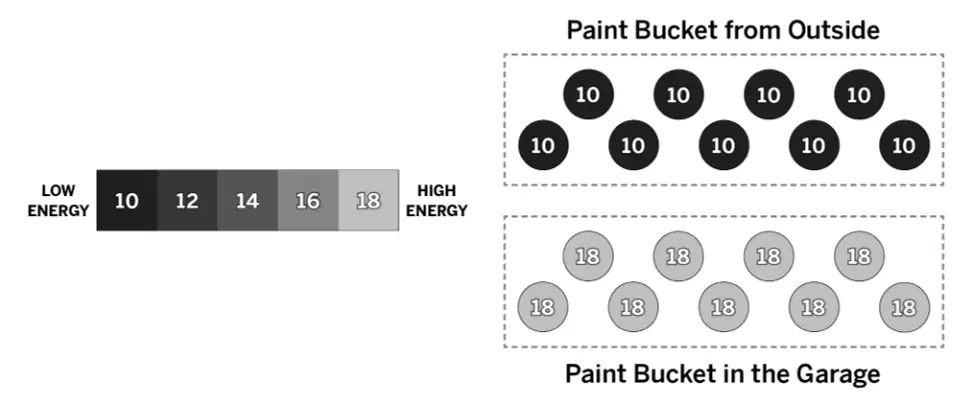
Flori has one bucket of paint outside and one bucket of paint in her garage. Both paint buckets are the same size and have the same number of molecules. She brings the bucket in from outside and is going to stack it on top of the bucket in the garage. Use the information in the diagram to answer the question. How does the temperature of the garage bucket compare with the temperature of the outside bucket before the buckets touch? What will happen after the buckets have been touching for a while?
Before the buckets touch, the two buckets are different temperatures. Once the buckets are touching, both kinetic energy and cold energy will transfer between the molecules of the two buckets until both buckets reach the same temperature, which will be in between their starting temperatures.
Before the buckets touch, the garage bucket is hotter than the outside bucket. Once the buckets are touching, the cooler outside bucket will gain kinetic energy until the molecules of both buckets have an energy of 18, because hotter things increase the temperature of cooler things.
Before the buckets touch, the garage bucket is cooler than the outside bucket. Once the buckets are touching, the hotter outside bucket will transfer kinetic energy to the molecules in the cooler garage bucket until both buckets reach the same temperature, which will be in between their starting temperatures.
Before the buckets touch, the garage bucket is hotter than the outside bucket. Once the buckets are touching, the garage bucket will transfer kinetic energy to the molecules in the cooler outside bucket until both buckets reach the same temperature, which will be in between their starting temperatures.
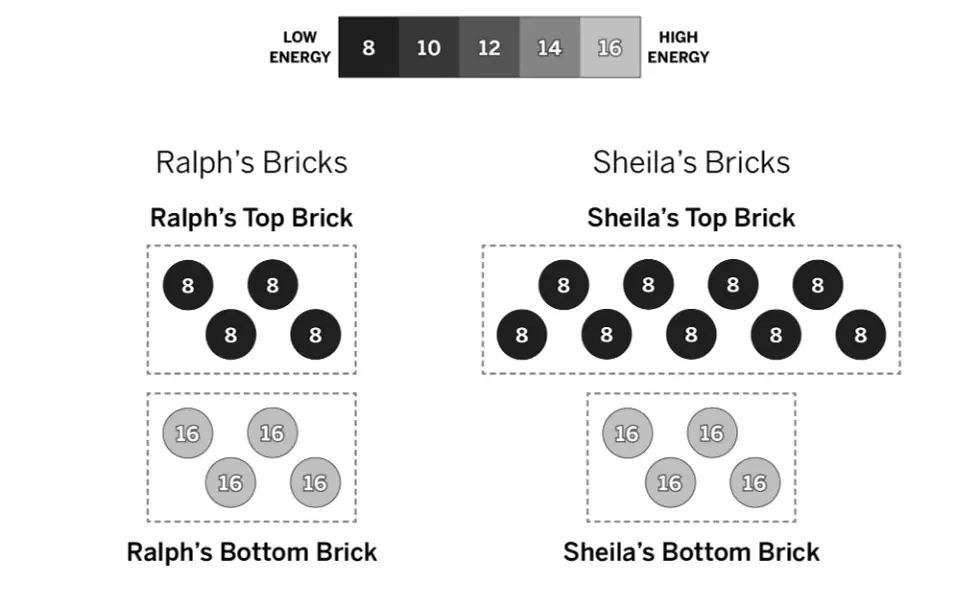
Ralph and Sheila are at a construction site and they are stacking bricks. Use the information in the diagram to answer the question. After the bricks have been touching for a while, whose top brick will be cooler?
Ralph's top brick will be cooler than Sheila’s top brick, because less energy has to transfer for Ralph’s brick’s molecules to reach the same temperature as the molecules of his bottom brick.
Sheila’s top brick will be cooler than Ralph’s top brick, because Sheila’s started with more total energy, so less energy had to transfer for both her bricks to reach the same total energy.
Sheila’s top brick will be cooler than Ralph’s top brick, because the energy that transferred to Sheila’s was spread out over more molecules.
Both will be the same temperature, because both bottom bricks had the same amount of energy to transfer and the molecules in the top bricks started with the same energy.
Rico and Bree are camping and have potatoes wrapped in foil to eat. Bree put her potato in the campfire for a while, but Rico did not. Now Bree’s potato has a high temperature. What is the difference between the molecules of the two potatoes?
There is no difference because both potatoes are made of the same type of molecules.
The molecules of Rico’s potato are smaller than the molecules of Bree’s potato.
The molecules of Bree’s potato are moving and the molecules of Rico’s potato are not moving.
The molecules of Bree’s potato are moving faster than the molecules of Rico’s potato.

Karim brings a chair from the backyard into his house and is going to stack it on top of another chair. Both chairs are the same size and have the same number of molecules. Use the information in the diagram to answer the question. How does the temperature of the bottom chair compare with the temperature of the top chair before the chairs touch? What will happen after the chairs have been touching for a while?
Before the chairs touch, the bottom chair is cooler than the top chair. Once the chairs are touching, the top chair will transfer kinetic energy to the molecules in the cooler bottom chair until both chairs reach the same temperature, which will be in between their starting temperatures.
Before the chairs touch, the bottom chair is hotter than the top chair. Once the chairs are touching, the bottom chair will transfer kinetic energy to the molecules in the cooler top chair until both chairs reach the same temperature, which will be in between their starting temperatures.
Before the chairs touch, the chairs are different temperatures. Once the chairs are touching, both kinetic energy and cold energy will transfer between the molecules in the two chairs until both chairs reach the same temperature, which will be in between their starting temperatures.
Before the chairs touch, the bottom chair is hotter than the top chair. Once the chairs are touching, the cooler top chair will gain kinetic energy until the molecules in both chairs have an energy of 35, because hotter things increase the temperature of cooler things.
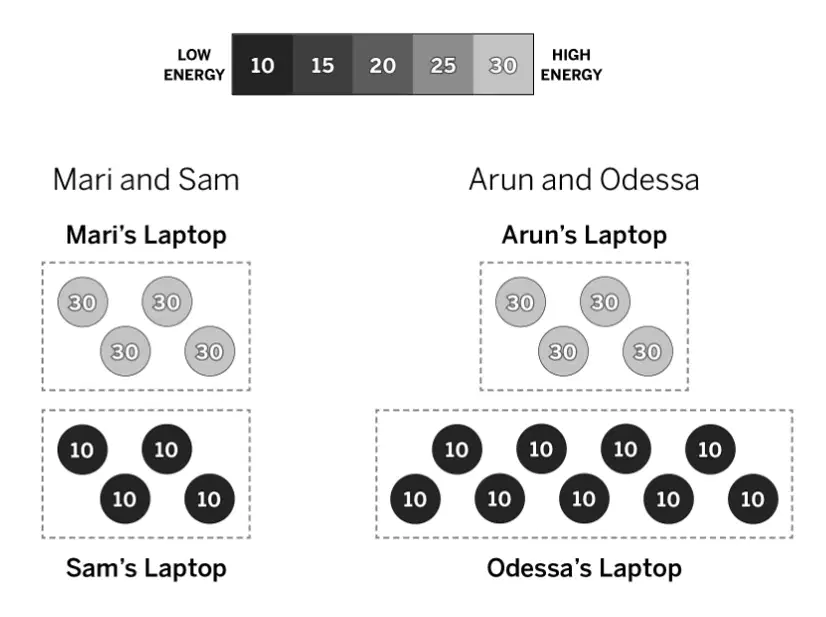
Four people are putting their laptop computers away. Mari puts her laptop on Sam’s laptop, and Arun puts his laptop on Odessa’s laptop. The diagram above shows the laptops before they touch each other. Use the information in the diagram to answer the question. After the laptops have been touching for a while, will Sam’s laptop or Odessa’s laptop be cooler, and why?
Sam’s laptop will be cooler than Odessa’s laptop, because less energy has to transfer for the molecules of Sam’s laptop to reach the same temperature as the molecules of Arun’s laptop.
Both laptops will be the same temperature, because both Arun’s and Mari’s laptops had the same amount of energy to transfer and the molecules in Sam’s and Odessa’s laptops started with the same energy.
Odessa’s laptop will be cooler than Sam’s laptop, because Odessa’s started with more total energy, so less energy has to transfer for her and Arun’s laptops to reach the same total energy.
Odessa’s laptop will be cooler than Sam’s laptop, because the energy that transferred to Odessa’s was spread out over more molecules.
Eric pours some iced tea into a glass. When he puts the iced tea in the glass, the energy of the glass decreases. What must be true of the energy of the iced tea?
Its energy stays the same while the energy of the glass decreases.
Its energy decreases while the energy of the glass decreases.
Its energy increases while the energy of the glass decreases.
It is impossible to know without data on the number of molecules in each object.
After a candle is blown out, the wax of the candle decreases in temperature. What happens to the molecules of the wax when the temperature of the wax decreases?
The energy of the molecules of the wax decreases.
The cold energy of the molecules of the wax increases.
The energy of the molecules of the wax increases.
The wax loses heat molecules.

