
Font size
 Worksheets
Electricity and Magnetism Study Guide
Total questions: 27
Worksheet time: 23mins
As electrons flow through a circuit, the voltage remains constant. What happens to the flow of electrons, or current, if the resistance increases?
The current decreases so the electrons would slow down
The current stays the same so the electron flow would stay constant
The current increases so the electrons would speed up
The current increases so more electrons would flow through the circuit
Three circuits each have the same exact components except for the battery. Circuit #1 has a 6 volt battery, Circuit #2 has a 9 volt battery. Circuit #3 has a 12 volt battery. Which of the following statements describes how voltage, current, and resistance are related by Ohm’s Law in these circuits?
As voltage increases, current decreases and resistance decreases.
As voltage increases, current increases and resistance stays the same.
As voltage increases, current decreases and resistance stays the same.
As voltage increases, current stays the same and resistance decreases.
Which material below has the lowest electrical resistance?
Wood
Copper
Rubber
Water
If you decrease the voltage in a circuit, what will happen to the current if resistance stays the same?
The current will decrease
The current will increase
The current will stay the same
The current first decrease, then increases
How should you wire four bulbs in a circuit so that all bulbs will shine as brightly as possible?
in parallel
in a series
with no switch
in an open circuit
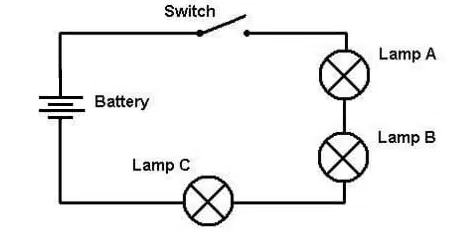
In the diagram, which of the following bulbs will go out if the switch is opened?
Only Bulb A
Only Bulbs A and B
Only Bulbs B and C
All bulbs will go out.
When an electrician wires a house or a building that will be using lights in several rooms, appliances, air conditioner/heater, or any other electrical device, which type of circuits are used?
series circuits
parallel circuits
direct circuits
alternating circuits
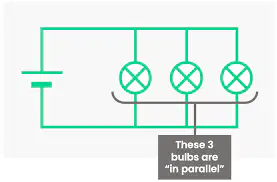
The diagram above represents a circuit with 3 light bulbs. If the middle bulb burns out, what happens to the other bulbs?
The other 2 bulbs will keep working.
The first bulb will work but the last bulb will not work.
None of the bulbs will work.
What happens to the brightness of the bulbs of a circuit wired in series if more bulbs are added?
The bulbs get brighter
All the bulbs get dimmer
The bulbs stay the same brightness
The bulbs how zero current and go out
What type of current travels in only one direction?
Series current
Parallel current
Direct current
Alternating current
Selena created an electromagnet in science lab. She picked up 10 paper clips with her electromagnet. What could she do to increase the strength of her electromagnet and pick up more paper clips?
Use fewer coils of wire.
Use a screw that is the same size as the nail.
Use a battery with more voltage to increase the current.
Replace the nail with a piece of copper.
If you place several compasses around an electric wire, then run current through the wire, the compasses change where they are pointing. Why is this?
The wire is moving back and forth
Electrons moving through the wires create magnetic fields
Compasses point towards the path of the electricity
The compasses are conductors of electricity
What is an electric generator?
A magnet is rotated through a coil of wire to produce an electric current.
Electric potential in a rotating coil of wire creates a permanent magnet.
An electrical current causes a coil of wire to rotate in a magnetic field.
Forces from a permanent magnet allow a coil of wire to rotate.
Which of the following will be surrounded by a magnetic field?
A wire that is conducting an electrical current.
An aluminum rod that has been touched by a magnet.
Two copper wires held close together.
A pot being heated on an electric stove.
Which of the following will increase the strength of the magnetic field in an electromagnet?
Decreasing the current in the wire that surrounds the iron core.
Removing the iron core from the center of the electromagnet.
Decreasing the number of loops of wire around the iron core.
Increasing the number of loops of wire around the iron core.
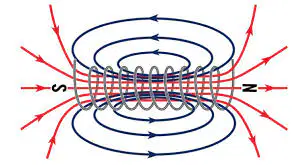
What part of the solenoid is shown by the gray arrows in the diagram?
The magnetic field.
The electrical current.
The iron core.
The source of electrical current.
What is the current in a circuit with 6 ohms of resistance and a battery containing 24 Volts?
1/4 A
144 A
4 A
0.4 A
If the potential difference is 12 volts and the resistance is 5 ohms, what is the current?
2.4 A
60 A
0.417 A
17 A
What size resistor would produce a current of 3 Amp when connected to a 12 Volt battery
1 Ohm
3 Ohms
4 Ohms
12 Ohms
Match the following quantities with their units.
Current, I
Amps, A
Voltage, V
Volts, V
Resistance, R
Ohms, Ω
Energy, E
Joules, J
Disabled Current
What unit is used to measure current?
Ohms
Omega
Volts
Amps
How do you calculate current from voltage and resistance?
Current = voltage x resistance
Current = resistance x power
Current = voltage ÷ resistance
Current = resistance ÷ voltage

