
NEW
Font size
 Worksheets
9 ECB Term 2 Revision
Total questions: 65
Worksheet time: 33mins

What is the financial responsibility of every individual according to the text?
To spend money freely without planning
To manage money in ways that provide the greatest satisfaction
To save all money without spending
To ignore financial planning
How do people build wealth according to the document?
By spending more than they earn
By making decisions about managing financial rewards and risks
By avoiding any financial planning
By relying solely on luck
What is a common habit of wealthy people?
Living beyond their means
Making thriftiness a habit
Ignoring their budget
Spending without planning
Why do wealthy people budget meticulously?
To avoid paying taxes
To know where every cent is going
To impress others
To spend more on luxury items
What type of financial goals do wealthy people have?
Vague financial goals
No financial goals
Very precise financial goals
Random financial goals
What kind of savings and investment plans do wealthy people have?
Random savings and investments
No savings and investments
Targeted savings and investments
Unplanned savings and investments

What are the three key strategies involved in managing finances responsibly?
Setting financial goals, Budgeting, Minimising risks
Setting financial goals, Saving and investing, Minimising risks
Budgeting, Saving and investing, Minimising risks
Setting financial goals, Saving and investing, Budgeting
What does ROI stand for in financial terms?
Rate of Interest
Return on Investment
Revenue on Income
Ratio of Income
What are the possible types of returns on an investment?
Only positive
Only negative
Positive or negative
Neutral
What are earnings called when an investment is sold for a profit?
Dividends
Interest
Capital gains
Tax benefits
Which of the following is a type of benefit from investments?
Regular income from rent or dividends
Increased expenses
Higher taxes
Reduced savings
What does ROI stand for in financial terms?
Return on Investment
Rate of Interest
Return on Income
Revenue on Investment
What is the formula for calculating ROI?
ROI = (R - I) / I x 100
ROI = (I - R) / R x 100
ROI = (R + I) / I x 100
ROI = (R - I) / R x 100
What is the key concept that relates to investing, involving risk and return?
Profit and Loss
Supply and Demand
Risk and Return Trade-off
Cost and Benefit
What happens to the potential return when the risk of a loss on an investment increases?
The potential return decreases
The potential return remains the same
The potential return increases
The potential return is eliminated
What does the trade-off in investing refer to?
The balance between supply and demand
The balance between the lowest risk and highest return
The balance between cost and profit
The balance between time and money
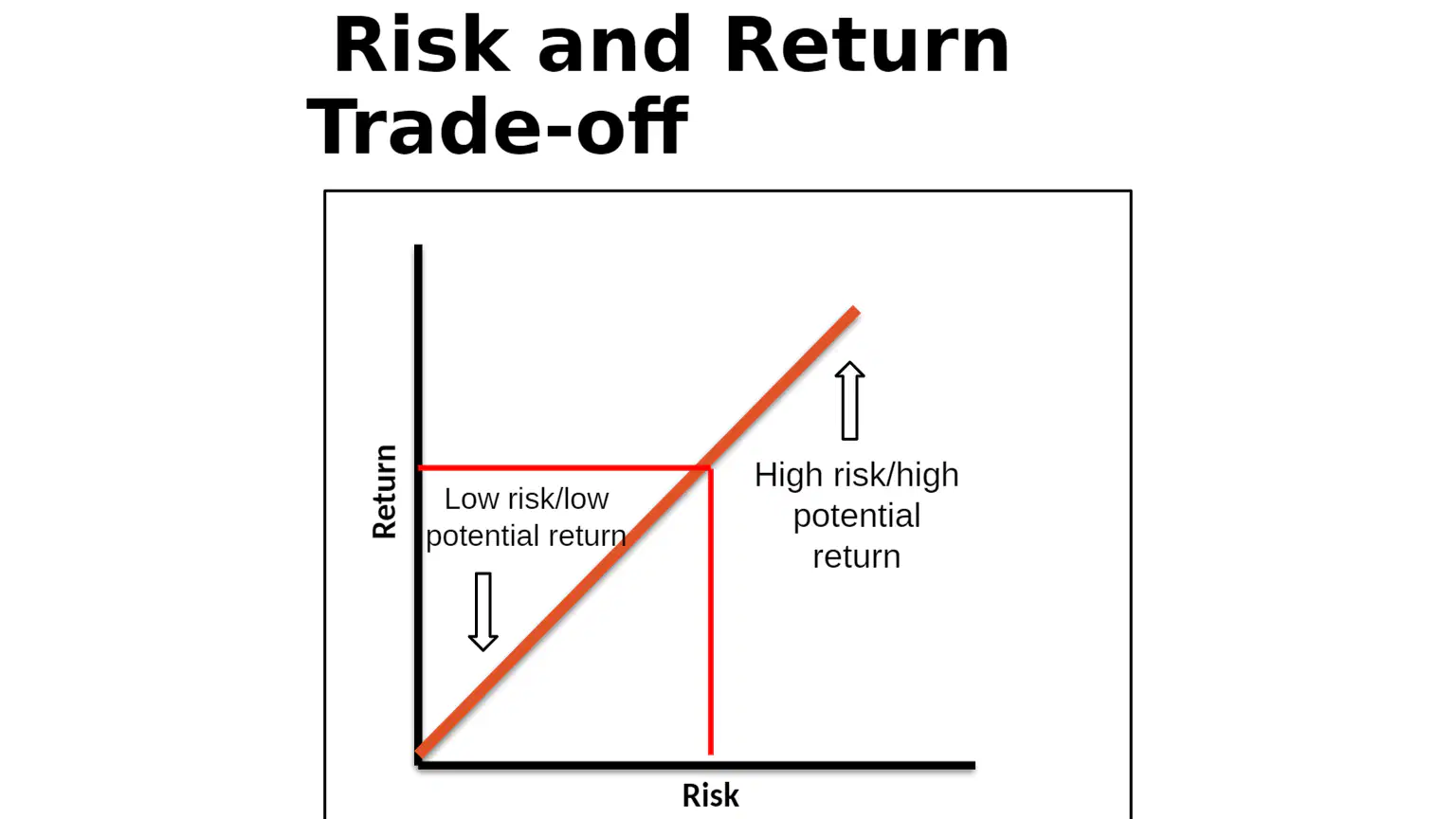
What does the Risk and Return Trade-off diagram illustrate?
The relationship between risk and return
The relationship between supply and demand
The relationship between price and quantity
The relationship between cost and profit
What is a common misconception about risk and return?
Higher risk guarantees greater return.
Higher risk equals greater return.
Higher risk means no return.
Higher risk means lower return.
What does the risk/return trade-off demonstrate?
Higher risk guarantees higher returns.
Higher risk provides the possibility of higher returns.
Higher risk ensures no losses.
Higher risk means lower potential returns.
What does higher risk also mean besides higher potential returns?
Lower potential losses.
No potential losses.
Higher potential losses.
Guaranteed returns.

Which type of investment is considered to have the highest risk and return?
Cash
Bonds
Shares
Collectibles

What type of investment is typically associated with lower risk and return?
Term deposits
Shares
Property
Collectibles

Which of the following is a type of managed fund focused on growth?
Managed funds (conservative/balanced)
Managed funds (growth)
Bonds
Cash

In the investment pyramid, which category is directly above 'Bonds'?
Cash
Shares
Property
Debentures
What is risk in the context of investments?
The chance an investment will provide positive returns
The chance an investment won't provide positive returns
The guarantee of positive returns
The certainty of no returns
Is it possible to avoid all risks when investing?
Yes, with enough research
No, but there are strategies for minimizing risks
Yes, by investing in multiple areas
No, and there are no strategies to minimize risks
What can help in identifying and managing risks?
Random decision-making
Careful planning
Ignoring potential risks
Investing without a plan

Which of the following is a strategy for managing risks?
Diversification
Ignoring risks
Taking more loans
Spending without a budget
What is one method to avoid financial scams?
Scam avoidance
Investing in unknown schemes
Sharing personal information freely
Ignoring financial advice
How can consumers protect themselves financially?
Insurance and other consumer protections
Avoiding all financial products
Relying solely on cash
Ignoring consumer rights
What is a strategy to manage debt effectively?
Managing indebtedness
Taking on more credit cards
Ignoring debt collectors
Spending more than you earn
What is the primary purpose of diversification in investments?
To increase investment risks
To minimize investment risks
To focus on a single asset class
To avoid spreading investments
What does diversification involve in terms of investments?
Concentrating investments in one industry
Spreading investments across a range of asset classes
Investing only in high-risk assets
Avoiding exposure to different markets
How does diversification help investors?
It increases the risk of poor performance
It limits exposure to different market classes
It helps to offset poor performance in any individual asset class
It focuses investments on a single market
What is the definition of indebtedness?
The state of being financially independent
The state of being indebted to another party for an amount of money borrowed
The process of saving money for future use
The act of investing in appreciating assets
Which of the following is considered a characteristic of good debt?
Borrowing money to purchase items that decrease in value
Limits what can be done with money due to interest payments
Helps generate income and increase net worth
Drains away savings through fees
What is a feature of bad debt?
Often there are tax incentives for investments
Borrowing money to purchase appreciating assets
Limits what can be done with money as interest payments and fees drain away savings
Helps increase net worth
Why might good debt be beneficial?
It decreases net worth
It involves purchasing depreciating assets
It often comes with tax incentives
It limits financial flexibility

Which of the following is considered a form of good debt?
Credit cards
Vehicle loans
Education expenses
Store cards for consumable items

What is a potential danger of using credit cards for reward schemes?
Rewards are not valuable
Interest offsets the value of rewards
Rewards are too difficult to earn
Credit cards have no interest

Which type of debt is associated with small business ownership?
Bad debt
Good debt
Grey area
No debt

What is generally true about education and earning potential?
More education decreases earning potential
Education has no effect on earning potential
More education increases earning potential
Education guarantees high earnings

What is the primary purpose of insurance?
To provide loans to consumers
To protect consumers from major financial ruin due to unexpected events
To increase consumer spending
To offer investment opportunities
What does the insured pay in return for transferring the risk of losses to the insurer?
Deductible
Interest
Premium
Tax
What does the insurer agree to do for the policyholder if a specified event occurs?
Charge additional fees
Reimburse the policyholder for their costs or losses
Cancel the policy
Increase the premium
What type of insurance pays for damage and repairs to a vehicle?
Health
Vehicle
Life
Travel
Which type of insurance covers costs associated with loss or damage to insured buildings and possessions?
Property/home and contents
Liability
Income protection
Health
What does health insurance typically cover?
Vehicle repairs
Hospital and medical costs not covered by Medicare
Loss of goods during travel
Property damage
Which type of insurance provides a lump-sum payment to the beneficiary in the event of the insured person's death?
Travel
Health
Life
Liability
What is the purpose of liability insurance?
Protects against injuries and accidents on property
Covers travel expenses
Pays for vehicle repairs
Provides income during sickness
Which insurance type covers unexpected events on a holiday or business trip?
Income protection
Travel
Life
Health
What does income protection insurance provide?
Coverage for vehicle damage
Payment for medical expenses
Portion of normal income if unable to work due to sickness or accidents
Lump-sum payment upon death
What is a wise step to take before acting on any financial matters?
Seek independent legal advice
Ignore legal advice
Consult friends
Make decisions alone
What does estate planning involve?
Writing a will to outline asset distribution after death
Ignoring financial disputes
Spending all assets before death
Avoiding legal documentation
Why is it important to have a written contract in financial matters?
To protect financial interests in case of disputes
To avoid paying taxes
To confuse the court
To make financial matters more complex
What is a common result of poor estate planning?
Financial disputes
Increased wealth
No legal issues
Simplified asset distribution
What is a significant risk when managing finances?
Becoming the target of a scam
Saving too much money
Investing in real estate
Spending on luxury items
What are investment scammers skilled at convincing people of?
That the investment is risky
That the investment is real and returns are high
That the investment is illegal
That the investment is unnecessary
What happens to the money in a scam?
It is invested in stocks
It is saved in a bank
It goes to the scammer's bank account
It is used for charity
What should you be suspicious of?
Anyone offering easy money
Anyone offering advice
Anyone asking for help
Anyone selling products
What is almost always present in a scam?
A guarantee
A catch
A refund
A contract
What is the time horizon for savings accounts?
Short term
Medium term
Long term
Medium to long term
Which investment option has a high level of liquidity?
Fixed-term investments
Savings accounts
Corporate bonds
Debentures
What is the expected return for fixed-term investments?
Low (avg 2%)
Moderate (avg 3%)
Fixed interest rate (avg 4%)
High (avg 5%)
Which investment option is described as having a very low level of risk?
Fixed-term investments
Savings accounts
Corporate bonds
Debentures

