
Font size
 Worksheets
(REVIEW) Unit 1: Foundations of American democracy
Total questions: 61
Worksheet time: 51mins
Philosopher and writer of "The Leviathan" . He believed that life without government is “solitary, poor,
nasty, brutish, and short.”
Thomas Hobbes
John Locke
Benjamin Franklin
AlexanderHamilton
Philosopher who wrote that people are born free and equal and must give consent to be governed.
John Locke
Thomas Hobbes
Jean-Jacques Rousseau
John Adams
Philosopher who stated, “Man was born free, and he is everywhere in chains.” He envisioned citizens voting and participating in government.
Jean Jacques Rousseau
John Locke
Thomas Hobbes
Benjamin Franklin
Philosopher who believed in limited government, a republic and separation of powers
Rousseau
Locke
Hobbes
Montesquieu
In a state of nature, people are born free and equal
natural law
limited government
social contract
freedom
An agreement between the government and the governed
social contract
natural law
political gospel
independence
Government is created by and subject to the will of the people
popular sovereignty
limited government
independence
republicanism
Government kept under control by checks and balances and separation of powers
limited government
Autocracy
Democracy
Presidency
Citizens elect leaders who act on their behest. The leaders act to benefit the citizens, otherwise they will be removed from office.
Republicanism
Democracy
Theocracy
Autocracy
In a town hall meeting, James, Ava, and William are discussing the level of government in the United States that has direct democracy. Which level of government are they referring to?
State and local governments
Federal government
Both state and federal governments
None of the above
In a school project, Abigail, Grace, and Aiden are discussing the main idea behind participatory democracy. What is the main idea they should focus on?
Broad participation by citizens in politics and civil society
Group-based policymaking by political parties and interest groups
A limited or filtered role for the people with a small group of elites having political power
Direct voting on policies by the people
William, Nora, and Maya are discussing the main idea behind pluralist democracy. What is the core concept they are likely to agree upon?
Group-based policymaking by political parties and interest groups
Broad participation by citizens in politics and civil society
A limited or filtered role for the people with a small group of elites having political power
Direct voting on policies by the people
In a school debate, Mia argues that a certain document supports participatory democracy. Which document is she referring to?
Brutus No. 1
Federalist No. 10
The Constitution
The Declaration of Independence
In a school election, Avery, Abigail, and Mason are discussing the concept of elite democracy. What is the main idea behind elite democracy that they are discussing?
A limited or filtered role for the students with a small group of student council members having decision-making power
Group-based policymaking by different clubs and interest groups within the school
Broad participation by all students in school activities and decision-making
Direct voting on school policies by all students
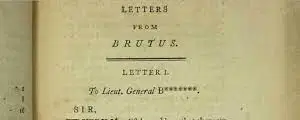
Which document opposes 'Brutus No. 1'?
Federalist 10
Magna Carta
Antifederalist Papers
Declaration of Independence
Before the U.S. Constitution was ratified, Federalists and Anti-Federalists argued over the role of the central government. The statement below reflects those arguments.
Which group held the position in the quote below:
"A strong national government with power over the states is needed to protect the states from excessive competition and fighting with one another. Let the thirteen states, bound together in a permanent Union, agree in erecting one great American system, superior to the control of all foreign influence."
Anti-Federalist
Federalist
In Federalist Paper #10, what is a faction?
a majority tyranny
the extended sphere
special interest groups
the new Constitution
“But if, on the other hand, this form of government contains principles that will lead to the subversion of liberty—if it tends to establish a despotism, or, what is worse, a tyrannic aristocracy; then, if you adopt it, this only remaining assylum for liberty will be shut up, and posterity will execrate your memory.”
Declaration of Independence
Articles of Confederation
Brutus #1
Federalist #10
“That to secure these rights, Governments are instituted among Men, deriving their just powers from the consent of the governed, --That whenever any Form of Government becomes destructive of these ends, it is the Right of the People to alter or to abolish it, and to institute new Government”
Declaration of Independence
Articles of Confederation
U.S. Constitution
Letter from Birmingham Jail
There are two methods of curing the mischiefs of faction: the one, by removing its causes; the other, by controlling its effects.
Federalist No. 10
Federalist No. 51
Federalist No. 70
Brutus No. 1
Match each action / responsibility with the branch of government it is most associated with
Makes laws
Legislative Branch
Interprets laws
Judicial Branch
Enforces Laws
Executive Branch
Which founding document contains the Bill of Rights, which protects our personal freedoms?
Articles of Confederation
The Declaration of Independence
The U.S. Constitution
The Pentagon Papers
Which historical figure wrote "Democracy In America", which identified the 5 founding principles of Democracy?
Alexis de Tocqueville
Alexander Hamilton
Thomas Jefferson
George Washington
Which U.S. motto was chosen to represent the many different cultures working together to achieve a unified goal?
All For One & One For All
E Pluribus Unum
In God We Trust
Unified We Stand
Match the 5 Values of Democracy with the appropriate definition
Resources are privately owned & there is little economic interference from the government
Laissez-faire
the ability to act independently from the majority
Individualism
Everyone in society is equal
Egalitarianism
personal freedom within society
Liberty
People's active participation in the government
Populism
Historical document responsible for announcing U.S. independence from Great Britain.
U.S. Constitution
Bill of Rights
DeLome Letter
Declaration of Independence
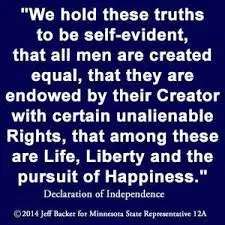
Which vocabulary term is most associated with the following excerpt:
Individualism
Popular Sovereignty
Laissez-Faire
Unalienable Rights
Which historical document serves as the "supreme law of the land"?
The Declaration of Independence
The Paris Peace Treaty
The U.S. Constitution
The Articles of Confederation
1.) American citizens are born with (a) , which are life, liberty, and the pursuit of happiness.
2.) The American government if founded on the idea of (b) , which means the power of the government resides with the American people.
3.) Along with being a permanent resident of the U.S. for at least 5 years (c) must be able to read, write, & speak basic English.
Which vocabulary term is most associated with the fact that Americans have the ability to make their own economic decisions with little to no interference from the government?
Populism
Egalitarianism
Individualism
Laissez-faire
When thinking like a Historian, which action would be considered a good practice?
using only primary sources to gather information
looking at multiple points of view on an event
using only one source to research information about an event
never checking the validity of a source
Which vocabulary term is most associated with the process of making a law?
Legislation
Populism
Commerce
Unalienable
Which of the following actions would be most associated with the vocabulary term Commerce ?
trading goods internationally
attending college
running for a government office
voting in a public election
Which U.S. motto was chosen to set the U.S. apart from Communist nations that did not offer religious freedoms?
"Peace Through Strength"
"Eureka"
"E Pluribus Unum"
"In God We Trust"
Organize these options into the right categories
cannot run for President
Is able to run for president
receives citizenship at birth
receives citizenship through a legalization process
must demonstrate ability to read, write, & speak English
receives citizenship even if born abroad due to both parent being U.S. citizens
John Locke argued that all humans are born with what natural rights?
life, liberty, property
life, cooperation, liberty
opportunity, property, support
opportunity, life, liberty
Why did Montesquieu advocate the separation of powers?
to stop political parties from gaining too much power
to ensure power divisions along party lines
to eliminate conflict between branches of government
to limit the power of any single group or person
John Locke helped develop the idea of a social contract between citizens and the
monarchy.
church.
government.
philosophers.
According to Thomas Hobbes, what is the purpose of government control over citizens?
to provide safety and security
to erase natural human tendencies
to create a balanced society
to overcome corruption
John Locke thought people were neither good nor bad naturally. How did Hobbe's views differ from Locke's?
Hobbes thought people were naturally violent.
Hobbes thought people were naturally kind.
Hobbes thought people were naturally peaceful.
Hobbes thought people were naturally evil.
In a federal system of government, power is
divided between the national government and the states.
held by one person who makes all the decisions.
held by a central government that makes all the decisions.
divided equally between all state governments.
An oligarchy is best defined as
a government ruled by a dictator.
a government ruled by a monarchy.
a government ruled by a small, elite group.
a government led by a large, select group.
In an autocracy, what kind of power does the leader hold?
He holds all the power.
He holds limited power as an appointee.
He is one of a group that holds power.
He is only a figurehead.
The two forms of democracy are
national and state.
republican and democrat.
local and national.
direct and representative.
In a parliamentary system of representative democracy, the prime minister
is appointed by the monarch.
is elected by representatives chosen by the people.
is the leader of the party that won the most seats in Parliament.
is elected directly by the people.
Which example describes natural rights?
rights that are given under specific circumstances.
rights that are granted to only certain citizens.
rights that can be restricted by government
rights that should be protected by the government
Which describes the main action called for by the Declaration of Independence?
to seek peace with Great Britain
to give the United States the power of self-government
to declare war on Great Britain
to create the First Continental Congress
Why were the Articles of Confederation replaced with the Constitution?
The Articles of Confederation did not give strong power to the federal government.
The Articles of Confederation did not create a governmental structure for the states.
The Articles of Confederation did not provide powers for strong individual state governments.
The Articles of Confederation did not allow the federal government to deal with foreign countries.
What was the subject of most debate between large and small states at the Constitutional Convention?
taxes
slavery
representation
delegation
In what part of the Great Compromise are the ideas of the Virginia Plan represented?
the Senate
the House of Representatives
the Office of the President
The Unicameral Legislature
The preamble begins with "We the People of the United States," which establishes the idea of
popular sovereignty.
judicial review.
checks and balances.
separation of powers.
Which best describes a role of the executive branch of the federal government?
governing commerce
interpreting laws
regulating taxes
enforcing laws
When the Supreme Court makes a ruling on a case that serves to interpret a law passed by Congress, it is an example of
presidential veto.
popular sovereignty.
checks and balances.
habeas corpus.
Under the Constitution, political rights protect the freedoms of
citizens accused of a crime.
elected representatives.
every American citizen.
state and national offices.
The idea that government is not above the law is an example of
rule of law.
federalism.
limited government.
guaranteed rights.

Which constitutional principle is being represented?
separation of powers
individual rights
checks and balances
federalism

Which consitutional principle is being represented?
federalism
checks and balances
popular sovereignty
rule of law

Which constitutional principle is being represented?
separation of powers
checks and balances
federalism
guarantee of rights

Which constitutional principle is being represented?
checks and balances
judicial review
guarantee of rights
federalism

Which constitutional principle is being represented?
guarantee of rights
social freedom
judicial review
checks and balances
natural rights
A right that is given by the government

