
 Worksheets
Unit 2 Forces Review Questions Complete
Total questions: 181
Worksheet time: 7hrs 10mins
In the context of forces, what could it be?
Select 2
Push
Pull
Lift
Drop
Without forces, what would happen in the universe?
Everything would change
Nothing would change
Some things would change
Change is unpredictable
Fill in the blank: The direction of a force can be described as ______, Right, Up, Down, East, West, etc.
Left
Forward
Reverse
Sideways
How is the strength of a force indicated when using arrows?
By the color
By the length
By the width
By the shape
What does a longer arrow represent when describing forces?
Weaker
Stronger
Neutral
Balanced
What is the standard unit for measuring force in the metric system?
Joules
Pounds
Newtons
kg
Fill in the blank: The symbol for gravitational force is ____.
Fg
W
Fw
g
Weight is a force. Like all forces, weight is measured in ______ in the metric system.
kilograms (kg)
Newtons (N)
Pounds (lbs)
Joules (J)
An object's mass is always the same, no matter where the object is located. True or False?
True
False
Why is a person's weight less on the moon than on Earth?
The moon has no gravity
Gravity is weaker
The person is farther from the earth
The moon is smaller
If the surface is sloped, the normal force would point 90 degrees up from that sloped surface. True or False?
True
False
Friction is greater when sliding on ______ compared to sliding on ice.
Select all that apply
grass
sand
wood
Friction always generates ______.
Light
Sound
Heat
Electricity
Air resistance mostly depends on which factor?
Mass
Velocity
Temperature
Pressure
ill in the blank: The symbol for applied force is _____.
Fg
Ff
Fapp
Fc


A box has three forces applied to it in the horizontal direction: a 50 N force to the right, a 30 N force to the left & a 20 N force to the right. What is the net force on the box?
40 N to the left
40 N to the right
100 N to the right
100 N to the left
The free body diagram of four boxes are shown below. Which box is in equilibrium?
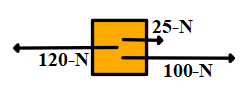
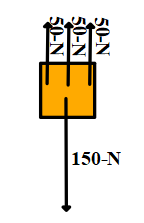
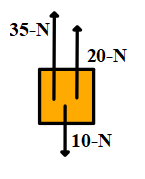
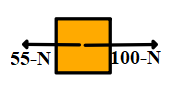
What does it mean for an object to be in equilibrium? Select ALL correct answers.
It has no net force acting on it.
The forces acting on the object all cancel out.
The forces acting on an object balance out.
The sum of all the forces acting on an object is 0.
The object is ONLY at rest.

Which diagram best shows person pushing a couch (accelerating) across the floor?


A man standing on a scale in an elevator notices that the scale reads 40 newtons greater than his normal weight. Which type of movement of the elevator could cause this greater-than-normal reading?
accelerating upward
accelerating downward
moving upward at a constant speed
moving downward at a constant speed
Which of the following is possible for an object with balanced forces acting on it? (Choose all that apply)
at rest
moving at constant speed
changing direction
slowing down
Which of the following is possible for an object with unbalanced forces acting on it? (choose all that apply)
Moving to the right with a constant speed of 3 m/s
Moving to the left with rightward acceleration
changing direction
at rest
Whenever an object is moving, there is always this force opposing the motion:
inertia
momentum
friction
applied force
Which of these include only contact forces?
Fapp Fg Fnorm
Fapp Ftens Fnorm
Fb Fapp Fg
Fair Fnorm Fg
The force that keeps objects on top of surfaces instead of letting them sink into the surface is known as:
normal
abnormal
static
inertia
The same as a frictional force.
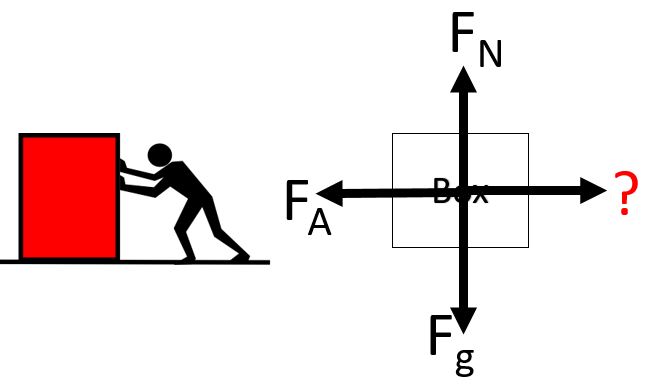
air resistance (drag)
Choose the word that best fits this definition:
An influence that can change the motion of an object. A push or pull that acts upon an object as a result of that objects interactions with its surroundings.
Inertia
Forces
Free Body Diagram
Friction
Choose the word that best fits this definition:
A graphical illustration used to visualize the applied forces, moments, and resulting reactions on a body in a given condition.
Inertia
Forces
Free Body Diagram
Friction
Choose the word that best fits this definition:
Defined as the force of gravity on the object and may be calculated as the mass times the acceleration of gravity, w = mg.
Mass
Weight
Net Force
Normal Force
Choose the word that best fits this definition:
The universal force of attraction acting between all matter. It is by far the weakest known force in nature.
Tension Force
Coefficient of Friction
Gravitational Force
Magnitude

If the floor is pushing you up, what force is this called?
Normal Force
Air Resistant Force
Frictional Force
Applied Force
What does it mean when the vector sum of all forces is zero?
There is no net force acting on the object
There is a positive net force acting on the object
There is a negative net force acting on the object
The object is experiencing an unbalanced force
A force that causes an object to accelerate must be:
At least 10 N
A balanced force
A total of 0 net force
An unbalanced force
Choose one of the following choices that happens after a balanced force hits an object
No change in motion
It speeds up
It slows down
It changes direction
After a football is thrown, what forces are acting on it?
The initial contact force and gravity
Gravity and air resistance
Initial velocity and normal force
Gravity and normal force
If a soccer ball was moving to the right towards the goal with a force of 27 N, what would cause the ball to be in equilibrium?
An equal force in the opposite direction
An unbalanced force of gravity
The normal force that opposes gravity
The ball is in equilibrium because only gravity is acting on it
What is the effect of an unbalanced force on an object's motion?
It causes the object to stop
It causes the object to accelerate
It has no effect on the object's motion
It causes the object to decelerate
What is the net force on an object in equilibrium?
Equal to the weight of the object
Zero
Equal to the mass of the object
Depends on the speed of the object
What is the role of friction in the motion of a rolling ball?
It speeds up the ball
It slows down the ball
It has no effect on the ball
It changes the direction of the ball
If the net force points in the same direction an object is moving the object
speeds up
slows down
changes direction
keeps steady speed
What is Newton's 1st Law of Motion?
An object in motion stays in motion unless acted upon by an external force.
An object at rest stays at rest unless acted upon by an external force.
Both A and B.
None of the above.
Newton's First Law is also called the Law of __________.
Momentum
Thermodynamics
Inertia
Movement
Inertia depends upon the _________ of an object.
mass
force
weight
momentum
In Newton's cradle, the number of balls that move after one ball is released is an example of ____.
Energy conservation
Inertia
Friction
Centrifugal forces


What mass has more inertia?
1000kg of bricks
1000kg ton of feathers
2kg toy car
a commercial jet
Newton's three Laws of Motion describe the motion of:
Only small objects
Only large objects
Any object
Only objects on earth
Fill in the blank: The word 'inertia' is derived from the Latin word 'inert', meaning ______.
Full of energy
Lacking the ability to move
Constantly changing
Moving quickly
What happens to the motorcycle rider when the motorcycle crashes into the wall?
He stops immediately
He continues moving forward
He moves backward
He falls to the side.
What immediate force is acting directly on the rider's body when the motorcycle hits a wall?
No force
Centripetal force
Frictional force
Air resistance
What happens to the rider's body when no force acts directly on it?
It stops
It accelerates
It continues moving
It changes direction.
Fill in the blank: The force that acts toward the center of a circular path is known as ________.
gravitational force
centripetal force
centrifugal force
frictional force
In the Gravitron ride, what is responsible for the circular motion pushing outward keeping people against the wall of the ride?
Inertia
Centripetal force
Gravitational force
Friction
True or False: Centrifugal force exists in the context of a Gravitron ride.
True
False
What does the term 'centripetal' refer to in circular motion?
Inward force
Outward force
Upward force
Downward force

Which direction would the person move if the walls suddenly disappeared while they were in position 3 in the picture?
Down
Up
Right
Left
Which direction would the person move if the walls suddenly disappeared while they were in position 2 in the picture?
Down
Up
Right
Left
Which direction would the person move if the walls suddenly disappeared while they were in position 1 in the picture?
Down
Up
Right
Left
Which direction would the person move if the walls suddenly disappeared while they were in position 4 in the picture?
Down
Up
Right
Left
Up-Left
Newton's Second Law can also be stated as _____________.
the Law of Inertia
F=ma
Every action has an equal but opposite reaction.
What is the unit for acceleration?
m/s^2
m/s
Newtons
grams
What Unit do we Measure Force in?
Newtons
Joules
Volts
Lumens
F= mass * acceleration
A 20 kg bike accelerates at 10 m/s2. what is the force acting upon it?
25 Newtons
20 Newtons
200 Newtons
10 Newtons
An object of mass 10 kg is accelerated upward at 2 m/s2. What force is required?
20 N
2 N
5 N
0 N

Will it take more force to push an empty shopping cart or a shopping cart that is full?
The empty shopping cart
The full shopping cart
They will take the same amount of force
Depends on what is in the full shopping cart
F = ma
Football A has a greater mass than football B. Which football will have greater acceleration when both are thrown with the same force in the same direction?
Football A
Football B
They will have the same acceleration
Mass has no effect on acceleration

According to Newton's second Law, which would take more force to slow down?
The silver car
The green car
They would both take the same force
A golf ball and a bowling ball are both accelerating at the same rate. Which one requires a greater force?
golf ball
bowling ball
Same force
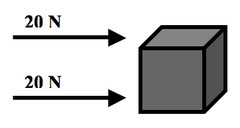
Jenny applies a 60 N force to a 20 Kg cart, what is the acceleration of the cart if friction can be neglected?
1200 m/s2
0.33 m/s2
20 m/s2
3 m/s2
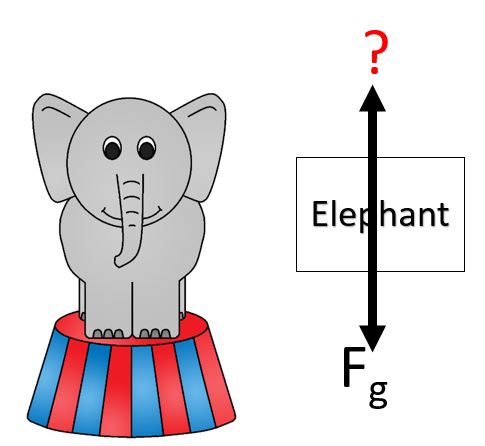
Whenever an object is moving, there is always this force opposing the motion:
inertia
momentum
friction
applied force

10 N up
20 N down
10 N down
22.4 N up

10 N right
14.1 N right
20 N up
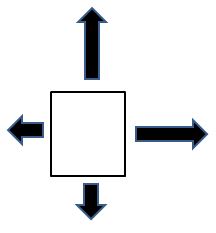
This object would be moving (pick all that are correct):
up
down
left
right
The down-arrow in this diagram is most-likely:
gravity
normal
a push or pull
friction
Which diagram best shows person pushing a couch (accelerating) across the floor?
Which would hit the ground first if dropped from the same height in a vacuum—a feather or a metal bolt?
the feather
the metal bolt
They would hit the ground at the same time.
They would be suspended (floating) in a vacuum.
A freely falling object starts from rest. After falling for 6 seconds, it will have a speed of about:
6m/s
36m/s
60m/s
12m/s
15. Joe jumps out of a helicopter. Which free body diagram(FBD) illustrates Joe's free fall motion?


An object travelling at terminal velocity moves at a steady speed.
True
False

Which diagram shows the forces acting on Peter when he is falling at Terminal Velocity?
1
2
3
When a skydiver is falling what happens to
a) her velocity
b) the air resistance?
a) Increases
b) increases
a) increases
b) decreases
a) increases
b) stays the same
a) stays the same
b) increases
Which situation produces more pressure on the floor?
standing on one foot
standing on two feet
standing on four feet
all produce the same pressure
Newton's Second Law says that F=m*a.
Therefore, if the force increases, then the acceleration
increases
decreases
stays the same
Newton's Second Law says that F=m*a.
Therefore, if the mass increases, then the acceleration
increases
decreases
stays the same

which box has more acceleration?
top
bottom


What happens when two objects, such as a baseball and a bat, collide?
They hit each other with the same force in the same direction.
They hit each other with the same force in opposite directions.
They hit each other with unequal force in opposite directions.
One remains still while the other one moves in the same direction.
Newtons law states that for every action, there is an_________ reaction
unequal and opposite
stronger and opposite
equal and similar
equal and opposite

Force always come in________
waves
triplets
pairs
Newton's Third Law (Law of Action-Reaction) is also known as...
The Law of Inertia
The Law of Acceleration
The Law of Force Pairs

The car is driving down the street. What object in this picture creates the force that pushes the car forward?
The engine
The wheels
The exhaust
The ground
You and your friend are both wearing roller skates. You push your friend. What might happen?
Your friend moves back, but you don't.
You move back, but your friend doesn't.
You and your friend both move back.
Neither of you move back.
You kick a soccer ball. What is true about the force on you and the ball?
The force on the ball is bigger.
The force on you is bigger.
Both forces are the same.
The Moon's gravity pulls on the Earth and the Earth's pulls on the Moon. Which force is stronger?
The Earth's pull is stronger.
The Moon's pull is stronger.
The two forces are the same.
A small car and a large car get into an accident. The small car is much more seriously damaged than the large car. Why might this happen?
The big car has more mass, so it exerts a larger force than the small car.
The big car has a larger acceleration than the smaller car, so it stays safe.
The forces are the same, so the lower mass car has a larger acceleration, causing more damage.
Big cars are built with stronger materials compared to small cars.
You throw a ball. Your hand creates a force on the ball, and the ball creates a force on your hand. Choose the correct answer:
The force on the ball and your hand are equal.
The force on the ball and your hand act in opposite directions.
The force on the ball and your hand act at the same time.
All of the above.
Action: Cannon pushes on cannonball
Reaction: Cannonball flies forward
Reaction: Cannonball pushes back on cannon
Reaction: Cannonball falls to the ground
Reaction: Cannonball pushes into the air
Action: Gravitational attraction pulls a book down
Reaction: A surface or the ground pushes the book up
Reaction: The book pulls back on the Earth
Reaction: The book falls to the ground
Reaction: The book pushes against a surface or the ground.
Action: A swimmer pushes the water backwards
Reaction: The swimmer moves forward
Reaction: The water pushes the swimmer forward
Reaction: The swimmer is tired
Reaction: The water moves backward
Action: Mrs. Scarborough pushes on the wall.
Reaction: The wall pushes Mrs. Scarborough back.
Reaction: The wall moves.
Reaction: A friction force with the ground keeps Mrs. Scarborough in place.
Reaction: The wall absorbs her force.
Action: A baseball player throws a ball.
Reaction: The ball flies through the air.
Reaction: The ball pushes back on the player's hand.
Reaction: The ball falls to the ground.
Reaction: The ball pushes on the air.
A force can be exerted by one object on itself.
True
False
What is the reaction force when a person jumps up?
The person pushes on the ground.
The ground pushes the person up.
The person moves upwards.
The person moves downwards.
What will happen when a person jumps off of a canoe?
The canoe will continue in the same direction as it was moving before.
The canoe will remain stationary.
The canoe will move in the direction of the person jumping.
The canoe will move backwards from the direction of the jump.
What are the correct action and reaction forces for walking?
Action: The person pushes against the floor. Reaction: The floor pushes the person.
Action: The person moves forwards. Reaction: The person pushes against the floor.
Action: A person applies friction backwards.
Reaction: The friction pushes the person forwards.
Action: A person pushes against the floor. Reaction: The person moves forwards.
What is the correct reaction force for a hammer hitting a nail?
The nail goes into the wood.
The nail pushes back on the hammer.
The hammer pushes on the person.
The nail pushes back on the person.
Action: A bowling ball rolls into a bowling pin.
Reaction: The pin falls over.
Reaction: The pin pushes back on the ball.
Reaction: The ball rolls into the wall.
Reaction: The pin pushes against the floor.

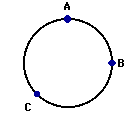
A car is doing donuts in a parking lot. It completes 5 circles in 35 seconds. What is the period of rotation, in seconds?
A pig is flying in uniform circles with a period of 2 seconds. How many circles does the pig complete over ten seconds?
A object is traveling in uniform circular motion. It has a period of 6 seconds. The radius of the circle is 3 meters. What is the tangential velocity, in m/s?
(round to a whole number)
When dealing with circular motion, the time that it takes to make one revolution of the circle is called the:
rotation.
orbit.
period.
segment.
Why does an object experiencing uniform circular motion have an acceleration?
because it ir changing speed
because it is changing direction
because it is moving n a straight line
because it has mass
An object in uniform circular motion is always moving ________________ the circle.
away from
toward
parallel to
tangent to
In uniform circular motion, which two variables point toward the center of the circle?
the centripetal force and the acceleration
the velocity and the mass
the period and the mass
the time and the radius

Neglecting air resistance, how would the horizontal acceleration and velocity of the hammer change if the thrower releases the chain?
The horizontal acceleration and velocity of the hammer would be along the Vtang vector.
The horizontal acceleration and velocity of the hammer would be inward toward the thrower.
The horizontal acceleration and velocity of the hammer would be straight down by gravity.
The horizontal acceleration and velocity of the hammer would be continue in a circle.
A car moves with a constant speed of 17 m/s on a circular track of 200 m radius. Calculate the acceleration of the vehicle. HINT: a = V2 / R
1.45 m/s2
0.76 m/s2
1.98 m/s2
2.34 m/s2
A 250 kg motorcycle goes around a 20.0 m radius turn at 19.0 m/s. What is the centripetal force on the motorcycle? HINT: f = MV2 / R
2396.6 N
4512.5 N
5006.8 N
5656.7 N

The _______________________ supplies the centripetal force requirement for the car to move in a horizontal circle. Without it, the car would turn its wheels but would not move in a circle (as is the case on an icy surface).
friction force
centrifugal force
normal force
applied force
A ball was swung at constant speed in a horizontal circle on the top of a level lab table. Which of the following was the direction of the acceleration on the ball?
The acceleration was inward along the radius of the circle.
The acceleration was outward along the radius of the circle.
The acceleration was tangent to the circle in the direction of the ball's motion.
D.The acceleration was perpendicular to both the ball's motion and the tabletop.
What is “Centripetal Force”?
Centripetal Force is a force that acts on a body moving in a circular path and is directed toward the center around which the body is moving.
Centripetal Force is the resistance to motion of one object moving relative to another.
Centripetal Force are attractive or repulsive forces between particles that are caused by their electric charges.
Centripetal Force is the force of attraction between all masses in the universe; especially the attraction of the earth's mass for bodies near its surface.

In this diagram, what do the red arrows represent?
the acceleration vector
the velocity vector
the centripetal force vector
the force of gravity
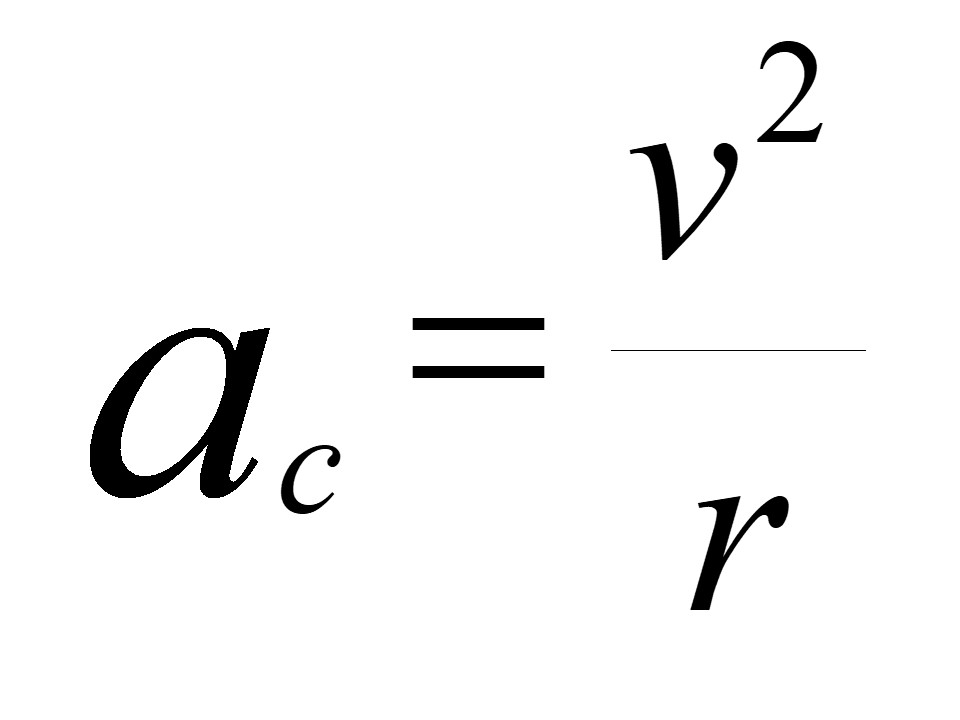
What's the centripetal acceleration of an object traveling 2.3 m/s around a circle of diameter 0.6 m?
5 m/s2
17.63 m/s2
10 m/s2
8.81 m/s2
The drum of a washing machine rotates 1800 times in 3 minutes. What is the period?
0.1 s
0.2 s
0.3 s
0.5 s
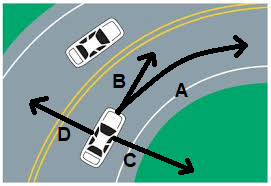
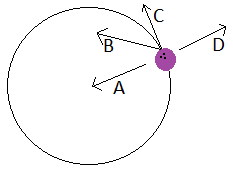
A car is rounding a bend as shown in the diagram. Which arrow correctly shows the direction of the cars velocity?
A
B
C
D
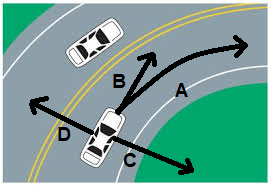
In the diagram of the car, if the driver took his hands off the steering wheel, which arrow correctly shows the direction the car would travel in?
A
B
C
D
A 22.0 kg child is riding a playground merry-go-round that is rotating at 40.0 rev/min. What centripetal force must she exert to stay on if she is 1.25 m from its center?
120 N
240 N
480 N
960 N

