
 Worksheets
The Super CPS Revision Quiz
Total questions: 264
Worksheet time: 4hrs 47mins
What is the unit to MEASURE force?
Kilogram
Meter
Pounds
Newton


A type of friction that occurs when air pushes against a moving object it to decelerate.
surface area
air resistance
velocity
gravity
Newton's First Law of Motion states that an object at rest stays at rest unless a _____ acts on it.
Balanced force
Net force
Weak force
Strong force


If two magnets are close together, the magnetic force will be ________.
smelly
weak
strong
positive
Force that affects the weight of an object
magnetism
friction
gravity
air resistance
Is the force usually exerted by a surface on an object that is resting against it.
Friction
Normal force
Elasticity
Tension

Brittany has a bar magnet. What will happen when she brings the north end of her magnet to the south end of her magnet?
They will attract
Nothing will happen
They will repel
Sparks will fly


Rough surfaces have _________
greater friction
less friction
the same level of friction
How would the absence of friction affect a marble travelling on a long, straight path?
the marble's speed would decrease
the marble would remain at a constant speed
the marble's speed would increase
the marble would stop immediately
Which of these materials do you predict would have the MOST amount of friction?
metal
tile
sand paper
denim
Frictional force depends on ____
A. Surface area in contact
B. roughness of surface
C. both a and b
D. none of the above
The direction of force of friction is always _____ to the direction of motion
same
opposite
unchanged
none of these
If we apply oil on door hinges, the friction will
(a) increase
(b) decrease
(c) disappear altogether
(d) will remain unchanged


Why does the melting point of metals increase across period 3, from Sodium (Na) to Aluminium (AI)?
Size of atoms gets smaller
Attraction force between nuclei and free electron increases
Increased space between the valence electrons in the "sea"
Increased number of valence electrons contributed to the "sea"
Which statement describes the lattice structure of a metal?
The lattice consists of alternating positive ions and negative ions.
The lattice consists of neutral atoms arranged in layers.
The lattice consists of positive ions in a ‘sea of electrons’.
The lattice consists of neutral atoms in a ‘sea of electrons’.
Metals consist of a lattice of positive ions in a ‘sea of electrons’. Why is aluminium malleable?
Its ions repel each other.
Its ions are attracted to the ‘sea of electrons’
Its ions are tightly packed together.
Its layers of ions can slide over each other.
The tendency of an atom to attract a shared pair of electrons
Atomic Radii
Ionization Energy
Electronegativity
Electron Afinity
Oxidation Number
Atomic radii trends is . . . .
generally decrease along each period of the table, from the alkali metals to the noble gases; and increase down each group.
generally increase along each period of the table, from the alkali metals to the noble gases; and increase down each group.
generally increase along each period of the table, from the alkali metals to the noble gases; and decrease down each group.
generally decrease along each period of the table, from the alkali metals to the noble gases; and decrease down each group.
Electronegativity trends is . . . .
increases on passing from left to right along a period, and decreases on descending a group.
increases on passing from left to right along a period, and increases on descending a group.
decreases on passing from left to right along a period, and decreases on descending a group.
decreases on passing from left to right along a period, and increases on descending a group.
Metallic character trends is . . . .
decrease going across a period and tends to increase going down a group.
increase going across a period and tends to increase going down a group.
decrease going across a period and tends to decrease going down a group.
increase going across a period and tends to decrease going down a group.
Which element has bigger atomic radii?
Beryllium is bigger than Fluorine
Oxygen is bigger than Sulphur
Litihium is bigger than Sodium
Phosphorus is bigger than Bromine
Which element has smaller atomic radii?
Beryllium is smaller than Fluorine
Sulphur is smaller than Oxygen
Litihium is smaller than Sodium
Potassium is smaller than Bromine
Which element has higher electronegativity?
Fluorine is higher than Oxygen
Potassium is higher than Sodium
Aluminium is higher than Boron
Phosphorus is higher than Chlorine


To which group does this atom belong?
1
3
13
11
The periodic table is arranged by ______
Atomic Mass
Number of Electrons
Atomic Number
Atomic Weight
The term valence electron refers to…
The total number of electrons in an atom
The electrons in the first energy level
The electrons in the outermost energy level
Electrons that are found in the nucleus
Elements in Group 6 of the periodic table would have how many valence electrons?
2
6
8
Unable to tell from the given information
Which element is located in Group 3, Period 2?
Magnesium
Lithium
Helium
Boron
Which of the following elements has 7 valence electrons?
Sodium (Na)
Aluminum (Al)
Fluorine (Fl)
Calcium (Ca)
As you look down a group, electronegativity
increases
decreases
completely described by a magnitude with a direction.
The fastest trains are magnetically levitated above the rails to avoid friction and are therefore called MagLev trains. Some can travel 250 km in a half an hour.
What is their average speed?
250 km/hr
500 km/hr
125 km/hr
A hummingbird averages a speed of about 45 km/hour. Ruby-throated hummingbirds take a non-stop trip across Gulf of Mexico in which they fly for 18 hours straight! How far is their migration assuming their average speed?
810 km
2.5 km
3.6 km
360 km
4 m/s in the same direction
An airplane accelerates down a runway at 4 m/s/s
for 8 s until it finally lifts off the ground.
Determine the velocity at take-off.
0.5 m/s
32 m/s
2.0 m/s
16 m/s/s
Which of the following is not associated with acceleration?
Picture a car moving to the right AND slowing down.
In which direction is its acceleration?
Left
Right
An object that is free-falling is acted upon by the force of gravity alone.
True
False

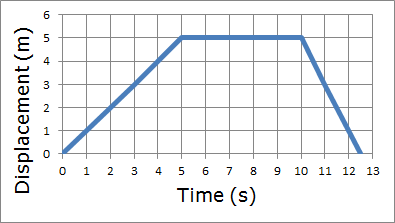

Stationary relative to the reference position
Accelerating and moving away
Fastest steady speed; moving away from the reference position

if you drop 2 rocks off of a tower - one weighing 500 g and the other 250 g, which hits the ground first
The lighter one because it accelerates faster
The heavier rock because it is attracted by the Earth more
The heavier rock because it pushes the air away as it falls.
The same since acceleration by gravity is a constant.

You are riding your scooter to your friend's at 2 m/s and reach the big path and accelerate at 1 m/s/s for 3 seconds. How fast are you then going?
6 m/s/s
6 m/s
5 m/s
5 m/s/s
Definition: Regular arrangement (repeating pattern) of particles (atoms).
Element
Lattice
Molecule
Mixture
Compound
Definition: a substance only made of one type of atom.
Compound
Lattice
Molecule
Mixture
Element
Definition: A group of atoms bonded together (but not as a lattice/repeating pattern)
Element
Lattice
Molecule
Mixture
Compound
Definition: A substance containing atoms of two or more elements joined together by chemical bonds.
Element
Lattice
Molecule
Mixture
Compound
Definition: A combination of substances that can be physically separated. The particles (atoms or molecules) are not joined together by chemical bonds.
Element
Lattice
Molecule
Mixture
Compound
Water is a compound because it is made up of:
Atoms
atoms of only one element: hydrogen
atoms of only one element: oxygen
atoms of two elements, hydrogen and oxygen, mixed together but not chemically combined
atoms of two elements, hydrogen and oxygen, chemically combined
True/False: Compounds can be arranged as molecules.
True
False
True/False: Compounds can be arranged as lattices.
True
False
True/False: Elements in a compounds are always combined in fixed proportion (same ratio).
True
False
True/False: Elements in a mixture are always combined in fixed proportion (same ratio).
True
False
What is the difference between copper(I) oxide (Cu2O) and copper(II) oxide (CuO).
The copper(II) oxide (CuO) lattice has even amount of copper and oxygen atoms where as copper(I) oxide (Cu2O) lattice has two copper atoms for every oxygen atom.
The copper(II) oxide (CuO) lattice has two copper atoms for every oxygen atomwhere as copper(I) oxide (Cu2O) lattice has even amount of copper and oxygen atoms .
copper(II) oxide (CuO) is a molecule whereas copper(I) oxide (Cu2O) is a lattice
copper(II) oxide (CuO) is a lattice whereas copper(I) oxide (Cu2O) is a molecule
Groups or Periods: Run from left to right across the periodic table.
Group
Period
Groups or Periods: Run from top to bottom on the periodic table.
Group
Period
Groups or Periods: Indicate the number of valence electrons (outer shell electrons).
Group
Period
Groups or Periods: Indicate the number of electron shells.
Group
Period

Based on the mini periodic table. Sodium (Na) would have ___ valence electrons (outer shell) and ____ electron shells.
1, 3
3, 1
1, 2
2, 2
Based on the mini periodic table. Berrylium (Be) would have ___ valence electrons (outer shell) and ____ electron shells.
1, 3
2, 1
1, 2
2, 2
Based on the mini periodic table. Lithium (Li) would have ___ valence electrons (outer shell) and ____ electron shells.
1, 3
2, 1
1, 2
2, 2
Based on the mini periodic table. Helium (He) would have ___ valence electrons (outer shell) and ____ electron shells.
1, 3
2, 1
1, 2
2, 2
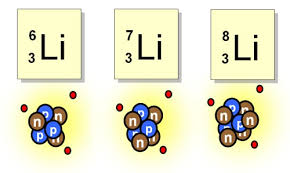
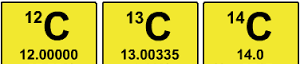
What do these isotopes of carbon all have in common?
They would all have the same number of neutrons.
They would all have the same mass number.
They would all have the same number of protons.
They would all have the same atomic mass.
What quantities vary between the isotopes of an element?
The number of protons.
The number of electrons.
The atomic numbers.
The number of neutrons.
Atom A: 2 protons, 2 neutrons, 2 electrons
Atom B: 2 protons, 1 neutrons, 2 electrons
Atom C: 1 proton, 2 neutrons, 2 electrons
Atom D: 1 protons, 0 neutrons, 1 electrons
Atom A and Atom B are...
Isotopes
The same atom
Ions
Different elements
Atom A: 2 protons, 2 neutrons, 2 electrons
Atom B: 2 protons, 1 neutrons, 2 electrons
Atom C: 1 proton, 2 neutrons, 2 electrons
Atom D: 1 protons, 0 neutrons, 1 electrons
Atom A and Atom C are...
Isotopes
The same atom
Ions
Different elements
Atom A: 2 protons, 2 neutrons, 2 electrons
Atom B: 2 protons, 1 neutrons, 2 electrons
Atom C: 1 proton, 2 neutrons, 2 electrons
Atom D: 1 protons, 0 neutrons, 1 electrons
Which atom is an ion?
Atom A
Atom B
Atom C
Atom D
Iron is a good conductor, malleable and magnetic. What type of element is Iron?
Metal
Nonmetal
Metalloid
Semi-metal
Metalloids are the 'step' that separate the metals and the non-metals.
TRUE
FALSE
If a substance breaks easily, it is said to be ________________.
A. Maleable
B. Brittle
C. Conductive
D. Ductile
What is the element name of this symbol K?
A. Phosphorus
B. Potassium
C. Krypton
D. Magnesium
Which of the following refers to the element that has luster, is malleable and ductile, and is said to be a good conductor of heat and electricity.
A. Metals
B. Nonmetals
C. Metalloids
D. Semi-metals
Which of the following refers to the element that is usually a gas or a brittle solid at room temperature. It is a poor conductor of heat and electricity.
A. Metals
B. Nonmetals
C. Metalloids
D. Semi-metals
Which of the following is typically a good conductor of heat and electricity?
Metal
Nonmetal
Metalloid
Silicon is a
metal
metalloid
non-metal
non-element
Who is the best Science Teacher?
Mr Dean
Ms Brown
Mr Bye
Mr Maxwell
Inertia is an object's tendency to:
fall to the ground
slow down and stop
maintain a constant velocity
maintain a constant acceleration
You hold a pen up in the air and then let go of it.
The pen's inertia is its tendency to:
pick up speed
stay where it is
fall to the ground
maintain a constant speed
An object is moving in a straight line and slowing down.
Which of the following statements must be true?
The force of inertia is acting on the object
A net force is acting on the object, in the direction it is moving
A net force is acting on the object, in the opposite direction to its motion
No net force is acting on the object
A book sits on a table, without moving, for two months.
In those two months:
no forces acted on the book
only gravity acted on the book
a net force acted on the book
no net forces acted on the book
Which of the following objects are being acted on by net forces?
An apple speeding up as it falls to the ground
A shipping container being raised by a crane vertically at a constant speed
A train following a curved track at a constant speed
A car stopped at traffic lights
A skydiver is falling with a constant velocity and is acted on by two forces: gravity and air resistance.
The net force on the skydiver must be:
upwards, because air resistance is stopping the skydiver from speeding up
zero, because the skydiver's velocity is constant
downwards, because the skydiver is falling
A skier is moving over perfectly flat snow. Without using the poles to push, she is slowing down.
Which of the following statements are true?
Only air resistance causes the skier to slow down
Air resistance and friction between the skis and snow cause the skier to slow down
Gravity directly causes the skier to slow down

A hovercraft is speeding up as it moves to the right.
Which one of the free body diagrams below best represents the forces acting on it?
A
B
C
D

Look carefully at the free body diagram on the left.
Which of the following statements can you conclude from it?
The object is accelerating
The object is expanding, stretched up and down and left and right
The object is stationary
The object has a constant velocity
According to Newton's third law of motion, every force is paired with a reaction force that acts:
on the same object in the same direction
on the same object in the opposite direction
on a different object in the same direction
on a different object in the opposite direction

The bolt in the diagram (left) has gravity pulling it down and a magnetic force pulling it up. These forces are equal and opposite.
According to Newton's third law, what is the force paired with the Earth's gravitational pull on the bolt?
Note: Not all forces are shown in the diagram.
The magnet's magnetic pull on the bolt
The bolt's magnetic pull on the magnet
The bolt's gravitational pull on the Earth
There is no paired force
A jet ski shoots a jet of water backwards. The force on the jet of water is paired with a reaction force, as described by the third law of motion.
Compared to the force on the jet of water, the reaction force:
is weaker
is a different type
acts on a different object (the jet ski)
A small sports car travelling at 60 km/h crashes into a large, stationary truck.
Which one of the following statements is true?
The car applies a force to the truck but there is no force from the truck onto the car
The force that the car applies to the truck when they collide is present before they make contact
While the car and truck are in contact, equal and opposite forces act on each of them
During the collision, the car exerts a force on the truck and the truck exerts a force on the car, but these are not related

Which of the diagrams below best represents the gravitational forces acting between the Sun and Jupiter?
A
B
C
D

In 1972 on the Apollo 16 mission, astronaut Charles Duke left a family photo on the surface of the Moon.
Which one of the following statements is true?
The Moon is much smaller than the Earth, so exerts no gravitational force on the photo
The Moon exerts a gravitational force on the photo, but the photo does not exert a gravitational force on the Moon
The Moon and photo both exert gravitational forces on each other, but the force applied by the Moon to the photo is much greater
The Moon and photo exert equal and opposite gravitational forces on each other
The net force acting on an object is equal to:
its weight times its velocity
its mass divided by its acceleration
its mass times its velocity
its mass times its acceleration

A 50 kg girl is accelerating down a water slide at 2 m/s/s.
What is the net force acting on her?
0.04 N
25 N
52 N
100 N
A meteoroid is accelerating toward Mars at 10 m/s/s under a gravitational force of 95 N.
What is its mass?
0.105 kg
9.5 kg
105 kg
950 kg

A cannon has ten times the mass of the cannonball it fires.
Compared to the cannonball, the cannon will experience:
the same size force but ten times the acceleration
the same size force but one tenth of the acceleration
ten times the force but the same acceleration
one tenth of the force but the same acceleration

If the acceleration is kept constant. The mass of the object is ___________ to the force it exerts.
Directly proportional
Inversely proportional
If the mass is kept constant. The acceleration of the object is ___________ to the force it exerts.
Directly proportional
Inversely proportional
If the force is kept constant. The mass of the object is ___________ to the acceleration.
Directly proportional
Inversely proportional
Which term best matches the following definition?
Definition: the tendency of an atom to prefer to have a full valence shell.
Octet Rule
Valence Shell
Molecule
Compound
Chemical Bond
Which term best matches the following definition?
Definition: the electron shell which is furthest from the nucleus; outer shell.
Octet Rule
Valence Shell
Molecule
Compound
Chemical Bond
Which term best matches the following definition?
Definition: a group of atoms bonded together; at least two atoms bonded together.
Octet Rule
Valence Shell
Molecule
Compound
Chemical Bond
Which term best matches the following definition?
Definition: at least two different elements (type of atom) bonded together.
Octet Rule
Valence Shell
Molecule
Compound
Chemical Bond
Which term best matches the following definition?
Definition: the glue that holds atoms together in molecule or compounds.
Octet Rule
Valence Shell
Molecule
Compound
Chemical Bond
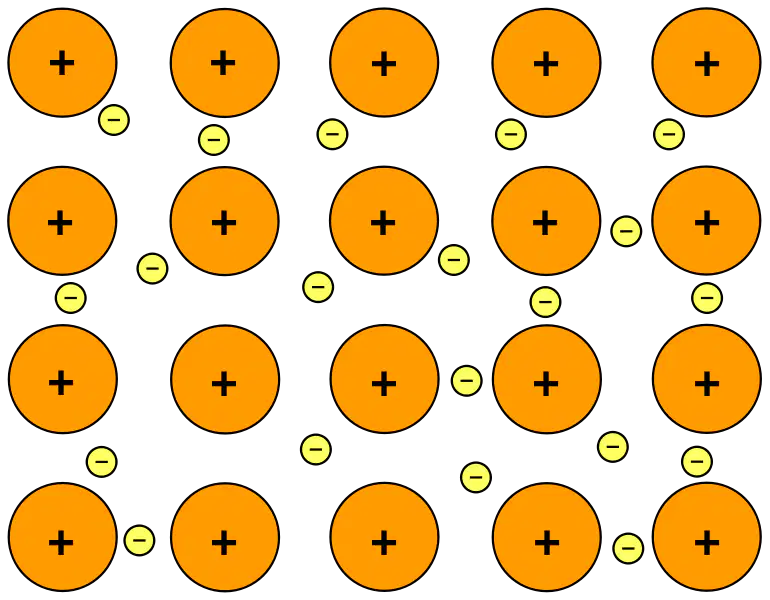
Which type of bonding does the image best represent?
Ionic
Covalent
Metallic
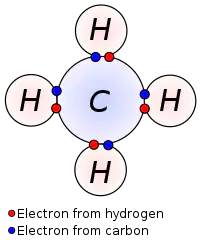
Which type of bonding does the image best represent?
Ionic
Covalent
Metallic

Which type of bonding does the gif best represent?
Ionic
Covalent
Metallic
Which type of bonding occurs between metal atoms?
Ionic
Covalent
Metallic
Which type of bonding occurs between non-metal atoms?
Ionic
Covalent
Metallic
Which type of bonding occurs between metals and non-metal?
Ionic
Covalent
Metallic
Which type of bonding best fits the following definition.
Definition: Atoms sharing electrons to have a full valence shell.
Ionic
Covalent
Metallic
Which type of bonding best fits the following definition.
Definition: A cloud of delocalised (roaming around) electrons around a metal cation lattice.
Ionic
Covalent
Metallic
Which type of bonding best fits the following definition.
Definition: The electrostatic attraction between positive cations (formed from atoms that have lost electrons) and negative anions (formed from atom that gave gained electrons).
Ionic
Covalent
Metallic

What type of bonding is present in an Iron nail (made of Fe atoms)?
Metallic
Covalent
Ionic
What type of bonding is present in an silver ring nail (made of Ag atoms)?
Metallic
Covalent
Ionic
What type of bonding in carbon dioxide (made of molecules containing CO2)?
Metallic
Covalent
Ionic
What type of bonding in ozone (made of molecules containing O3)?
Metallic
Covalent
Ionic
What type of bonding in sodium fluoride (made of the compound containing NaF)?
Metallic
Covalent
Ionic
What type of bonding in magnesium cloride (made of the compound containing MgCl2)?
Metallic
Covalent
Ionic
Inertia is the tendency of any object to maintain its:
Acceleration
Shape
Velocity
Position
An object has a velocity of 7 m/s east. Due to the object's inertia it will tend to:
continue moving at 7 m/s east
slow down but continue in an easterly direction
stop
maintain its speed but slowly change direction
Due to inertia, a particular object has a tendency to maintain it's a velocity of 0 m/s.
Which best describes the object's current state of motion?
It is at rest
It is moving slowly in a straight line, slowing down
It is moving slowly in a curving trajectory
It could be any of the above three answers

When you throw a stone up in the air, it naturally falls back down to the Earth. This is because of its inertia.
True
False
Which is Newton's first law of motion?
Every object persists in its state of rest or uniform motion in a straight line unless it is compelled to change that by forces impressed on it.
Force is equal to change in momentum (mV) per change in time. For a constant mass, force = mass x acceleration
For every action, there is an equal and opposite re-action
Which of the following objects have constant velocity, or zero acceleration?
A basketball slowing down as it rolls in a straight line
A train travelling at a steady speed on a straight track
A bungee jumper falling
A car accelerating out of a driveway
Which of the objects from the previous question have net forces acting on them?
A sizzling pizza sitting on a plate
A tennis ball being thrown from one person to another
A train travelling at a steady speed on a straight track
Inertia is a type of force.
True
False
An object's inertia means that if it is moving in a straight line it requires a force to keep it going at a constant speed.
True
False
What might an object do when there are no forces acting on it?
Start moving
Remain at rest
Stop moving
What might an object do when there are no forces acting on it?
Keep moving in the same direction at the same speed
Gradually slow down until it comes to a stop
Speed up
Definition: push or pull acting on an object
speed
force
position
mass
How is velocity different from speed?
Velocity is when an object goes in reverse.
Velocity is the direction an object moves in; it has nothing to do with speed.
Velocity is speed and direction together.
Velocity is exactly the same as speed.
An object's inertia is its tendency to maintain a constant:
Mass
Velocity
Speed
Acceleration
Which of the following are considered changes in acceleration?
speeding up
slowing down
changing direction
moving at constant speed of 100 km/h
Not moving at all
Which term matches the following definition?
Definition: The change in position of an object
Velocity
Vector Quantity
Scalar Quantity
Displacement
Speed
Which term matches the following definition?
Definition: The rate of change of an object's position and it's direction.
Velocity
Acceleration
Gravity
Displacement
Force
How do you calculate velocity?
= timedisplacement
= timeposition
= displacement × time
=position 2 − position 1
= timevelocity
How do you calculate acceleration?
= timedisplacement
= timeposition
= displacement × time
=position 2 − position 1
= timevelocity
How do you calculate displacement?
= timedisplacement
= timeposition
= displacement × time
=position 2 − position 1
= timevelocity
Which of the following would be appropriate units for acceleration?
km/h/h
m/s/s
ms-1
km/h
ms-2
Which of the following would be appropriate units for velocity?
km/h/h
m/s/s
ms-1
km/h
ms-2
Which term matches the following definition?
Definition: Any change in velocity (can be a change in speed or direction)
Velocity
Acceleration
Gravity
Displacement
Force
Which term matches the following definition?
Definition: The change in position of an object
Velocity
Acceleration
Gravity
Displacement
Force
Which term matches the following definition?
Definition: A push, pull or twist
Velocity
Acceleration
Gravity
Displacement
Force
Which term matches the following definition?
Definition: the force that attracts a body towards the centre of the earth, or towards any other physical body having mass.
Velocity
Acceleration
Gravity
Displacement
Force
Which of the scenarios below describe something accelerating?
A car turning a corner
An ice skater gliding in a straight line, gently slowing down
A pen knocked off a desk
A statue, unmoving, in the park
A skydiver at terminal velocity – when air resistance stops them going any faster
In which of the following situations would a car be speeding up while traveling forward?
positive velocity and positive acceleration
positive velocity and negative acceleration
negative velocity and positive acceleration
negative velocity and negative acceleration
In which of the following situations would a car be slowing down while traveling forwards?
positive velocity and positive acceleration
positive velocity and negative acceleration
negative velocity and positive acceleration
negative velocity and negative acceleration
Definition: Regular arrangement (repeating pattern) of particles (atoms).
Element
Lattice
Molecule
Mixture
Compound
Definition: a substance only made of one type of atom.
Compound
Lattice
Molecule
Mixture
Element
Definition: A group of atoms bonded together (but not as a lattice/repeating pattern)
Element
Lattice
Molecule
Mixture
Compound
Definition: A substance containing atoms of two or more elements joined together by chemical bonds.
Element
Lattice
Molecule
Mixture
Compound
Definition: A combination of substances that can be physically separated. The particles (atoms or molecules) are not joined together by chemical bonds.
Element
Lattice
Molecule
Mixture
Compound
Water is a compound because it is made up of:
Atoms
atoms of only one element: hydrogen
atoms of only one element: oxygen
atoms of two elements, hydrogen and oxygen, mixed together but not chemically combined
atoms of two elements, hydrogen and oxygen, chemically combined
True/False: Compounds can be arranged as molecules.
True
False
True/False: Compounds can be arranged as lattices.
True
False
True/False: Elements in a compounds are always combined in fixed proportion (same ratio).
True
False
True/False: Elements in a mixture are always combined in fixed proportion (same ratio).
True
False
What is the difference between copper(I) oxide (Cu2O) and copper(II) oxide (CuO).
The copper(II) oxide (CuO) lattice has even amount of copper and oxygen atoms where as copper(I) oxide (Cu2O) lattice has two copper atoms for every oxygen atom.
The copper(II) oxide (CuO) lattice has two copper atoms for every oxygen atomwhere as copper(I) oxide (Cu2O) lattice has even amount of copper and oxygen atoms .
copper(II) oxide (CuO) is a molecule whereas copper(I) oxide (Cu2O) is a lattice
copper(II) oxide (CuO) is a lattice whereas copper(I) oxide (Cu2O) is a molecule
Groups or Periods: Run from left to right across the periodic table.
Group
Period
Groups or Periods: Run from top to bottom on the periodic table.
Group
Period
Groups or Periods: Indicate the number of valence electrons (outer shell electrons).
Group
Period
Groups or Periods: Indicate the number of electron shells.
Group
Period
Based on the mini periodic table. Sodium (Na) would have ___ valence electrons (outer shell) and ____ electron shells.
1, 3
3, 1
1, 2
2, 2
Based on the mini periodic table. Berrylium (Be) would have ___ valence electrons (outer shell) and ____ electron shells.
1, 3
2, 1
1, 2
2, 2
Based on the mini periodic table. Lithium (Li) would have ___ valence electrons (outer shell) and ____ electron shells.
1, 3
2, 1
1, 2
2, 2
Based on the mini periodic table. Helium (He) would have ___ valence electrons (outer shell) and ____ electron shells.
1, 3
2, 1
1, 2
2, 2
What do these isotopes of carbon all have in common?
They would all have the same number of neutrons.
They would all have the same mass number.
They would all have the same number of protons.
They would all have the same atomic mass.
What quantities vary between the isotopes of an element?
The number of protons.
The number of electrons.
The atomic numbers.
The number of neutrons.
Atom A: 2 protons, 2 neutrons, 2 electrons
Atom B: 2 protons, 1 neutrons, 2 electrons
Atom C: 1 proton, 2 neutrons, 2 electrons
Atom D: 1 protons, 0 neutrons, 1 electrons
Atom A and Atom B are...
Isotopes
The same atom
Ions
Different elements
Atom A: 2 protons, 2 neutrons, 2 electrons
Atom B: 2 protons, 1 neutrons, 2 electrons
Atom C: 1 proton, 2 neutrons, 2 electrons
Atom D: 1 protons, 0 neutrons, 1 electrons
Atom A and Atom C are...
Isotopes
The same atom
Ions
Different elements
Atom A: 2 protons, 2 neutrons, 2 electrons
Atom B: 2 protons, 1 neutrons, 2 electrons
Atom C: 1 proton, 2 neutrons, 2 electrons
Atom D: 1 protons, 0 neutrons, 1 electrons
Which atom is an ion?
Atom A
Atom B
Atom C
Atom D
Solid metallic substances are....
Malleable
Brittle
Solid covalent substances are....
Malleable
Brittle
Solid ionic substances are....
Malleable
Brittle
Solid ionic substances are _________ electrical conductors.
Good
Bad
Liquid ionic substances are _________ electrical conductors.
Good
Bad
Aqueous ionic substances are _________ electrical conductors.
Good
Bad
Covalent substances are _________ electrical conductors.
Good
Bad
Metallic substances are _________ electrical conductors.
Good
Bad
Which usually has the lowest melting and boiling point?
Covalent
Metallic
Ionic
Metallic substances are usually....
Dull
Lustrous

What is the ionic formula for Zinc (II) Fluoride?
ZnF2
ZnF
Zn2F
Zn2F4

What is the chemical formula for Sliver (I) Phosphide?
Ag3P
Ag3PO4
Ag3PO3
AgP
What is the chemical name for for Na2S?
Sodium Sulfide
Sodium Sulfate
Sodium Sulfite
Disodium Sulfide

What is the chemical formula for Manganese (II) Oxide?
MnO
Mn2O
Mn2O4
MnO2

Magnesium ions would take a charge of
1+
2+
3+
0

Name this compound:
Cs2S
caesium sulfide
caesium sulfate
caesium II sulfate
caesium II sulfide

Name this compound.
MgF2
magnesium fluoride
manganese Phosphide
magnesium(III) fluoride
magnesium fluoride(II)

Name this formula:
Al2O3
Aluminum Oxide
Aluminum Oxygen
Antimony Oxide
Aluminum (III) Oxide

Name this compound.
NH4Cl
ammonium chloride
ammonium chlorine
nitrogen hydrogen chloride
nitrogen chloride
Which of the following are polyatomic ions?
CO32-
OH-
NH4+
H2
PO42-
What is the charge of the iron ion in FeO if the oxygen ion is -2?
0
+1
+2
+3
What is the charge of the iron ion in Fe2O if the oxygen ion is -2?
0
+1
+2
+3
What is the charge of the iron ion in Fe2O3 if the oxygen ion is -2?
0
+1
+2
+3
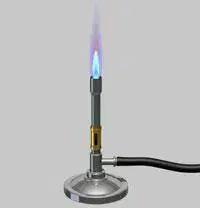
Methane, a gas, readily reacts with oxygen in the air during combustion. The reaction produces carbon dioxide and water vapor.
Write a word equation for this reaction:

Respiration is the process by which living organisms convert glucose and oxygen into carbon dioxide, water, and energy.
Write a word equation for this reaction:
Mixing hydrochloric acid and sodium hydroxide results in a chemical reaction known as neutralization. This reaction forms water and sodium chloride (table salt).
Write a word equation for this reaction:

Water can be formed by reacting oxygen and hydrogen gas together.
Write a word equation for this reaction:
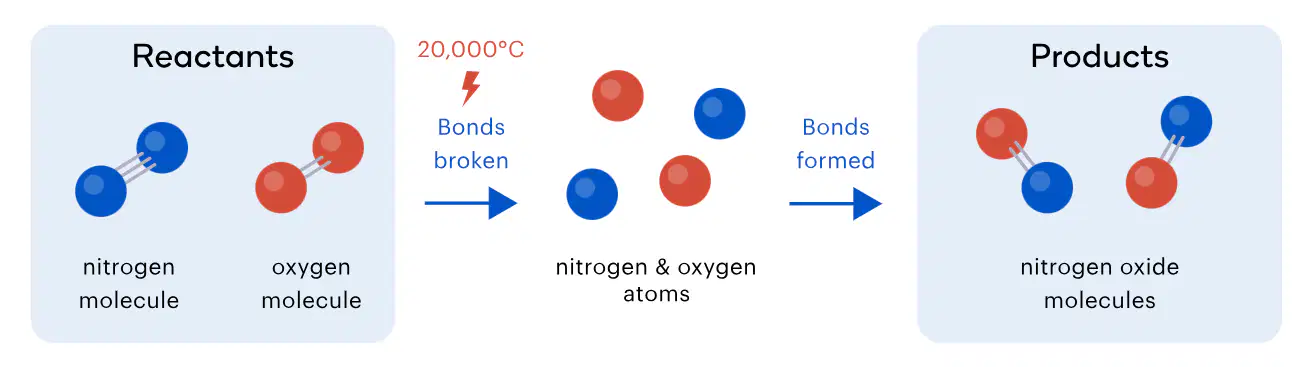
True/False: Chemical bonds are broken in the reactants in a chemical reaction.
True
False
True/False: Chemical bonds form in the reactants in a chemical reaction.
True
False
True/False: Chemical bonds form in the products in a chemical reaction.
True
False
True/False: Atoms can be destroyed in a chemical reaction.
True
False
True/False: Atoms can be created in a chemical reaction.
True
False
True/False: There are different elements before and after a chemical reaction.
True
False
True/False: There are different compounds and/or molecules before and after a chemical reaction.
True
False
Describe what a chemical reaction is, in terms of the substances involved and the atoms (chemical bonds between atoms) that make them up.

